How it works
1. Source
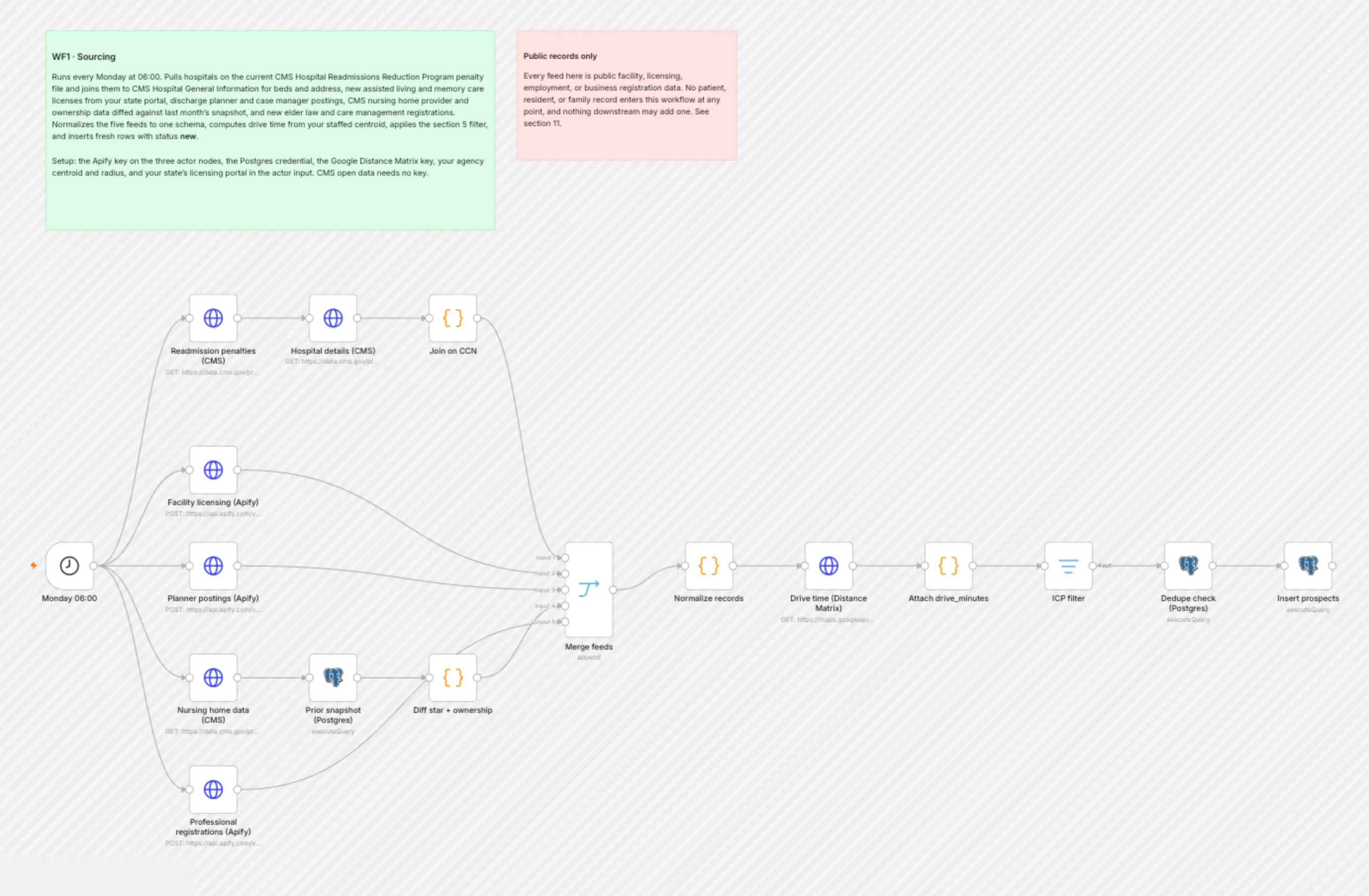
The system pulls referral professionals from five feeds weekly.
- Penalized hospitals. Hospitals on the current CMS Hospital Readmissions Reduction Program penalty list.
- New communities. Senior living and memory care communities with a license issued or pending in the last 120 days.
- Planner hires. Discharge planner and case manager job postings.
- Skilled nursing changes. Facilities with an ownership change or a star rating drop in the last quarter.
- New practices. Elder law attorneys and geriatric care managers who registered a new office.
2. Qualify
Filters drop:
- Out of range. Facilities outside the agency’s drive radius.
- No planner seat. Hospitals under 25 beds where no dedicated planner exists.
- Served in-house. Communities that run their own in-house care agency.
- Already known. Facilities already in the CRM.
- Nobody to write to. Any record whose contact resolves to a general information mailbox.
About half of the senior living records list a corporate office rather than a local director and go out here, which is an estimate from state license file samples.
3. Enrich
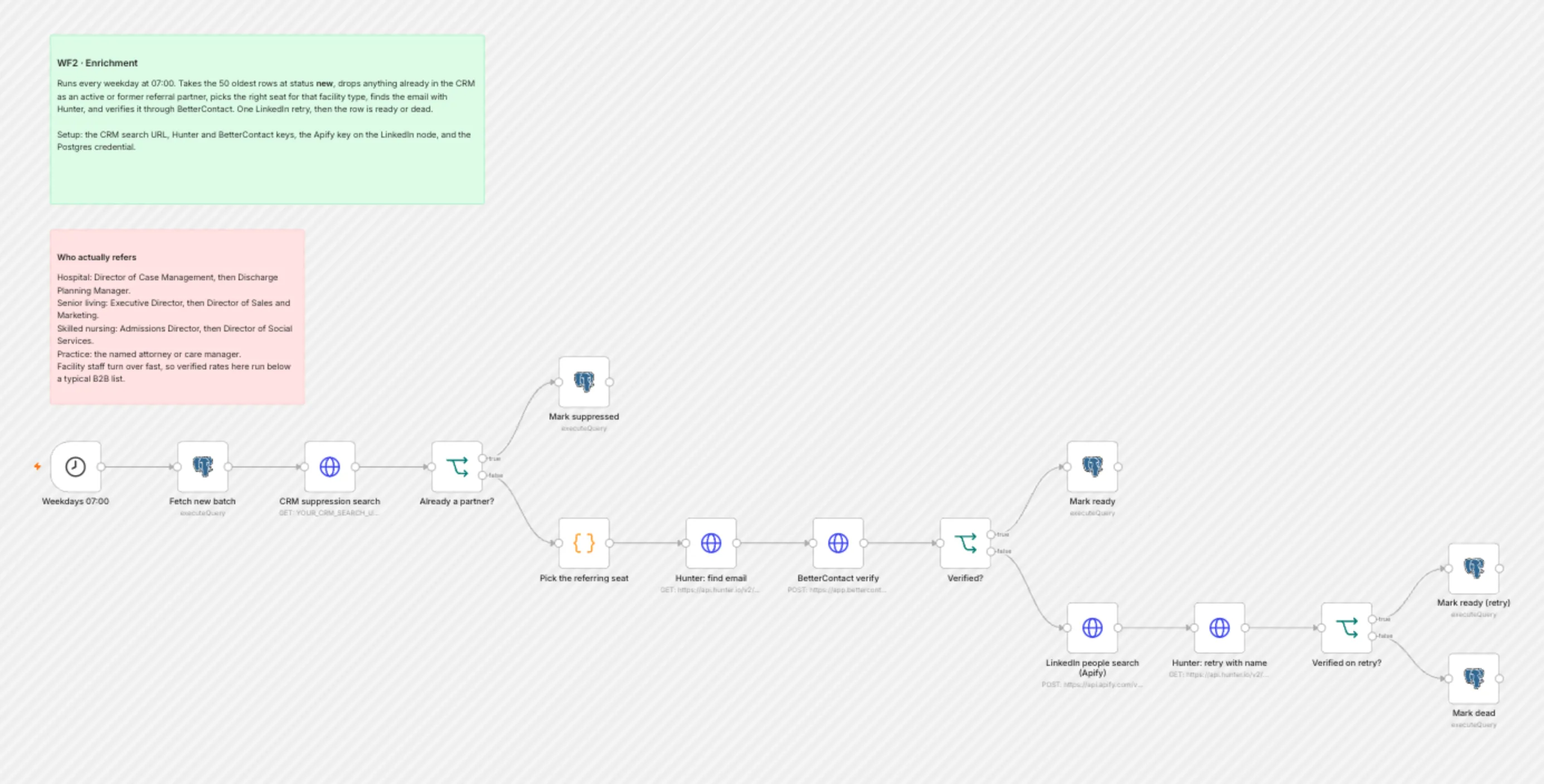
For each qualified facility, the system finds the named person in the referring seat.
- The seats. The case management director, the discharge planning lead, the senior living sales or executive director, the SNF admissions director, or the attorney.
- Resolve and find. It resolves the facility domain and locates the email with Hunter.
- Verify it. The BetterContact waterfall confirms the address.
- Where no name is published. It searches the title ladder for that facility type.
4. Outreach
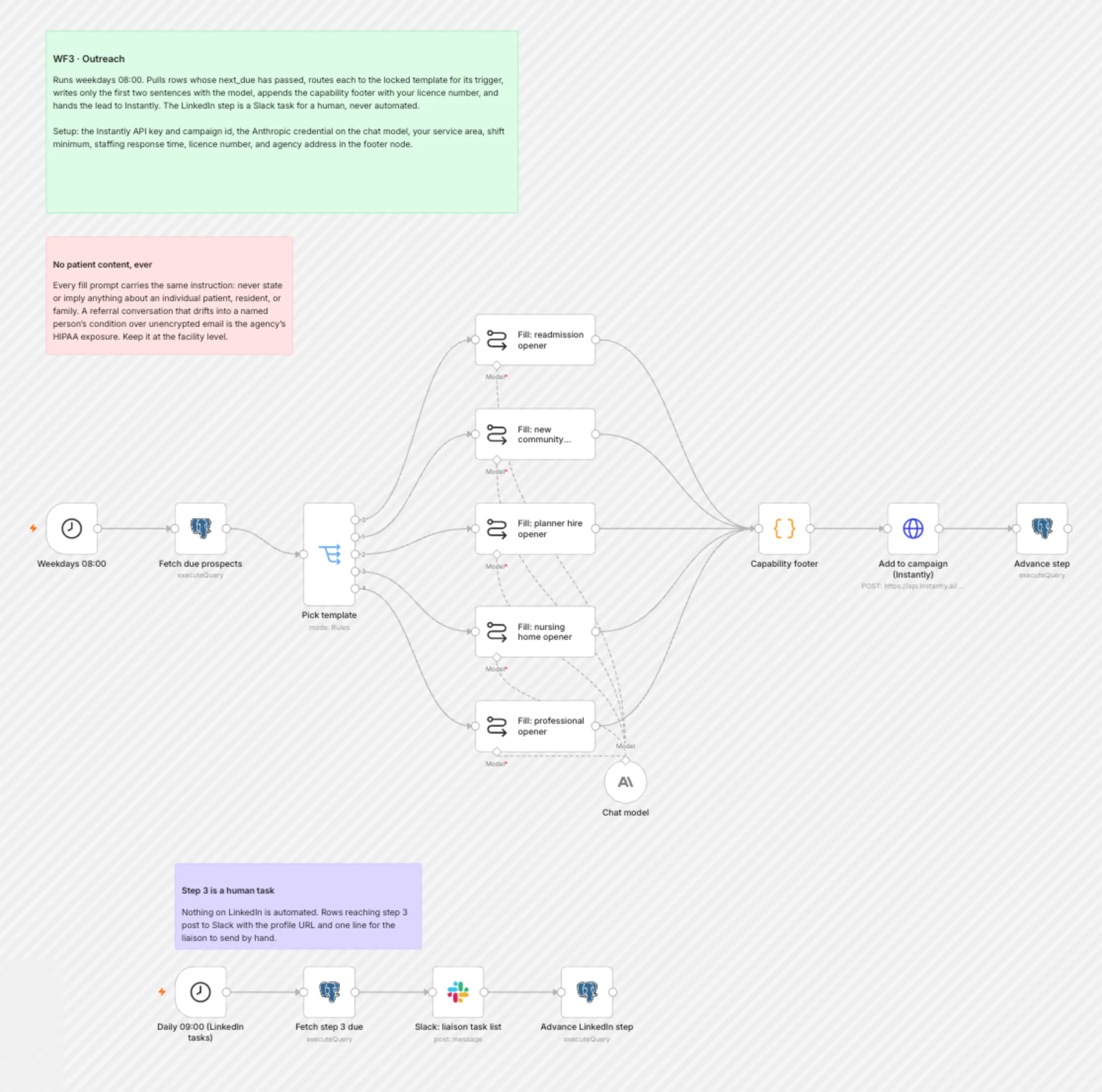
Three emails and one LinkedIn touch spread over 18 days.
- The opening line. Cites the readmission penalty percentage, the community’s license date and bed count, the planner’s posting date, or the ownership change.
- The offer. A 15-minute introduction plus a one-page capability sheet with service area, shift minimums, and how fast the agency can staff a discharge.
5. Book & track
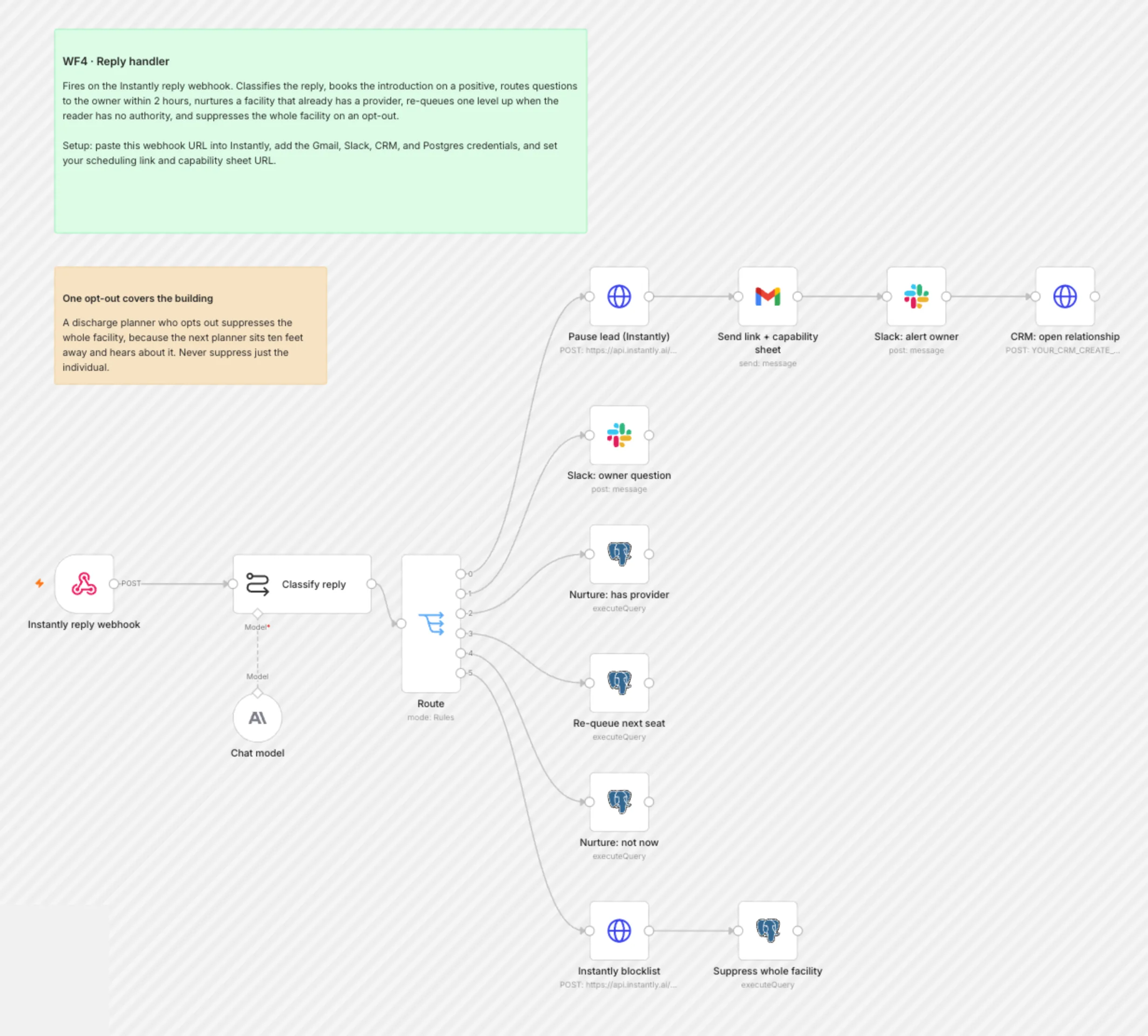
The Claude API sorts each reply into positive, question, has-provider, no-authority, not-now, or unsubscribe.
- Positive reply. Receives a scheduling link and the capability sheet.
- Owner alert. A Slack message quoting the trigger.
- CRM contact. Stores the facility type, the trigger, the bed count, and the referral seat, so the liaison walks in knowing what changed at that facility and who else there matters.
Lead sources for home care agencies
Ranked by signal quality:
1. Hospitals carrying a CMS readmission penalty
Under the Hospital Readmissions Reduction Program, CMS reduces payments for hospitals with excess 30-day readmissions, and it publishes the penalized hospital list with the payment adjustment factor as free open data on data.cms.gov.
A hospital losing revenue on readmissions has a funded, named reason to place more discharges with post-acute support that keeps patients out of the emergency department, and its case management team is under explicit instruction to find those partners.
| Feed | What it gives |
|---|---|
| CMS Hospital Readmissions Reduction Program file | The penalized hospital list with the payment adjustment factor, free open data on data.cms.gov. An n8n HTTP Request node pulls the current file |
| CMS Hospital General Information dataset | Bed count, address, and ownership type, joined to the penalty file |
The filter keeps hospitals inside the drive radius with 25 or more beds.
Highest intent of the five, because the penalty is public, dated, and quantified, and almost no competing agency reads the file.
Roughly 2,200 to 2,500 US hospitals carry a penalty in a given program year, which is an estimate from published CMS counts; one metro yields 5 to 25.
2. Senior living and memory care communities weeks from opening
A community with a license issued or an application pending is assembling its preferred provider list before the first resident arrives.
Assisted living residents routinely buy private duty hours on top of the community’s own care package for one-to-one companionship, hospital sitting, and overnight coverage.
- Where it comes from. State health department and social services licensing portals publish new and pending facility licenses.
- What each record carries. Facility name, address, bed count, license date, and the administrator of record.
- How it is pulled. An Apify actor runs the licensing search weekly by issue date.
- What is kept. Assisted living, memory care, and independent living with 30 or more beds.
High intent and a short window, because the preferred provider list is set in the 90 days around opening and rarely reopened.
3. Discharge planner and case manager job postings
A hospital or skilled nursing facility posting for a discharge planner, transitions of care coordinator, case manager, or medical social worker is about to put a new person in the exact seat that decides where patients go, and that person arrives with no established agency relationships.
- How it is pulled. An Apify job-board actor runs weekly by title across the served facilities.
- What the record gives. Facility name, title, posting date, and the hiring manager when shown.
Medium-high intent, and the timing matters more than the message: an introduction in the new planner’s first month costs nothing to accept and competes against habits that have not formed yet.
4. Skilled nursing ownership changes and star rating drops
CMS publishes provider information, ownership, and staffing data for every certified nursing home, including the overall star rating and the ownership record.
A facility that changed hands or dropped a star sees discharge planners and families look harder at alternatives to a longer stay, and its own admissions director is under pressure to show a strong discharge-to-home path.
- How it is pulled. The system pulls the CMS provider and ownership datasets monthly.
- How a change is found. It compares against the prior snapshot stored in Supabase and flags changes.
Medium intent, and the strongest use is the admissions director rather than the clinical team.
5. Elder law attorneys and geriatric care managers with a new office
An attorney or care manager who registered a new office or joined a new practice is rebuilding a local referral network, and both professions send private pay clients with the ability to fund hours for years.
- Where it comes from. Secretary of State registrations, sourced monthly and filtered to legal and health practitioner NAICS codes.
- How it is checked. Cross-checked against the public membership directories those professions maintain.
Lowest volume of the five and the longest to convert, though private pay cases from an elder law referral run longer than any other source in this list.
ICP definition
Filter logic the workflow applies.
What starts a row
| Filter | Rule |
|---|---|
| Hospital source | On the current CMS readmission penalty file, payment adjustment factor below 1.0, 25 or more staffed beds, inside the drive radius, ownership type excludes federal and military |
| Senior living source | License issued or pending within the last 120 days, facility type is assisted living, memory care, or independent living, 30 or more beds, no in-house private duty agency listed under the same ownership |
| Job post source | Title is Discharge Planner, Case Manager, Transitions of Care Coordinator, Medical Social Worker, or Director of Case Management, posted within the last 21 days, facility already in the served list |
| Skilled nursing source | Ownership change or overall star rating drop against the prior monthly snapshot, 40 or more certified beds, inside the drive radius |
| Professional source | Registered within the last 90 days, NAICS 541110 legal services or 621 health practitioner, practice description matches elder law, estate planning, guardianship, or care management |
What keeps a row
| Filter | Rule |
|---|---|
| Geography | Within the agency’s licensed service area and a 45 minute caregiver drive of an existing staffed client, or a named expansion territory |
| Facility size | Hospitals 25 or more beds, senior living 30 or more beds, skilled nursing 40 or more beds |
| Contact | A named person in the referring seat, resolved and verified; general information mailboxes are dropped |
| Excluded | Facilities owned by an organization that operates its own home care agency, facilities inside a competitor’s exclusive preferred provider agreement where known, current and former referral partners (CRM match), facilities that opted out, hospice-only providers, domains on the suppression list |
Outreach sequence
The four steps
| Step | Day | Channel | Goal |
|---|---|---|---|
| 1 | 0 | Opener citing the readmission penalty, license date, posting, or ownership change; offer a 15-minute introduction | |
| 2 | 5 | Send the one-page capability sheet: service area, shift minimums, staffing speed, payer types accepted | |
| 3 | 10 | Connection request naming the facility and the agency’s response time for a same-day discharge | |
| 4 | 18 | Breakup offering to be the backup agency for a discharge nobody else can staff |
Example step 1 (readmission penalty trigger)
Subject: [Hospital]‘s readmission adjustment and same-day discharges
Hi [First name], CMS lists [Hospital] with a [X]% payment adjustment under the readmissions program this year. The discharges that bounce back are usually the ones that went home to an empty house.
We staff personal care and overnight coverage across [service area], and we can cover a same-day discharge within [N] hours, including weekends.
Worth 15 minutes to see whether we are a fit for the cases your team struggles to place?
Expected reply rates
Expected reply rate: 3 to 6% on trigger sources, an estimate for a warmed domain writing to referral professionals.
This sits above the 2 to 4% a purchase-intent cold email earns because the ask is an introduction rather than a sale, and placing patients with providers is literally the recipient’s job.
- Hospital and senior living records. They reply at the high end because the trigger is dated and public.
- Elder law and care manager records. They reply at the low end because nothing forces their timing.
- The two weeks around major holidays. Volume drops, when discharge teams run short staffed and answer nothing that is not clinical.
Stack and running costs
| Tool | Purpose | Monthly |
|---|---|---|
| n8n Cloud | Orchestration | $24 |
| CMS open data (readmissions, hospital, nursing home) | Facility and penalty feeds | $0 |
| Apify | Licensing portal, job board, registry, and LinkedIn scrapers | $35 |
| Hunter | Referral-seat email finding | $34 |
| BetterContact | Waterfall enrichment + verification | $15 |
| Instantly | Sending + warmup | $37 |
| Claude API | First-line generation + reply classification | $8 |
| Sending domain | Deliverability | $1 |
| Supabase (free tier) | Prospect database + monthly CMS snapshots | $0 |
| Total | ~$155 |
The Google Distance Matrix API covers the drive-time filter inside its free monthly credit at this volume. Some state licensing portals charge $0 to $1 per record export; budget $10/month if your state does.