How it works
1. Source
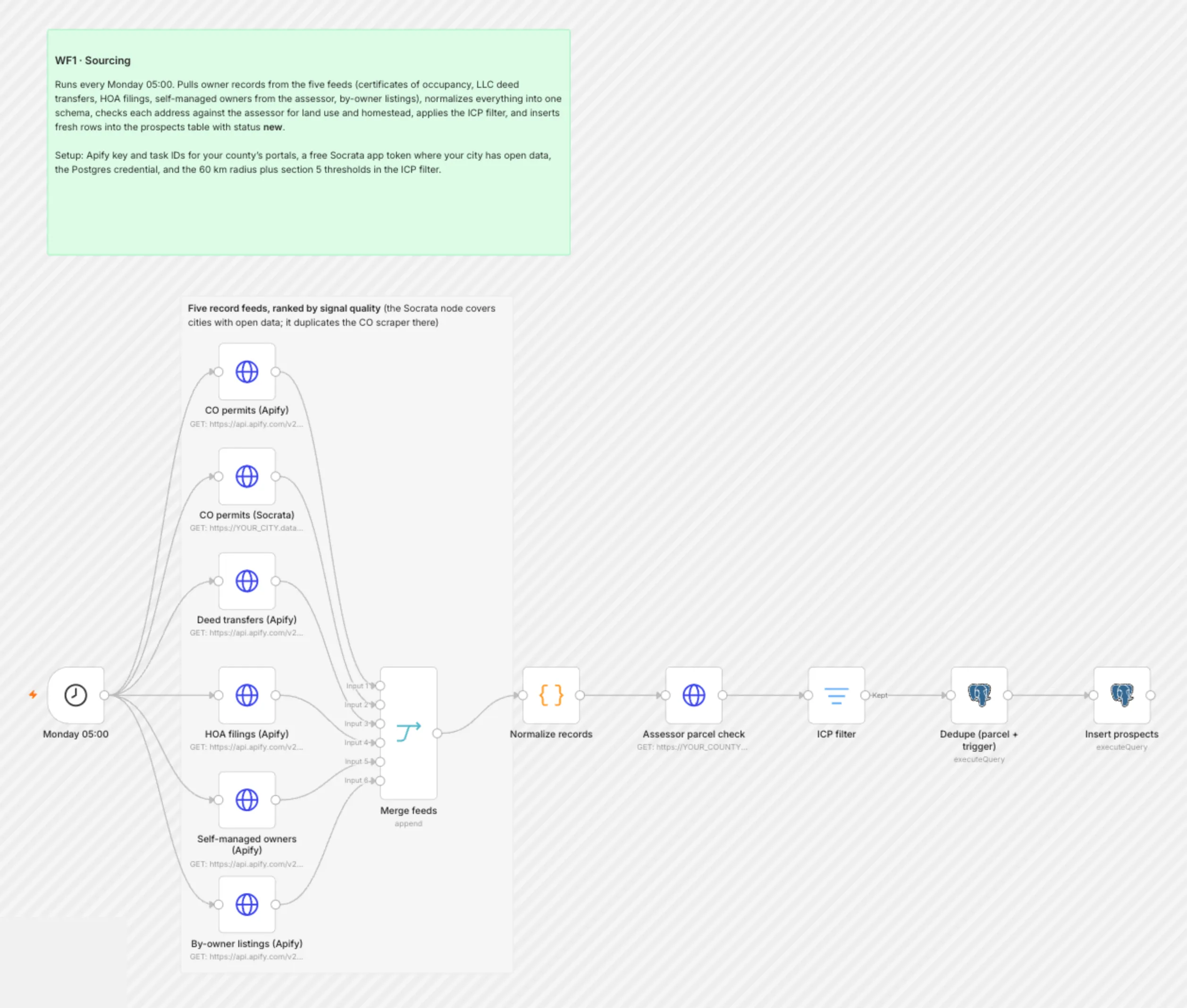
The system pulls prospects from five feeds weekly.
- Certificates of occupancy. For multifamily and commercial buildings, from the city or county permit portal.
- Deed transfers to LLCs. From the county recorder index.
- New HOA and condominium association filings. From the state business registry and HOA registry.
- Self-managed owners. Holding 5 or more rental parcels, from assessor records.
- Rental listings marked as managed by the owner. Scraped from the listing sites.
2. Qualify
Filters drop:
- Too small. Buildings under 5 units or 10,000 square feet.
- Owner-occupied parcels. The owner lives there.
- Cheap deeds. Anything under $500,000.
- Out of range. Anything outside a 60 km radius.
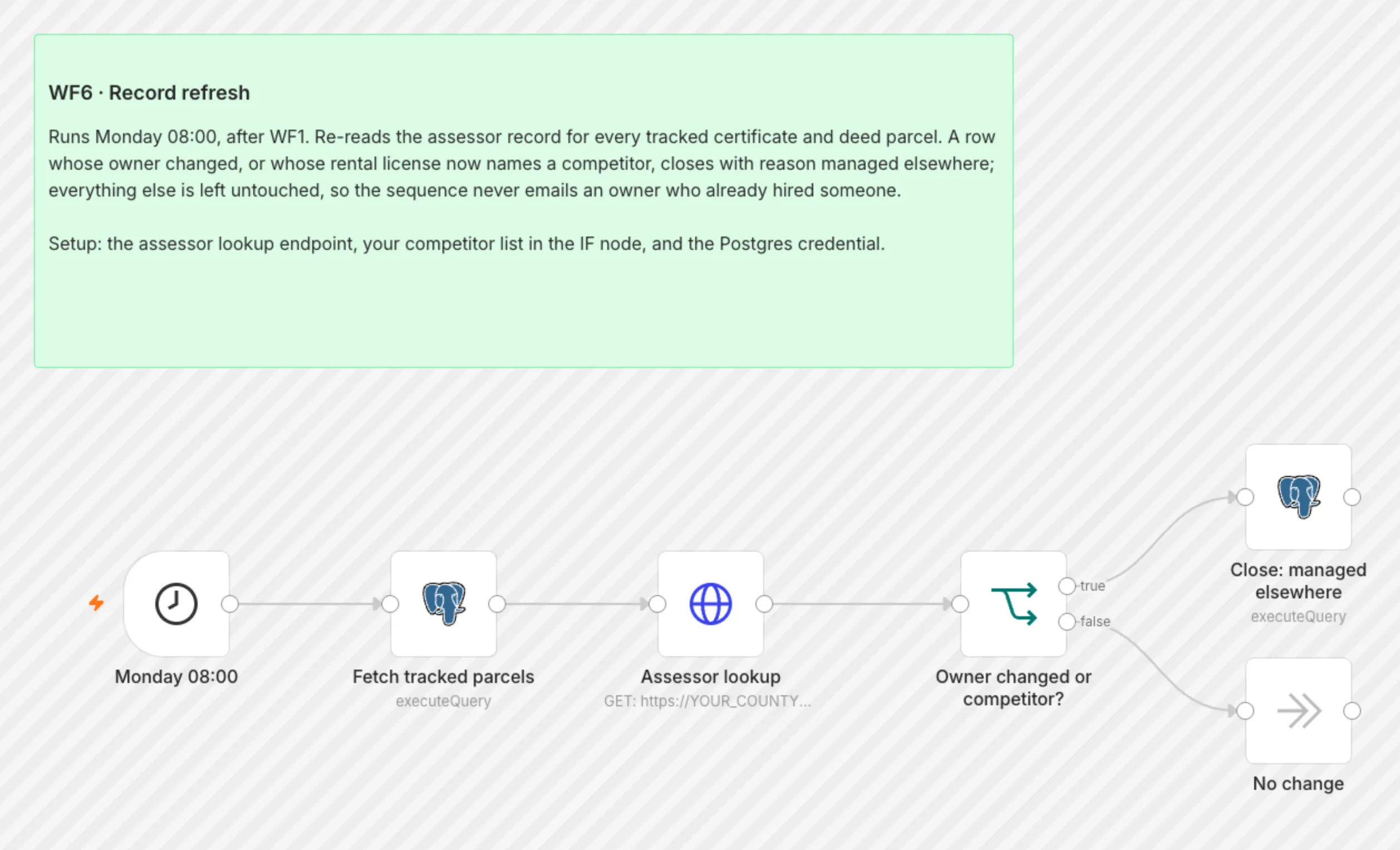
- Already served. Current clients, and owners who already list a management company on their rental licenses.
A duplex sale never reaches enrichment.
3. Enrich
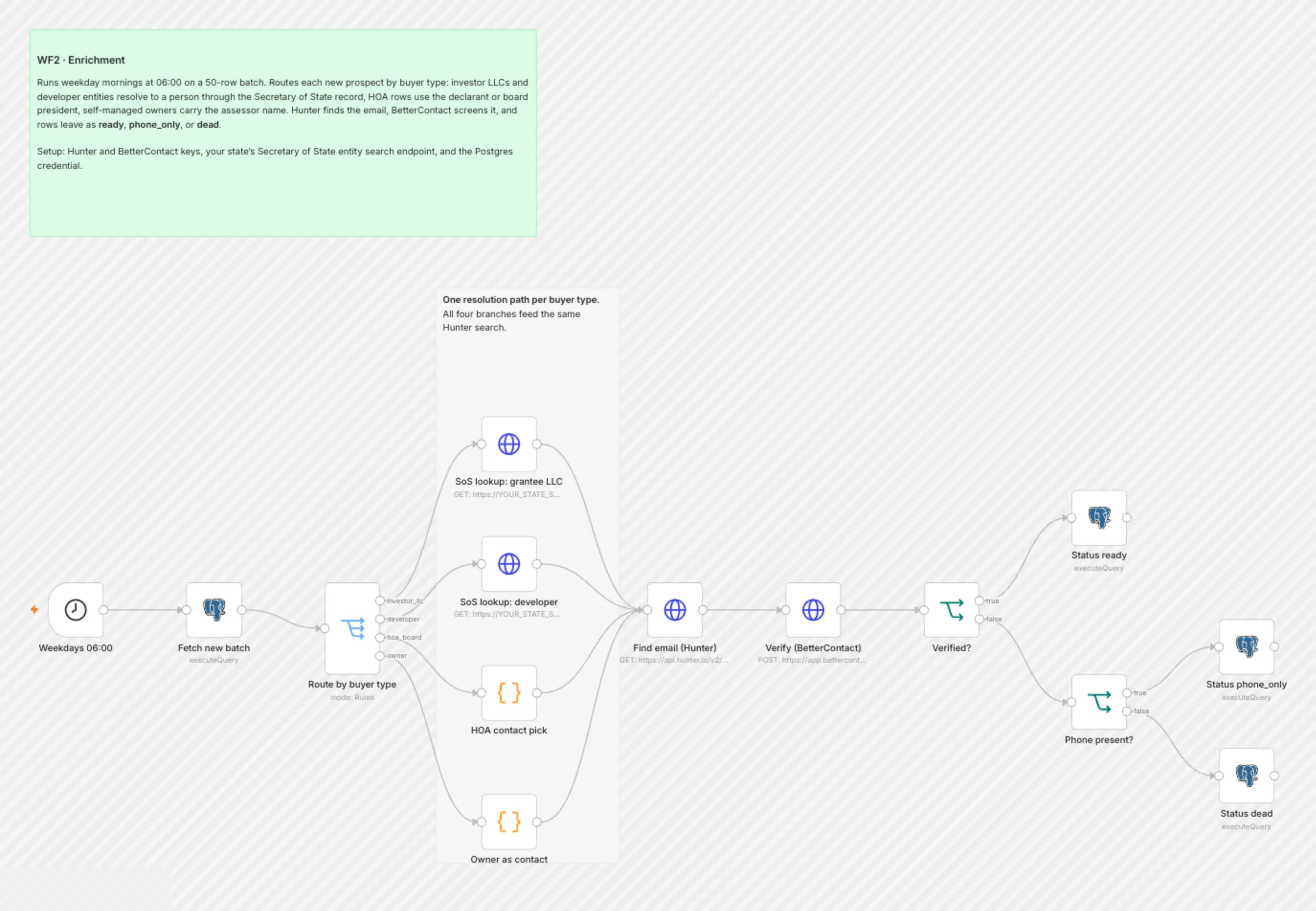
For each qualified record the system resolves the LLC to a person through the Secretary of State entity record, using the manager or the registered agent.
- Pick the seat. The developer’s asset manager or the HOA board president.
- Find the email. Hunter finds it.
- Screen it. The BetterContact waterfall.
4. Outreach
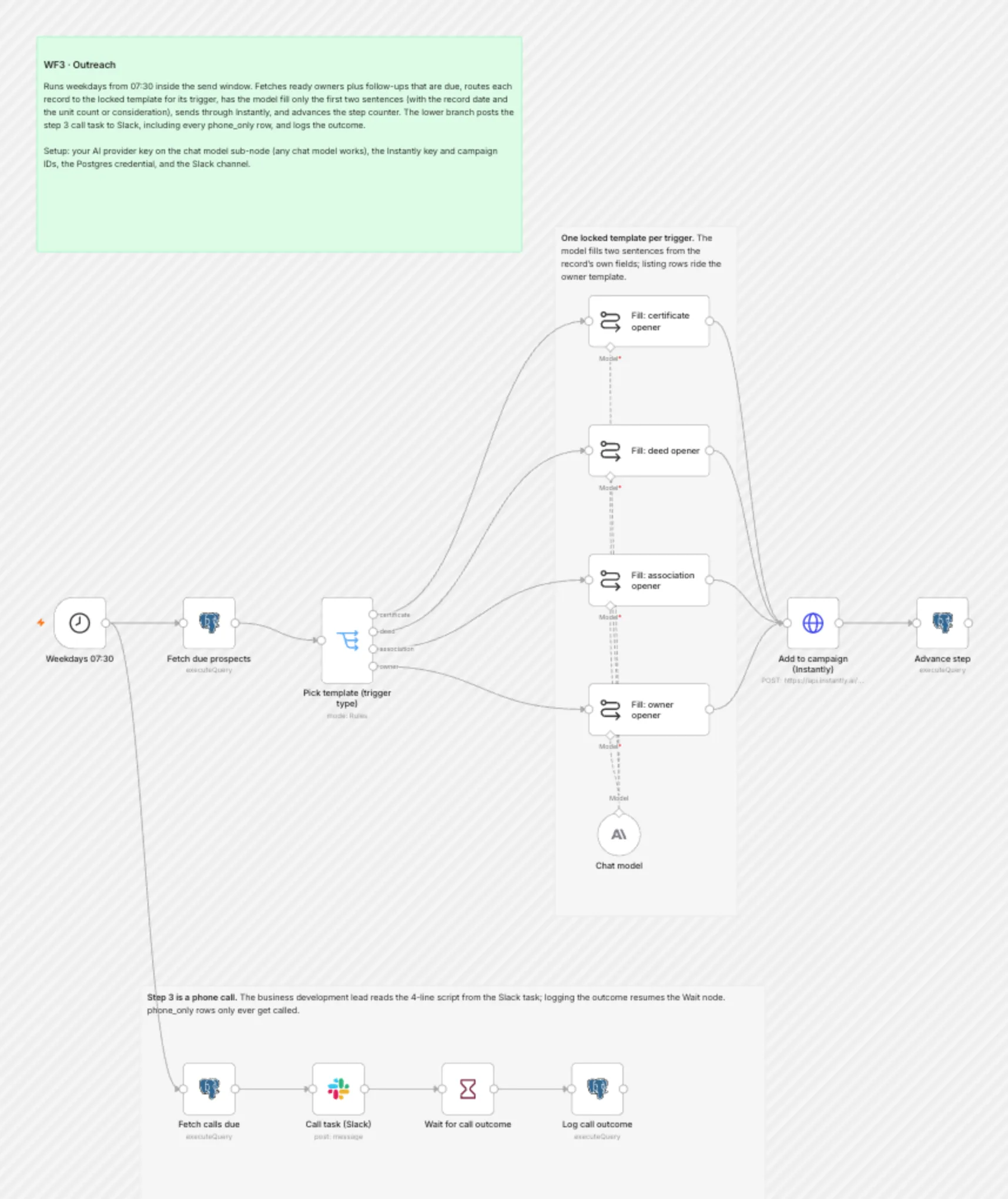
Five touches over 18 days, four by email and one by phone, with a 30-minute owner meeting as the ask.
Every one opens on the certificate of occupancy date, the recorded deed, the association filing date, or the parcel count.
5. Book, propose, and track
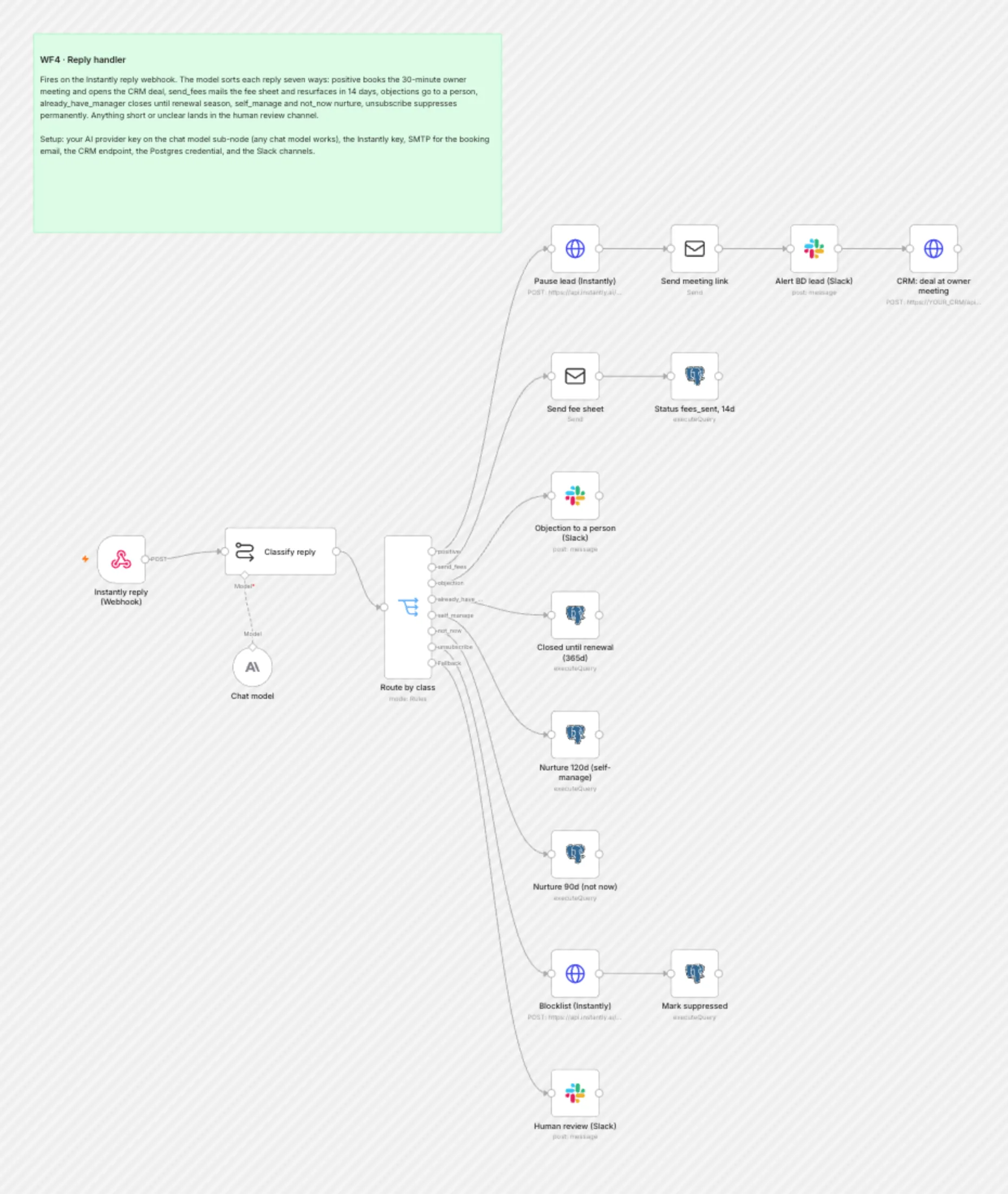
The Claude API sorts each reply into positive, send-fees, objection, already-have-manager, self-manage, not-now, or unsubscribe.
- Positive reply. Receives the 30-minute owner meeting calendar.
- Slack message. Carries the CO date or recorded deed, the address, the unit count, and the owner entity resolved from the Secretary of State record.
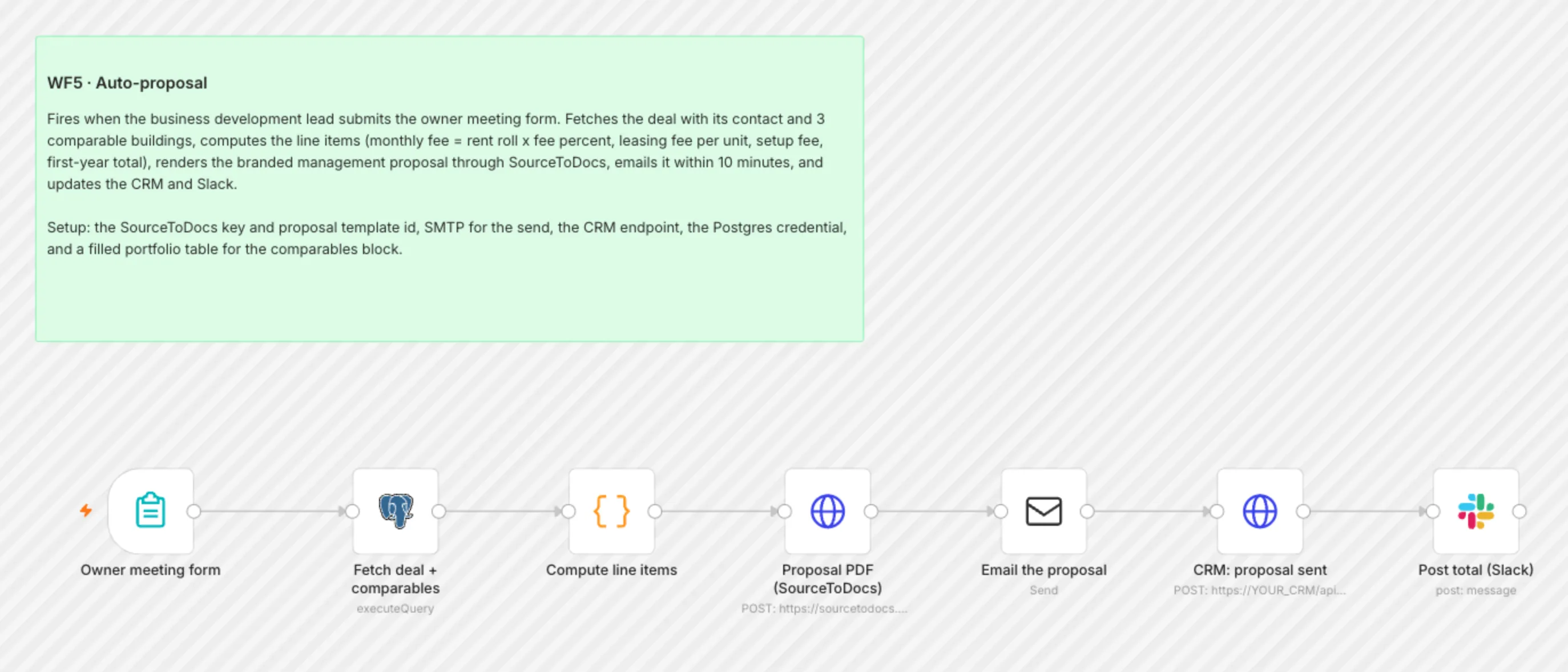
- The proposal. After the meeting the lead enters unit count, rent roll total, service tier, and fee percentage in a form; SourceToDocs returns the branded management proposal PDF and n8n emails it within 10 minutes.
- CRM record. Holds the permit, deed, or filing, the rent roll figure, the proposal PDF, and every email and call, so the owner’s next acquisition starts from a known fee history.
SourceToDocs is built by 2V Automation, the team behind this library.
Lead sources for property management
Ranked by signal quality:
1. Certificates of occupancy on new multifamily and commercial buildings
A certificate of occupancy means lease-up starts within 30 days and the developer signs a management agreement in the same window unless an affiliated manager already exists.
- How it is pulled. Each Monday an Apify scraper, or a Socrata API call in cities that publish open data (Chicago, Austin, Los Angeles), reads the building department’s CO records (Accela, OpenGov, NYC DOB NOW).
- What is kept. Permit type IN [certificate of occupancy, temporary certificate of occupancy] with use code IN [multifamily, mixed use, office, retail].
- Fields captured. Address, unit count or square footage, owner of record, developer entity, issue date.
Highest intent, and the owner is fielding 0 to 2 management pitches at this point, which is an estimate.
2. Investor purchases recorded as deed transfers to LLCs
A warranty deed or grant deed where the grantee is an LLC and the consideration is $500,000 or more means a new owner who has to decide within 30 to 60 days whether to self-manage, keep the seller’s manager, or hire new.
- How it is pulled. Weekly from the county recorder document index via an Apify scraper. Most counties expose a searchable index, and Socrata or ArcGIS open data portals in larger counties expose recorded documents by date.
- What is kept. Document type IN [warranty deed, grant deed, special warranty deed], and a grantee name containing LLC, LP, or Trust.
- Fields captured. Parcel number, address, grantee, grantee mailing address, consideration or transfer tax, recording date.
A grantee mailing address outside the county flags an absentee owner, the best buyer of third-party management.
3. New HOA and condominium association filings
A newly registered homeowners association or condominium association is a board that has to hire a manager within 90 days of turnover from the developer.
- The state business registry. New nonprofit corporations with “Owners Association”, “Homeowners Association”, “Condominium Association”, or “HOA” in the name, pulled weekly by an Apify scraper.
- State HOA registries where they exist. Colorado DORA HOA registration, the Florida DBPR condominium database, and the Nevada Real Estate Division association list.
- Fields captured. Association name, filing date, registered agent, unit count where stated, developer or declarant name.
Board contact is the declarant during developer control and the board president after turnover.
4. Self-managed landlords with 5 or more units
An owner whose name or LLC appears on 5 or more residential rental parcels in the assessor file and whose rental license lists no management company is spending 10 to 20 hours a month on management and is one bad tenant away from outsourcing, which is an estimate.
- How it is pulled. Monthly from the county assessor bulk file or parcel search via Apify, grouped by owner name and mailing address, joined to the city rental registration list where one exists.
- Fields captured. Owner name, mailing address, parcel count, total units, oldest acquisition year.
Lower urgency than a new building, higher lifetime value, because a 5-parcel owner brings every door at once.
5. Rental listings managed by the owner
A listing on Zillow Rentals, Apartments.com, or Craigslist where the listed contact is the owner means the owner is handling showings and screening alone right now.
- How it is pulled. Scraped weekly via Apify from listings in radius, filtered on listing type IN [for rent by owner] and joined to the assessor file to confirm 5 or more units.
- Fields captured. Address, rent, days on market, owner contact name, phone.
Lowest signal quality of the five; the sourcing workflow leans on it only in a week when the CO and recorder feeds are thin.
ICP definition
Filter logic the workflow applies.
What starts a row
| Filter | Rule |
|---|---|
| Certificate of occupancy | Full or temporary, for multifamily, mixed use, office, or retail, with 5+ units or 10,000+ sq ft |
| Deed | Warranty, grant, or special warranty deed to an LLC, LP, or Trust, $500,000+ consideration, multifamily, commercial, or mixed-use land use |
| HOA filing | Association filed within the last 180 days with 20+ units or an unknown unit count |
| Self-managed owner | 5+ parcels and 5+ total units with no management company on record |
| Listing | Owner-listed rental with 5+ total units under the owner |
What keeps a row
| Filter | Rule |
|---|---|
| Buyer type | Developers, investor LLCs, HOA boards, self-managed owners |
| Radius | Within 60 km of the office |
| Excluded | CRM match (client or open deal), competitors and their affiliated entities, REITs and institutional owners with in-house management, owner-occupied parcels (homestead exemption), records older than 60 days |
Outreach sequence
The five steps
| Step | Day | Channel | Goal |
|---|---|---|---|
| 1 | 0 | Cite the CO, deed, filing, or parcel count; ask for a 30-minute owner meeting before a manager is chosen | |
| 2 | 4 | Two-line follow-up with one lease-up or occupancy number from a comparable building | |
| 3 | 8 | Phone | Call the owner or asset manager, reference the record |
| 4 | 12 | Value angle: one pain (turnover cost, maintenance calls, delinquency) | |
| 5 | 18 | Breakup, leave the fee sheet |
Example step 1 (certificate of occupancy trigger)
Subject: lease-up at [address]
Hi [First name], saw the certificate of occupancy for [address] was issued on [issue date], [unit count] units. Lease-up decisions usually land in the next 30 days.
We manage [N] doors in [city], including [N] buildings we took from CO to 95% occupied in under 6 months.
Open to a 30-minute call next week to compare lease-up plans before you commit to a manager?
Expected reply rates
| Row type | Expected reply rate |
|---|---|
| Certificate of occupancy, deed transfer, and HOA filing sources | 2 to 5% |
| Self-managed owner and listing sources | 1 to 3% |
Both are estimates. A developer 30 days from lease-up answers near 5%; a 5-parcel landlord with no vacancy answers near 1%.
The calendar separates the two top feeds.
- Certificates of occupancy. They bunch up from May to October when construction closes out.
- Investor deed transfers. They spike in the last 6 weeks of the year as buyers close before December 31.
So the two top feeds peak in different quarters.
Stack and running costs
| Tool | Purpose | Monthly |
|---|---|---|
| n8n Cloud | Orchestration | $24 |
| Apify | Permit portal, recorder index, registry, assessor, and listing scrapers | $30 |
| Hunter | Decision-maker email finding | $34 |
| BetterContact | Waterfall enrichment + verification | $15 |
| Instantly | Sending + warmup | $37 |
| SourceToDocs (Starter) | Branded management proposal PDF from meeting form | $19 |
| Claude API | First-line generation + reply classification | $6 |
| Sending domain | Deliverability | $1 |
| Supabase (free tier) | Prospect database | $0 |
| Total | ~$165 |
Socrata open data, Secretary of State entity search, state HOA registries, and county assessor parcel lookups are free. Some county recorder portals charge $1 to $5 per document image, which the system never downloads; it reads the index only.