How it works
1. Source
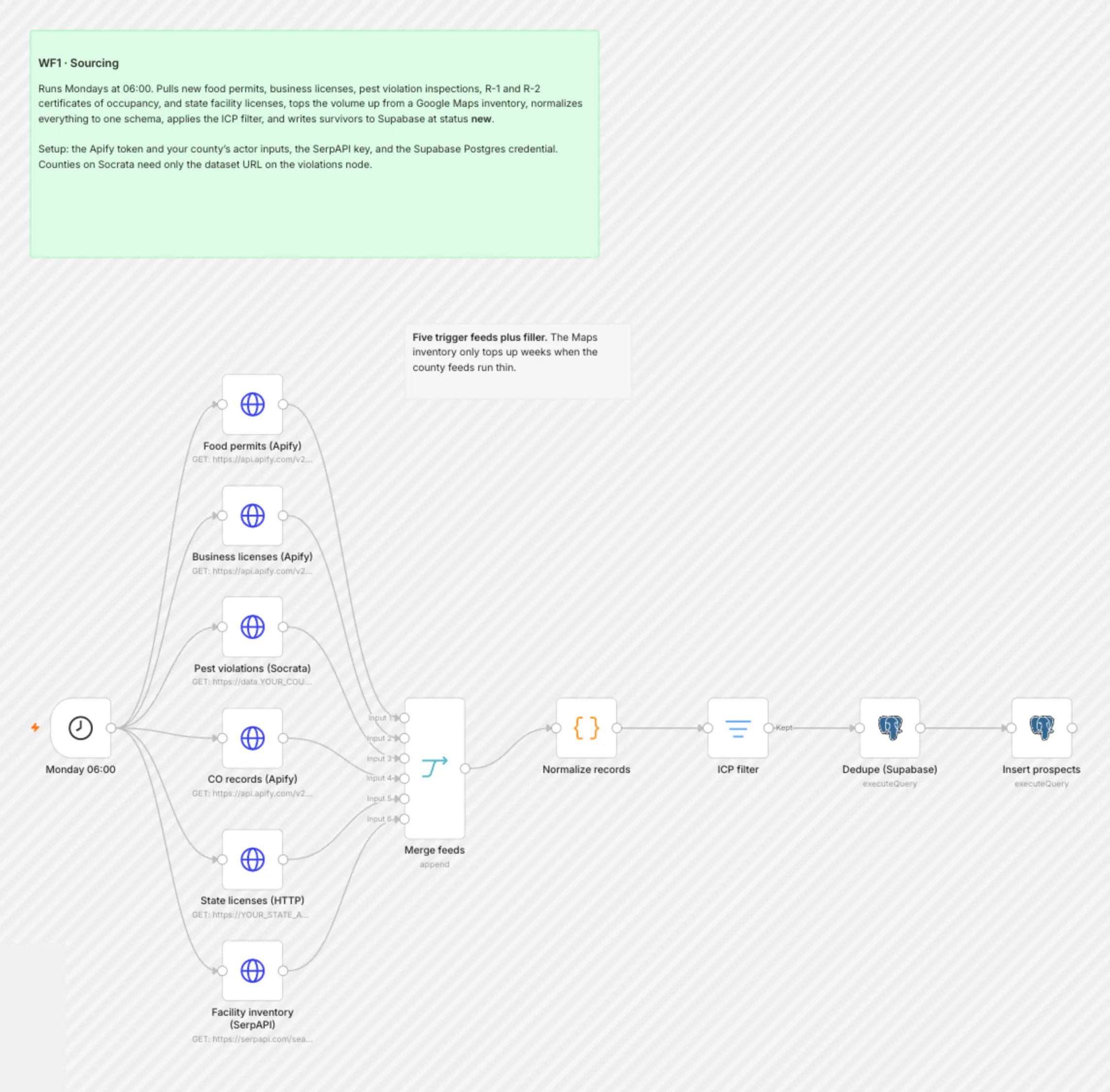
Five sources are pulled weekly.
- New food service permits and business licenses. From the county health department and the city license office.
- Published health inspection reports with pest violations. From the county inspection portal.
- Certificates of occupancy for multifamily and hospitality buildings. From the city building department.
- State food processor and warehouse licenses. From the state roster.
- A Google Maps inventory. Restaurants, hotels, and apartment communities in radius.
2. Qualify
Filters drop:
- Residential and undersized. Residential addresses, single-unit food carts, and properties under 20 units.
- Out of area. Anything outside the service radius.
- Already known. Current clients, and any company already in the CRM.
A home address or a 6-unit walk-up is gone before the enrichment step runs, so the Hunter credits go to accounts that sign monthly service agreements.
3. Enrich
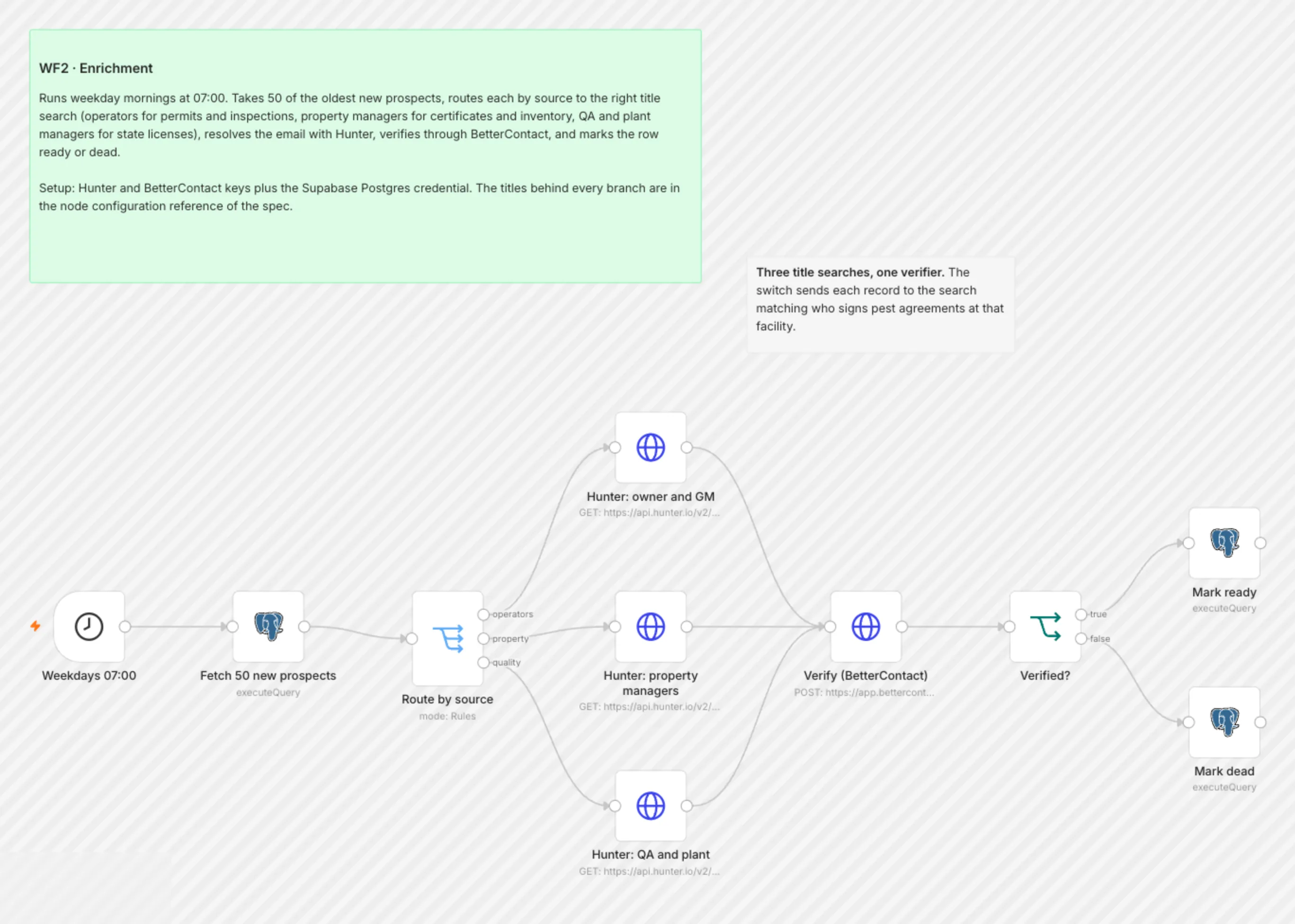
For each qualified account the system finds the person who owns the pest decision.
- Restaurants. The owner or general manager.
- Multifamily and hotels. The property manager or regional manager.
- Food processing and warehouses. The QA or plant manager.
- Then the address. Hunter resolves the email and BetterContact verifies it.
4. Outreach
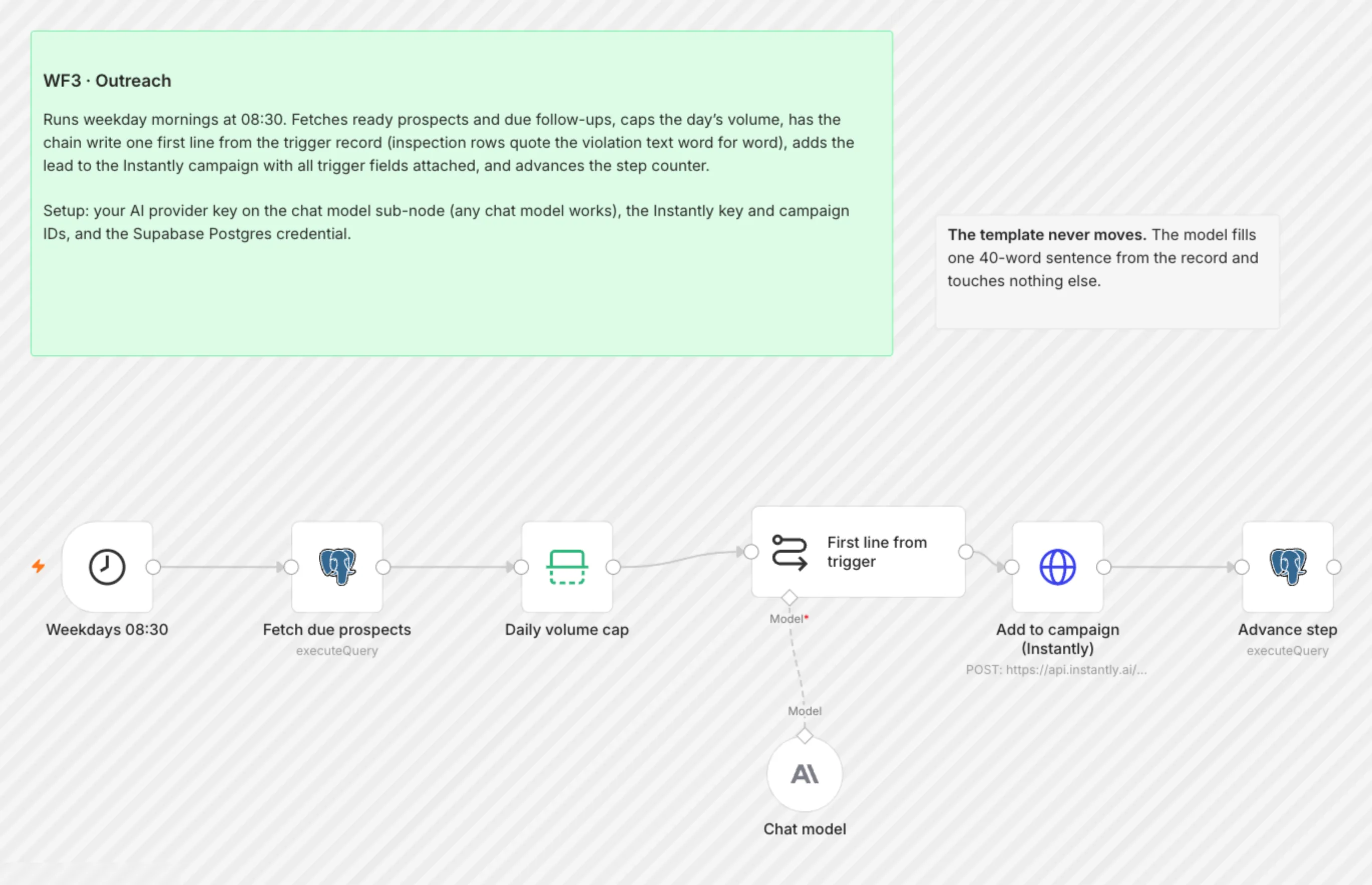
Four emails across 14 days.
- The opener. Quotes the permit issue date, the inspection date and violation text, the certificate of occupancy, or the license number.
- The ask. A 20-minute walkthrough before the health inspector or auditor arrives.
5. Book, quote, and track
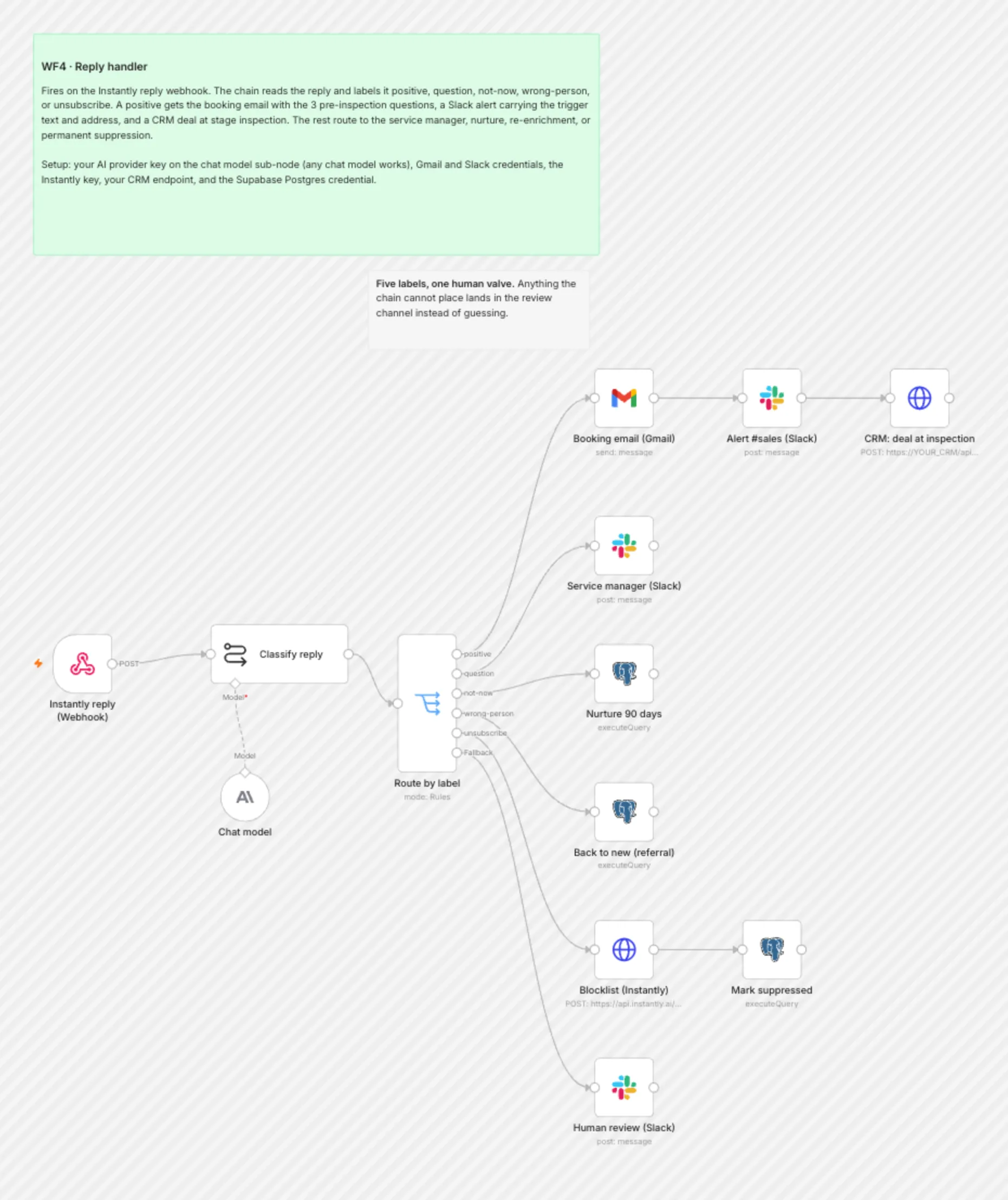
Claude tags each reply positive, question, not-now, wrong-person, or unsubscribe.
- Positive reply. Receives the walkthrough calendar and 3 pre-inspection questions.
- Slack to the service manager. Carries the permit or violation text, the address, the facility type, and the re-inspection or opening date.
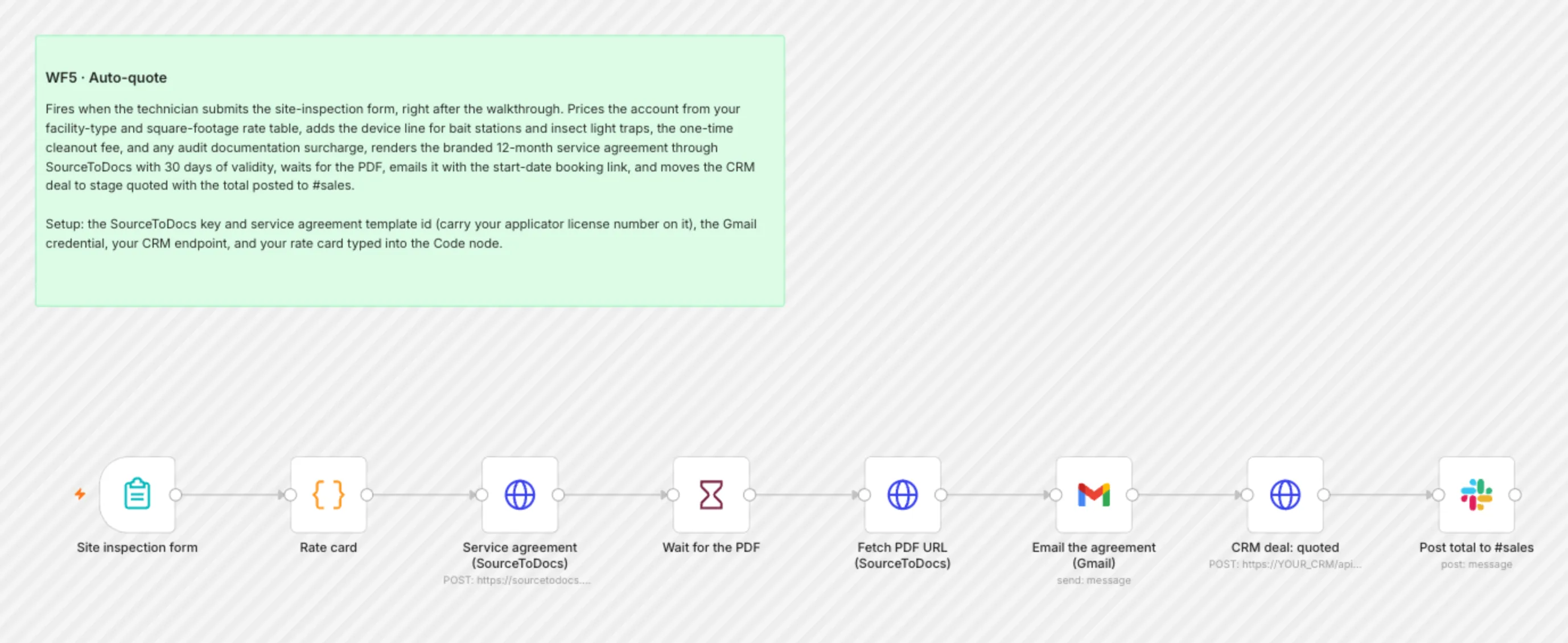
- After the walkthrough. The technician enters square footage, service frequency, target pests, device count, and any audit standard into a form.
- The agreement. SourceToDocs produces the branded service agreement and quote PDF from those fields, and n8n emails it within the hour.
- CRM record. Keeps the permit or inspection report, the device count, the signed agreement, and every email, so the renewal 12 months later starts from the original scope.
SourceToDocs is built by 2V Automation, the team behind this library.
Lead sources for commercial pest control
Ranked by signal quality:
1. New restaurant and food service permits
A new food establishment permit means the operator must show a pest control program and service log at the pre-opening health inspection, so a contract gets signed within 30 days of the permit.
- The weekly read. An Apify scraper reads the county health department’s new permit list every Monday.
- Where that list lives. Most counties expose it through an Accela or CityView portal, a Socrata open data feed, or a monthly PDF.
- The cross-check. The workflow matches it against new business license filings from the city license office.
- What the record carries. The business name, address, permit type, owner name, and issue date.
Highest intent, lowest competition, because most pest companies wait for the opening-week phone call.
2. Health inspection reports with pest violations
A published inspection citing “evidence of rodents”, “live roaches”, “flies”, or “pest control not adequate” means a re-inspection in 10 to 30 days and an operator who must show corrective action.
Their current vendor failed them.
- Where it comes from. The county inspection portal, weekly. Many counties expose a search page or a Socrata API with violation codes, and the system scrapes the rest through Apify.
- What the record carries. The inspection date, the violation text, the score or grade, and the re-inspection date.
Second highest intent, and the email writes itself from the violation line.
3. Multifamily and hospitality certificates of occupancy
A certificate of occupancy on a 20-unit or larger apartment building or a hotel means a property manager is setting up the vendor list during lease-up, and a pest program is a standard line on it.
- Where it comes from. The city building department’s CO records, pulled weekly through the same Apify permit actor, filtered to occupancy groups R-1 (hotels) and R-2 (apartments).
- What the record carries. The address, unit count, owner entity, and the management company when one is listed.
4. Food processor and warehouse licenses
A new state food processor, wholesale food, or cold storage license means the facility will face a GFSI, SQF, or AIB audit that requires a documented pest management program run by a licensed contractor.
- Where it comes from. The state department of agriculture or health license list, monthly. Most states publish a searchable list or a CSV.
- Why the state list. The FDA food facility registration database is closed to the public, so the state list is the practical source.
- What the record carries. The facility name, address, license type, and issue date.
5. Facility inventory (Google Maps, volume filler)
Restaurants with 50 or more reviews, hotels, and apartment communities in radius, sourced through SerpAPI Google Maps queries.
Most already have a vendor, so the pitch is a contract review at renewal, and the sourcing workflow draws on this list only in weeks when the permit and inspection feeds return too few new accounts.
Lowest intent of the five.
ICP definition
Filter logic the workflow applies:
| Filter | Rule |
|---|---|
| Facility type | Restaurants, bars, cafeterias, commissaries, hotels, motels, multifamily, food processors, cold storage, distribution warehouses, groceries |
| Size | 20+ units (multifamily), or 40+ rooms (hospitality), or 40+ seats (food service), or 10,000+ sq ft (processing and warehouses) |
| Radius | Within 50 km of base |
| Trigger window | Trigger dated in the last 45 days (permits, inspections, certificates of occupancy, licenses) |
| Violation text | Contains rodent, roach, cockroach, flies, pest, vermin, or harborage (inspection source only) |
| Contact | Owner, general manager, property manager, regional manager, chief engineer, QA manager, plant manager, operations manager |
| Excluded | Residential addresses, food trucks and carts, temporary event permits, government and public school facilities (formal procurement), national chains with corporate vendor programs, current clients (CRM match), competitors |
Outreach sequence
The four steps
| Step | Day | Channel | Goal |
|---|---|---|---|
| 1 | 0 | Quote the permit date, violation, CO, or license; ask for a 20-minute walkthrough before the health inspector or auditor arrives | |
| 2 | 3 | Two-line follow-up repeating the permit date, inspection date, or CO date and the opening-week deadline | |
| 3 | 7 | Value angle: one specific pain (re-inspection failure, tenant complaints, audit findings) | |
| 4 | 14 | Breakup, door open, same-week inspection and written agreement offer |
Example step 1 (new permit trigger)
Subject: pest program for [business name]
Hi [Name], the food service permit for [business name] at [address] was issued on [permit date]. The pre-opening inspection will ask for a pest control log and a service agreement on file.
We cover [N] restaurants in [city] with monthly service, documented bait stations, and a log the inspector can read in 30 seconds.
Worth a 20-minute walkthrough before you open in [week]?
Expected reply rates
| Row type | Expected reply rate |
|---|---|
| Permits, inspection violations, certificates of occupancy, and licenses | 3 to 6% |
| Facility inventory | 1 to 3% |
Both are estimates.
An operator with a re-inspection in 10 days answers near 6%; a hotel with a vendor under contract answers near 1%.
Rodent complaints and inspection violations rise from October to February as pests move indoors, and new restaurant permits peak from March to May, so the two top feeds carry the volume in different halves of the year.
Stack and running costs
| Tool | Purpose | Monthly |
|---|---|---|
| n8n Cloud | Orchestration | $24 |
| Apify | Permit, inspection, CO, and license scraping | $30 |
| SerpAPI | Facility inventory (Google Maps) | $25 |
| Hunter | Decision-maker email finding | $34 |
| BetterContact | Waterfall enrichment + verification | $15 |
| Instantly | Sending, warmup, reply webhook | $37 |
| Claude API | First lines and reply classification | $8 |
| SourceToDocs | Service agreement and quote PDF generation | $19 |
| Sending domain | Deliverability | $1 |
| Supabase (free tier) | Prospect database | $0 |
| Total | ~$195 |
Counties that expose inspection data through a Socrata open data API cost nothing to query, which lowers the Apify line.
Costs are current public starter tiers.