How it works
1. Source
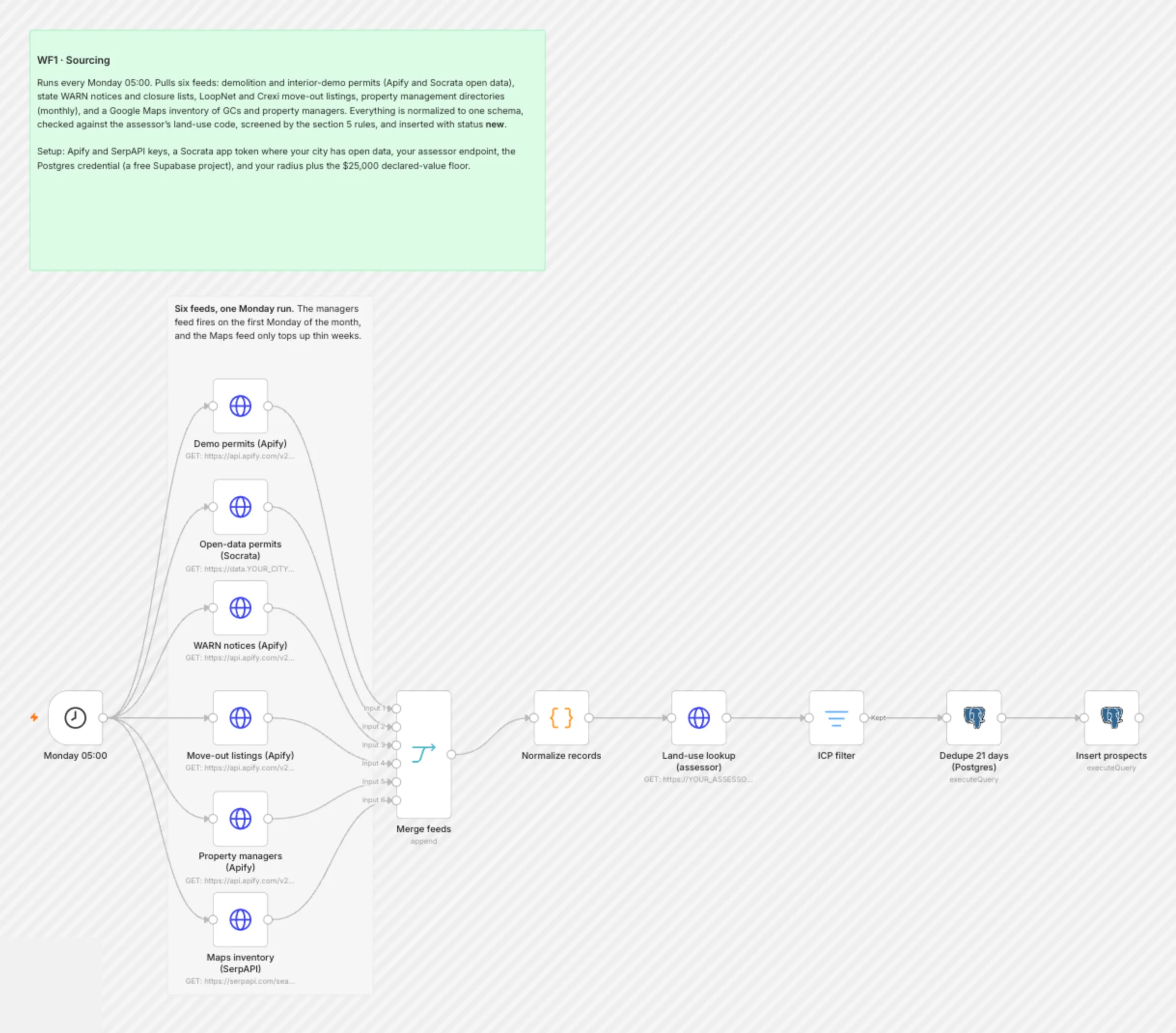
The system pulls prospects from four feeds weekly.
- Demolition and interior-demo permits. From the city or county permit portal.
- WARN notices and retail closure lists. From state labor departments.
- Commercial spaces listed as coming available. On LoopNet and Crexi, where the current tenant is moving out.
- Multifamily and office property managers. With 100 or more units under management.
2. Qualify
Filters drop:
- Small permits. Anything under $25,000 declared value.
- Single-family addresses.
- Out of range. Anything outside a 50 km radius.
- Already known. Current clients, and competitors.
A permit for a residential kitchen never reaches enrichment.
3. Enrich
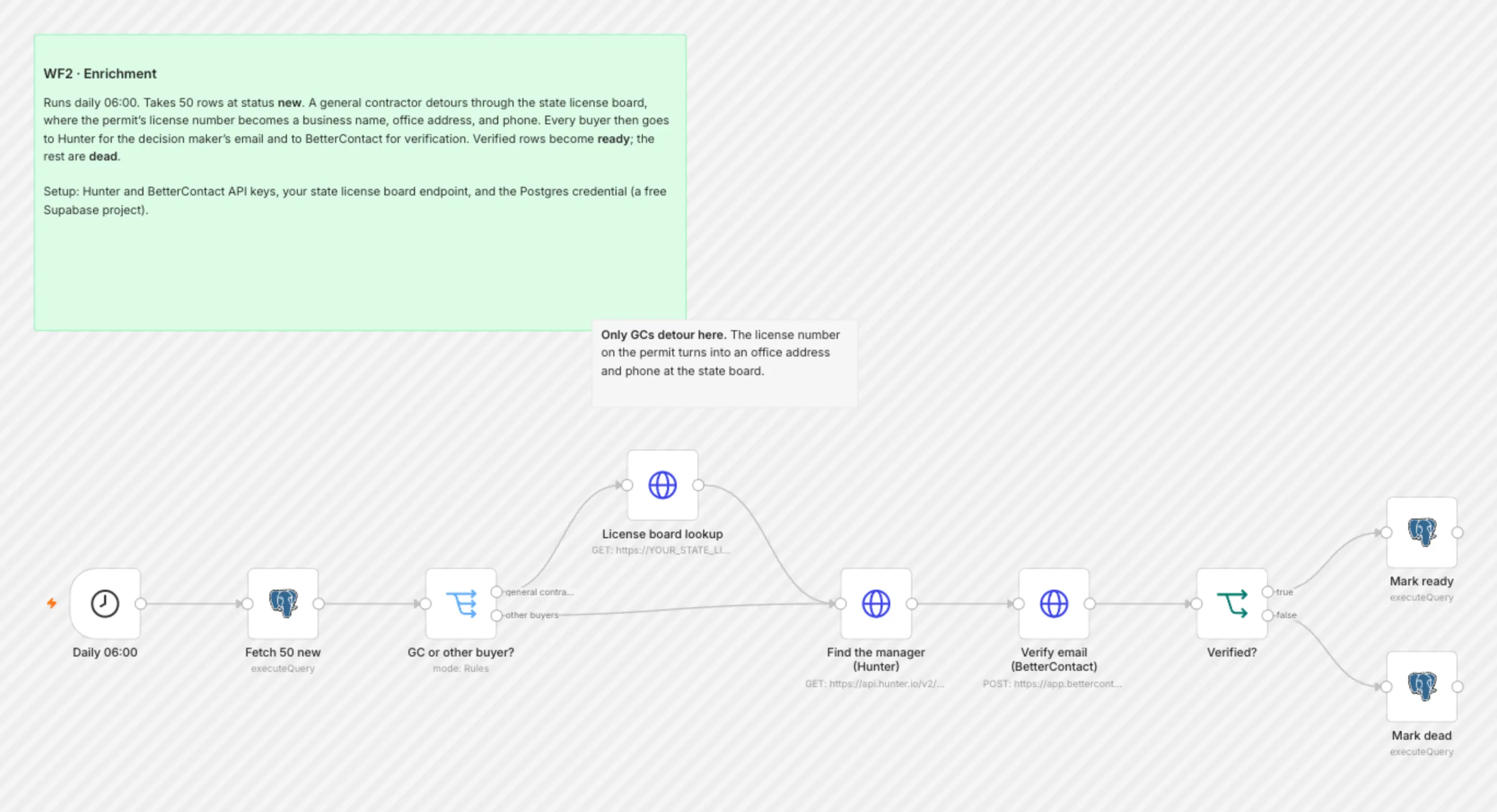
For each qualified record the system finds the project manager at the permit’s listed contractor, the regional manager at the closing retailer, or the property manager on the listing.
It then finds the email with Hunter and runs it through BetterContact’s verification waterfall.
4. Outreach
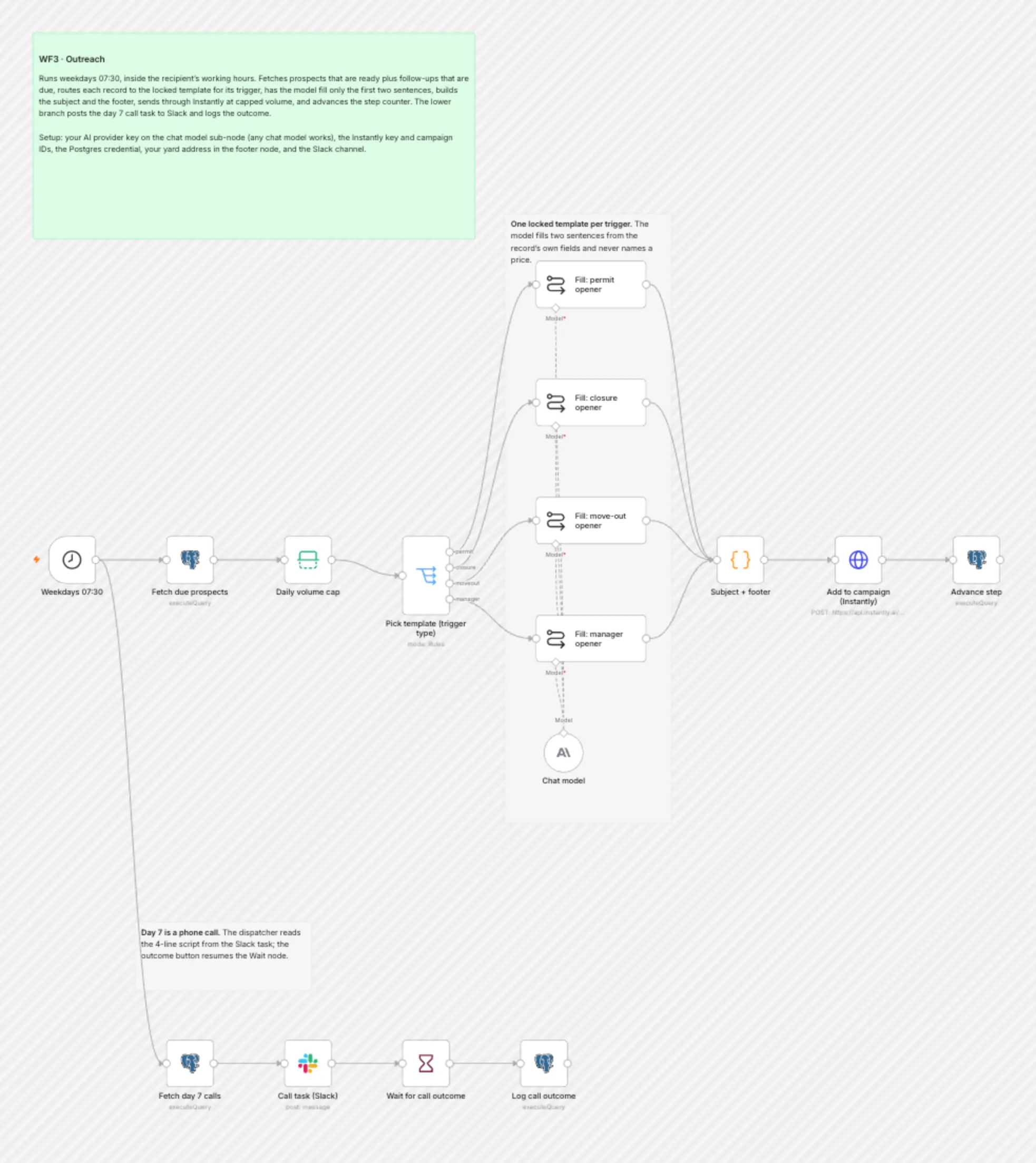
Four emails and one phone call over 16 days, each opening on the permit number, the WARN notice date, or the listing’s availability date, with a 15-minute site visit as the ask.
5. Book, quote, and track
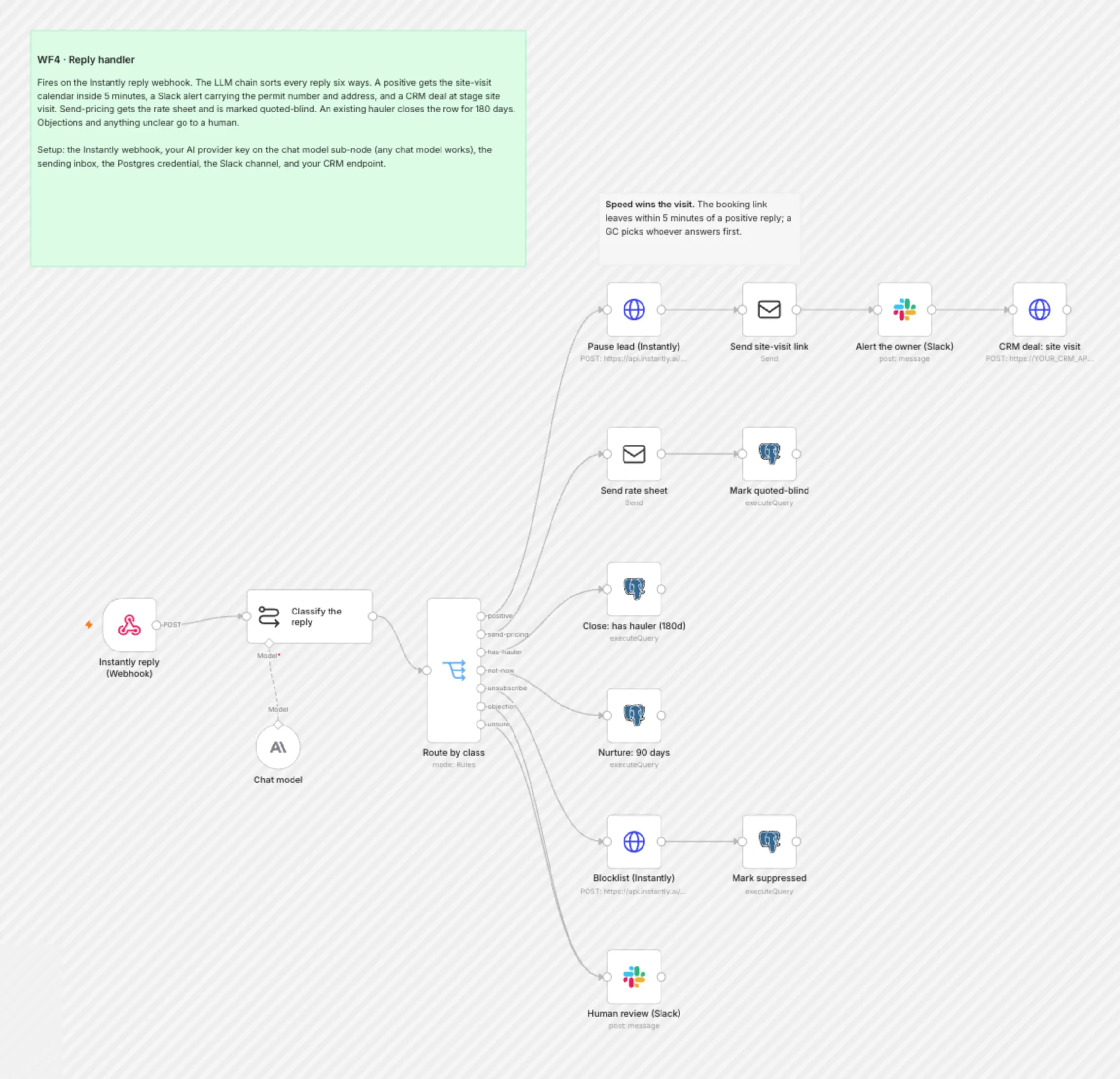
The Claude API sorts each reply into positive, send-pricing, objection, already-have-hauler, not-now, or unsubscribe.
- A positive reply. Gets a site-visit calendar, and the dispatcher’s Slack message carries the permit number or closure date, the address, the declared value, and the requested visit window.
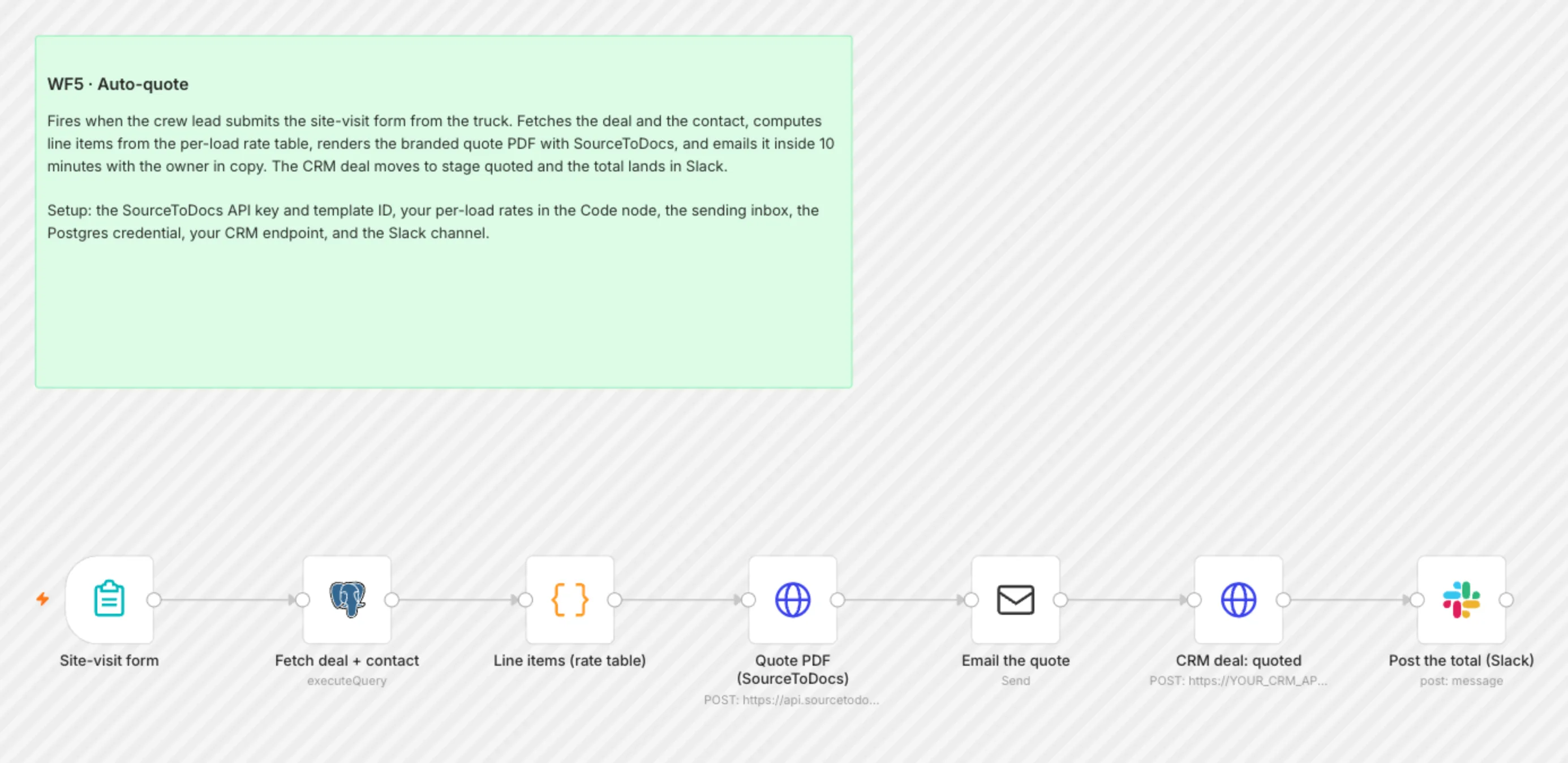
- The site-visit form. After the visit, the crew lead enters load count, material type, and access notes in a form.
- The quote. SourceToDocs returns a branded quote PDF and n8n emails it within 10 minutes.
- The CRM record. Keeps the permit or notice, the load estimate, the quote PDF, and every email and call, so a second job at the same address starts from the first quote.
SourceToDocs is built by 2V Automation, the team behind this library.
Lead sources for commercial junk removal
Ranked by signal quality:
1. Demolition and interior-demo permits
A demolition or interior alteration permit means a dumpster or haul-off crew is needed within 2 to 6 weeks, and the general contractor on the permit usually picks a hauler in the first week.
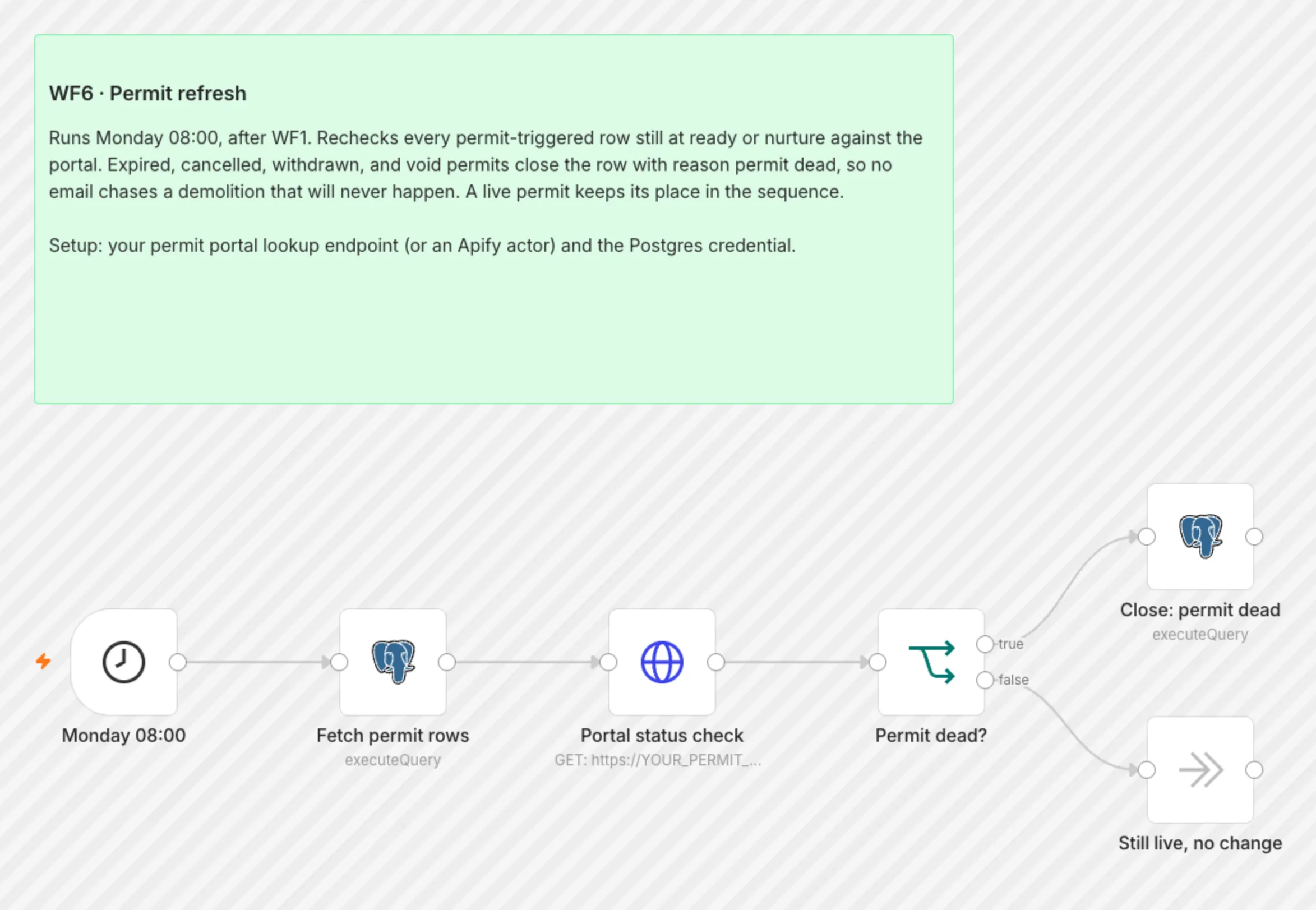
- How the portal is read. An Apify scraper, or a direct Socrata API call where the city publishes open data, reads the permit portal every Monday: Accela, OpenGov, NYC DOB NOW, the Chicago and Los Angeles Socrata feeds.
- What is kept. Permit type IN [demolition, interior demolition, alteration], with the declared-value floor applied.
- Fields captured. Permit number, address, contractor name, contractor license number, issue date, declared value.
Highest intent, lowest competition.
2. Store closures and liquidation notices
A WARN notice names a retailer, a location, and a closure date 60 days out.
Every state labor department publishes them weekly as an HTML table or PDF, and the fixtures, shelving, and stock left after liquidation are a 2 to 6 truckload job.
- Where it comes from. Scraped weekly via Apify from the state WARN page, plus retail closure lists in the local business journal.
- Fields. Company, address, closure date, headcount.
The regional facilities manager or the liquidator needs a hauler before the lease ends.
3. Commercial move-outs and lease expirations
A space listed on LoopNet or Crexi with an availability date in the next 90 days has a tenant leaving, and a tenant leaving has furniture, IT equipment, and build-out to clear.
- Where it comes from. Scraped weekly via Apify from LoopNet and Crexi listings in radius, filtered on availability date and size.
- Fields. Address, square footage, availability date, listing broker, current occupant where stated.
The facility manager of the departing tenant and the listing property manager both buy decommission hauling.
4. Property manager and facility turnover
Multifamily property management companies with 100 or more units have 40 to 60% annual turnover, so a 200-unit portfolio produces 80 to 120 unit turns a year with abandoned furniture in 1 of 5, which is an estimate.
Office property managers decommission floors when a tenant leaves.
- Where it comes from. apartments.com management company pages and IREM and BOMA member directories, via Apify.
Lower urgency than a permit, higher lifetime value, because the buyer signs an annual rate agreement.
5. Contractor and property manager inventory (Google Maps)
General contractors, demolition contractors, and property management offices in radius.
- Where it comes from. SerpAPI, filtered on review count.
Lowest intent of the five, and drawn on only in a week when the demolition permit and WARN feeds run short.
ICP definition
Filter logic the workflow applies:
| Filter | Rule |
|---|---|
| Buyer type | General contractors, demolition contractors, property managers, facility managers, regional retailers, liquidators |
| Permit | Demolition, interior demolition, alteration, or tenant improvement with a declared value of $25,000+ |
| Address | Commercial only (single-family and duplex parcels rejected by assessor land-use code) |
| Closure size | 20+ employees, or a 5,000+ sq ft store |
| Listing | 5,000+ sq ft with an availability date within 90 days |
| Portfolio | 100+ multifamily units, or 100,000+ sq ft of office |
| Radius | Within 50 km of the yard |
| Excluded | CRM match (client or open deal), competitors, national retailers with a corporate hauling contract on file, government-owned buildings, records older than 21 days |
Outreach sequence
The five steps
| Step | Day | Channel | Goal |
|---|---|---|---|
| 1 | 0 | Name the permit, WARN notice, or listing date; ask for a 15-minute site visit before demo starts | |
| 2 | 3 | Two-line follow-up with the open truck dates this week | |
| 3 | 7 | Phone | Call the contractor’s office, reference the permit |
| 4 | 11 | Value angle: recycling and landfill diversion ticket | |
| 5 | 16 | Breakup, leave the rate sheet |
Example step 1 (permit trigger)
Subject: haul-off for [address]
Hi [First name], saw permit [permit number] for interior demolition at [address] was issued on [issue date]. Once demo starts you will need debris hauled daily or every other day.
We run [N] trucks out of [city] and handle demo haul-off for [N] GCs, with same-day pickup and a landfill diversion ticket for every load.
Can I stop by the site for 15 minutes before demo starts and give you a fixed per-load price?
Expected reply rates
| Source | Expected reply rate |
|---|---|
| Permit, closure, and move-out sources | 3 to 6% |
| Property manager and inventory sources | 1 to 3% |
Both ranges are estimates.
- A GC whose demo starts in 2 weeks. Answers at the top of the range.
- A property manager with no turn scheduled. Answers at the bottom.
- Season. Demolition permits cluster from March to October, so the same sequence produces fewer replies in January and February, and retail closures peak in the 8 weeks after the holiday season.
Stack and running costs
| Tool | Purpose | Monthly |
|---|---|---|
| n8n Cloud | Orchestration | $24 |
| Apify | Permit portal, WARN page, LoopNet and Crexi scrapers | $30 |
| SerpAPI | Google Maps inventory | $25 |
| Hunter | Decision-maker email finding | $34 |
| BetterContact | Waterfall enrichment + verification | $15 |
| Instantly | Sending + warmup | $37 |
| SourceToDocs (Starter) | Branded quote PDF from site-visit form | $19 |
| Claude API | First-line generation + reply classification | $6 |
| Sending domain | Deliverability | $1 |
| Supabase (free tier) | Prospect database | $0 |
| Total | ~$190 |
Socrata open data APIs and state WARN pages are free.