How it works
1. Source
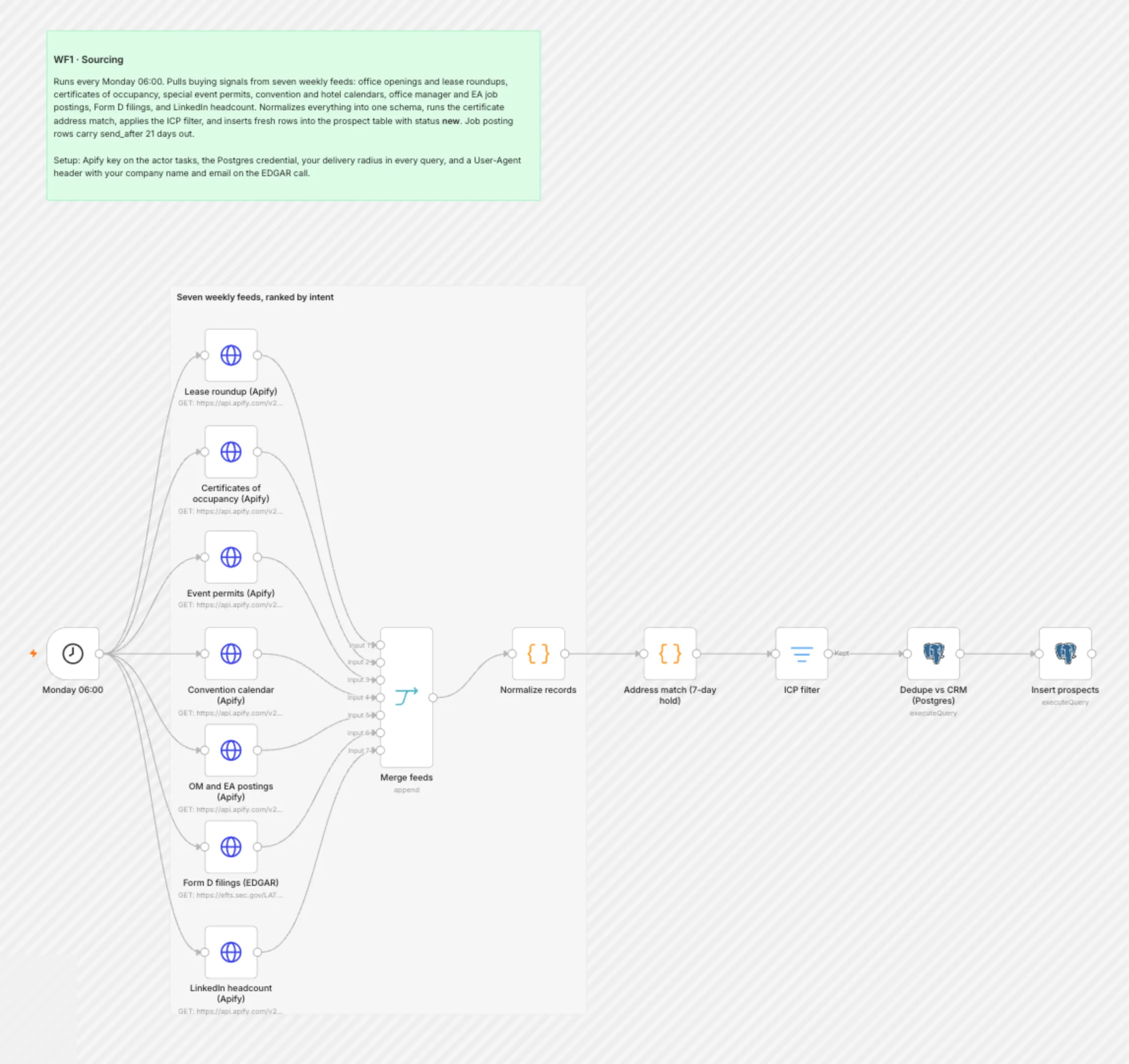
The system pulls buying signals weekly from four sources.
- New office openings and relocations. Business journal lease roundups, and certificates of occupancy for office space.
- Special event permits and convention center bookings. Filed events with a date attached.
- Office manager and executive assistant job postings. The person who will own the food budget.
- Growth signals. SEC Form D funding filings and job posting velocity.
2. Qualify
Filters drop:
- Too small. Companies under 30 employees.
- Too far. Addresses outside the 40 km delivery radius.
- Wrong building. Residential and retail occupancy.
- Already covered. Events with a named caterer already on the permit, and companies already in the CRM.
- No company name. Any record still unmatched after a 7-day address match.
Nothing reaches the contact-finding step until it passes, so the enrichment spend goes only to companies that can place a 30-person order.
3. Enrich
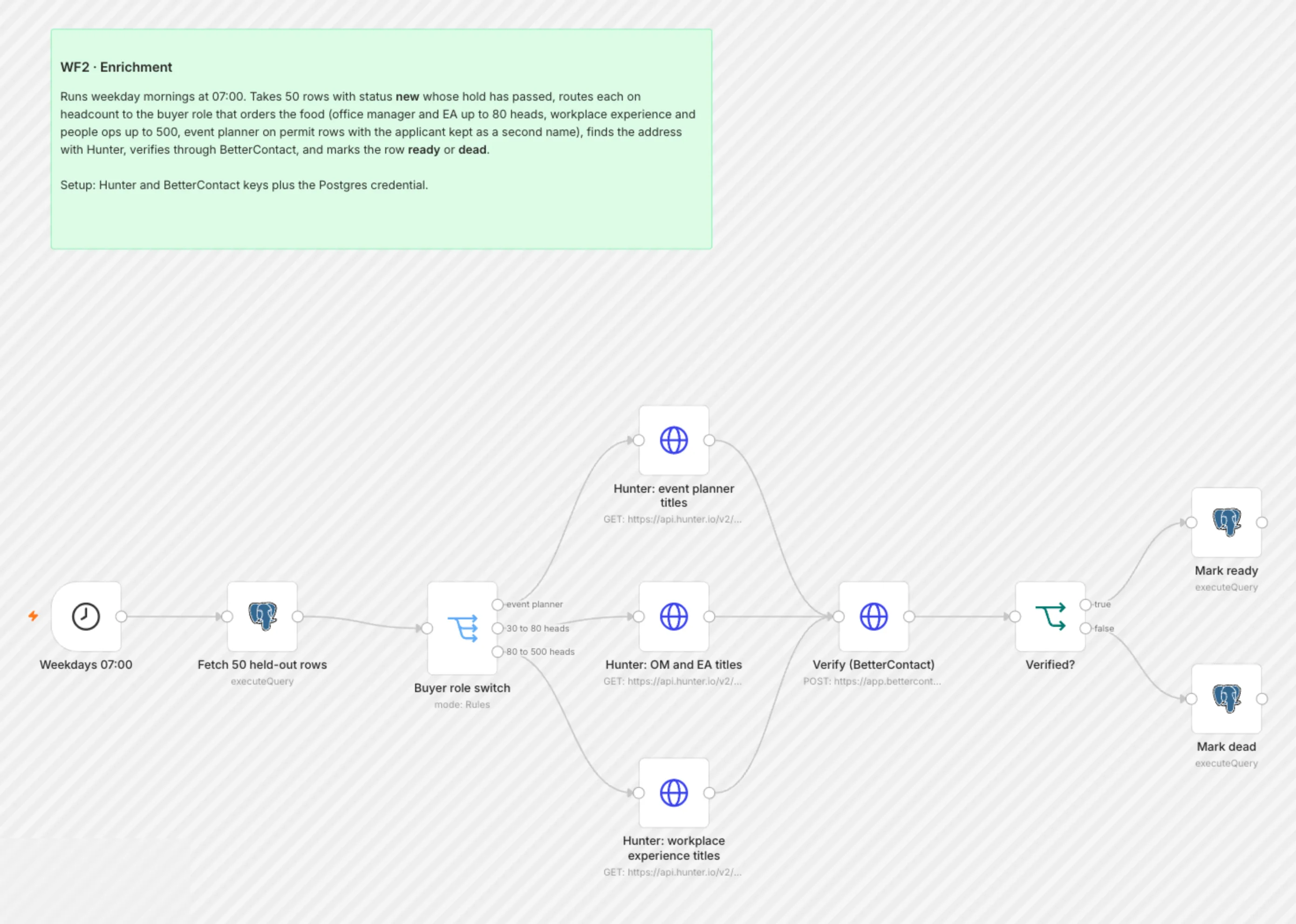
For each qualified company the system finds the person who orders the food.
- Who it looks for. The office manager, executive assistant to the CEO, workplace experience lead, or event planner, depending on headcount.
- How it finds them. Hunter pulls the address and BetterContact verifies it.
- Event permits. They also store the permit applicant’s name as a second contact.
4. Outreach
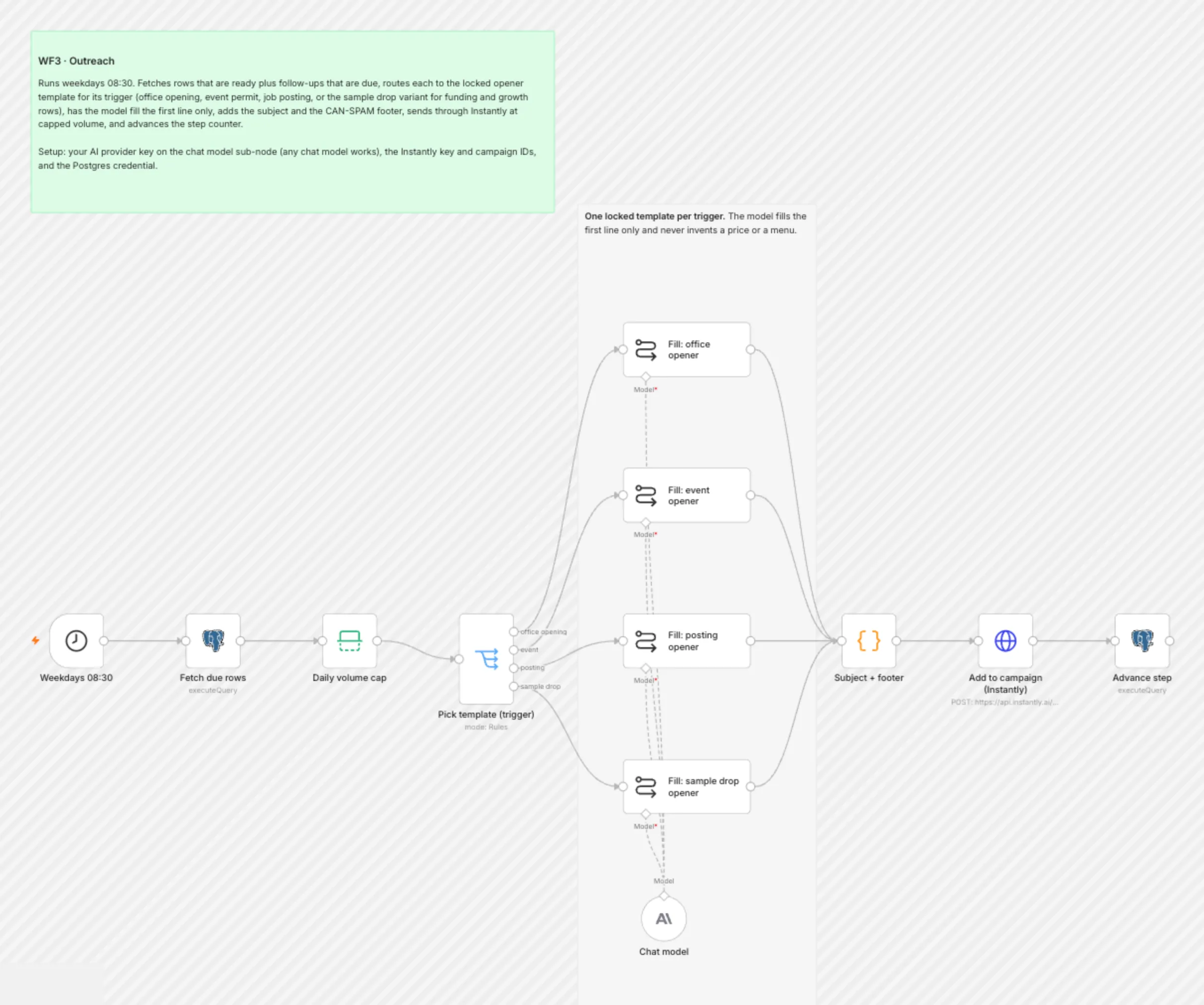
Four emails go out on days 0, 3, 7, and 14, each offering a tasting or a sample drop.
The opening line is built from the record the system pulled: the new office address and move-in month, the permitted event date and expected attendance, the Form D amount, or the job title that will own the lunch budget.
5. Book, quote, and track
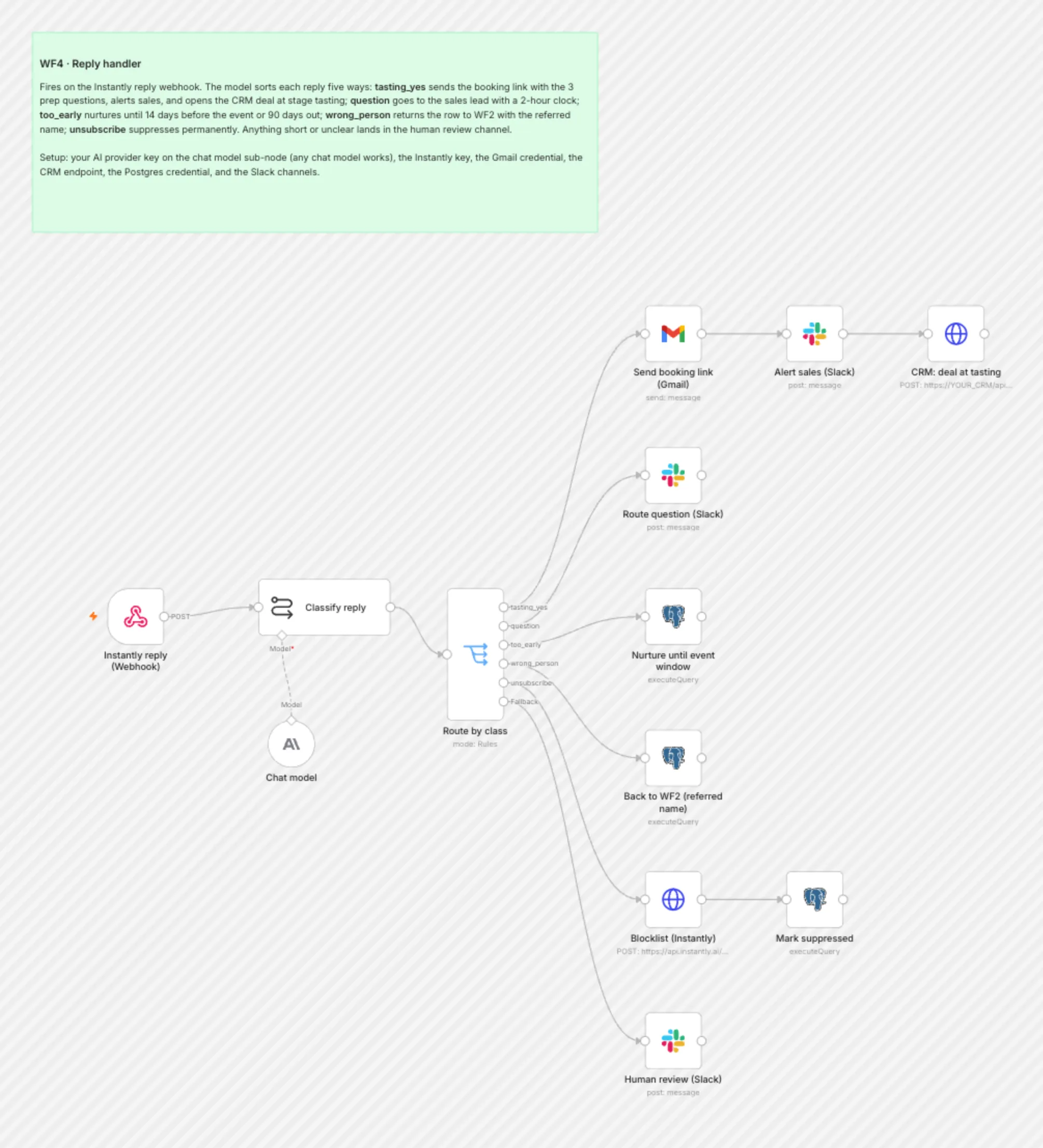
Every reply lands in a Claude step that sorts it into one of five buckets: wants a tasting, has a question, too early, wrong person, or remove me.
- Wants a tasting. The reply receives a booking link for a tasting or sample drop.
- The Slack message. The sales lead gets the company, the trigger (new address, event date, or round), the estimated headcount, and the contact’s role.
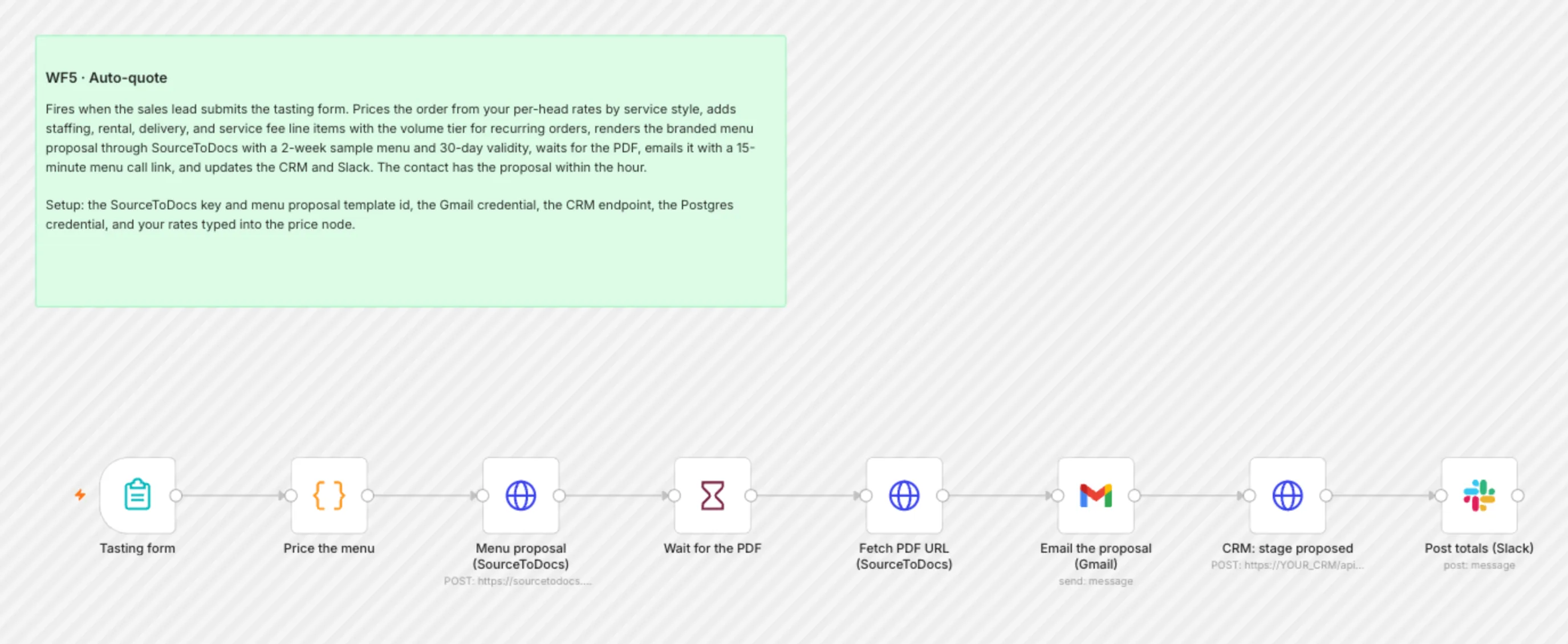
- The tasting form. Once the tasting is done, the sales lead fills in a short form: headcount, service style, frequency, dietary counts, delivery address, and dates.
- The proposal. Those form values feed a SourceToDocs template, and within the hour the contact has a branded menu proposal PDF with per-head pricing in their inbox, sent by n8n.
- The record. The CRM keeps the deal, the trigger record, the tasting date, and the proposal amount.
SourceToDocs is built by 2V Automation, the team behind this library.
Lead sources for corporate catering
Ranked by signal quality:
1. New office openings and relocations
A company moving into a new office picks its lunch and meeting vendors in the first 60 days, usually because the office manager is asked to “find a caterer” in week 1 and the first choice sticks for years.
Two feeds supply it weekly.
| Feed | What it reads |
|---|---|
| Apify page and RSS scraper | The local business journal’s lease roundup column and its office opening announcements |
| Apify actor on the permit search page | New certificates of occupancy for business occupancy group B, off the city or county permit search page. Accela and Tyler EnerGov both expose one |
What the record carries: the company name, the address, the square footage, the move-in month, and the landlord or broker.
Highest intent, because the buyer has no incumbent at the new address.
2. Special event permits and convention center bookings
A special event permit, a tent permit, or a temporary use permit filed by a company names an event 30 to 90 days out with an expected attendance figure, and a caterer is booked in that window.
Two feeds, both pulled weekly.
| Feed | What it reads |
|---|---|
| Apify actor on the city special event permit portal | The permit search, filtered to applicant type business and attendance of 50 or more |
| Apify scraper on the convention center and hotel conference calendars | The public event listings, filtered to corporate meetings and conferences with a named host company |
What the record carries: the applicant, the event name, the date, the venue, and the expected attendance.
Second-highest intent, because the date and headcount are already fixed.
3. Office manager and executive assistant job postings
A company hiring an office manager, executive assistant, or workplace experience coordinator is about to hand a new person the food budget, and a new hire has no vendor loyalty.
- Where it comes from. Indeed and LinkedIn job feeds, pulled weekly by an Apify job scraper filtered by title and by office location in radius.
- What is stored. The posting date, the title, and the company’s office address.
- When it sends. The sequence for this source lands 3 to 5 weeks after the posting, timed to the new hire’s first month.
4. Funding rounds and headcount growth
A Form D filing on SEC EDGAR names the company, the amount raised, and the date, and a funded team plans an offsite, an all-hands, and a recurring lunch within 90 days of closing.
- EDGAR. The full-text search API, free, pulled weekly and filtered by state and city of the issuer and by offering amount of $2M or more.
- LinkedIn headcount. An Apify company scraper stores monthly headcount for companies in radius with 30 to 500 employees, flagging growth of 20% or more in 6 months.
- What the sequence offers. A sample drop for the next team meeting instead of a tasting, because the event date is unknown.
Lowest intent of the four.
ICP definition
Filter logic the workflow applies:
| Filter | Rule |
|---|---|
| Company type | Offices, tech, professional services, law firms, finance, biotech labs, media, architecture and engineering |
| Size | 30+ employees, or 5,000+ sq ft of office, or a 50+ person event, or a $2,000,000+ raise |
| Radius | Within 40 km of the kitchen (office or event venue address) |
| Trigger window | Trigger dated in the last 30 days (openings, certificates of occupancy, job postings, Form D); events 21 to 90 days out (event permits, convention calendar) |
| Contact | Office manager, executive assistant, workplace experience, event planner, people ops, chief of staff |
| Excluded | Weddings and private parties, residential and retail occupancy, events with a named caterer on the permit, venues with an exclusive in-house caterer, government agencies (formal procurement), companies with a national food program vendor, current clients (CRM match), competitors |
Outreach sequence
The four steps
| Step | Day | Channel | Goal |
|---|---|---|---|
| 1 | 0 | Mention the new office, event permit, or posting and offer a tasting or sample drop | |
| 2 | 3 | Short bump with the move-in month or event date | |
| 3 | 7 | Value angle: one specific pain (dietary coverage, late deliveries, per-head cost creep) | |
| 4 | 14 | Breakup, door open, 48-hour menu proposal offer |
Example step 1 (office opening trigger)
Subject: lunch at [new address]
Hi [Name], saw [company] is moving into [sqft] sq ft at [new address] in [move-in month]. The first month in a new office is when the lunch and meeting orders get sorted, usually by whoever is asked first.
We feed [N] offices in [city] every week, cover every dietary list without a second order, and deliver inside a 15-minute window.
Can we drop a sample lunch for [headcount] people the week of [week]?
Expected reply rates
| Row type | Expected reply rate |
|---|---|
| Trigger sources (office openings, event permits, job postings) | 3 to 6% |
| Funding and headcount signals | 2 to 4% |
Both are estimates for a warmed domain and a single metro.
How often your business journal names the tenant and how many caterers already work your convention center will move them.
Stack and running costs
| Tool | Purpose | Monthly |
|---|---|---|
| n8n Cloud | Orchestration | $24 |
| Apify | Business journal, permit portal, event permit, convention calendar, job board, and LinkedIn scraping | $30 |
| Hunter | Decision-maker email finding | $34 |
| BetterContact | Waterfall enrichment + verification | $15 |
| Instantly | Sending, warmup, reply webhook | $37 |
| Claude API | First lines and reply classification | $8 |
| SourceToDocs (Starter) | Branded menu proposal PDF generation | $19 |
| Sending domain | Deliverability | $1 |
| Supabase (free tier) | Prospect database | $0 |
| Total | ~$170 |
The SEC EDGAR full-text search API is free. No Google Maps inventory source is used, so there is no SerpAPI line. Costs are current public starter tiers.