How it works
1. Source
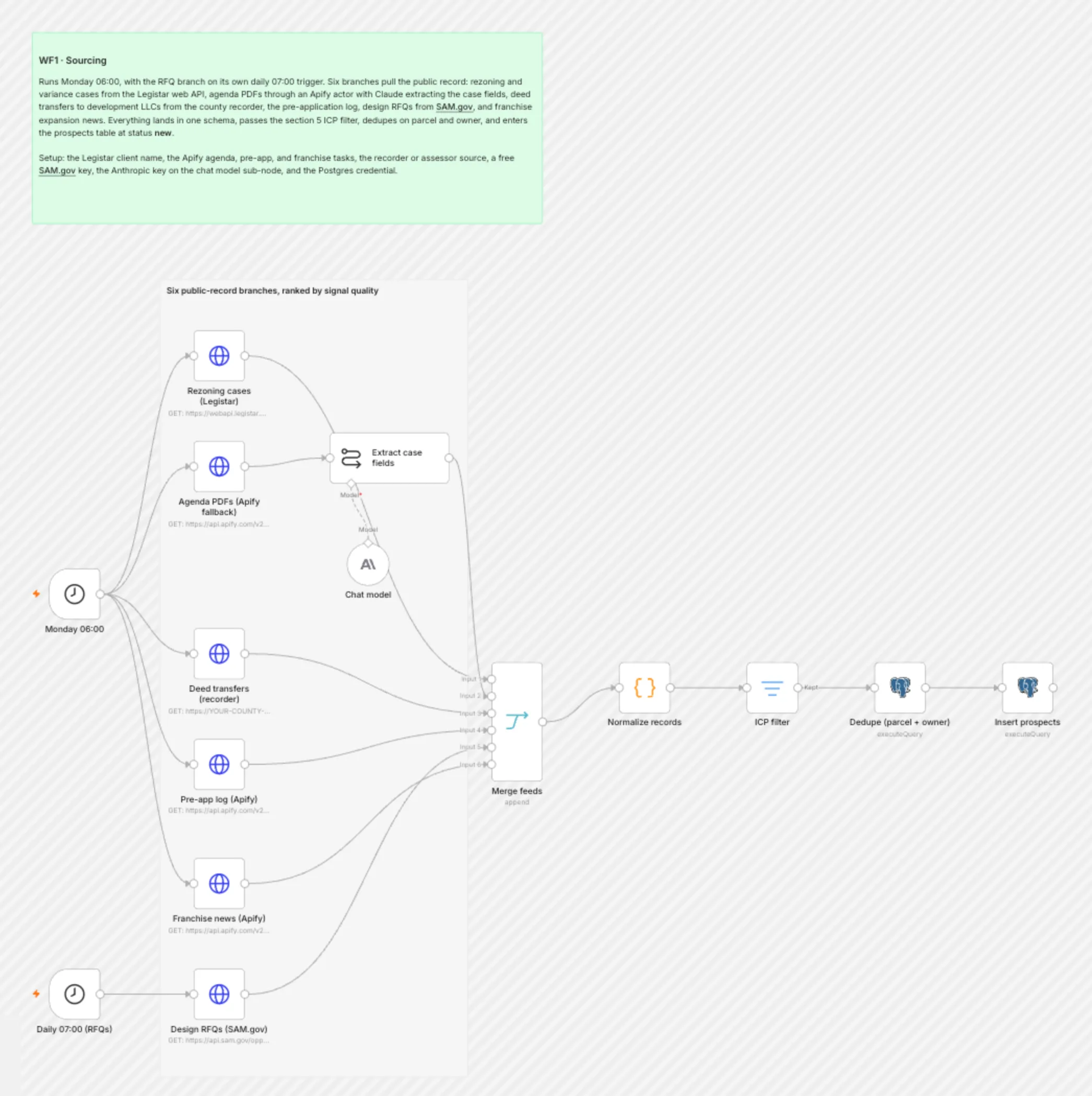
The system pulls projects from five sources weekly.
- Rezoning and variance applications. From planning commission agendas, either Legistar or the city agenda page.
- Deed transfers to development LLCs. From the county recorder.
- Pre-application conference logs and design review submittals. Where the city publishes them.
- Design RFQs. From city procurement portals and SAM.gov.
- Franchise and multi-site expansion announcements. From business journals and franchisor press releases.
2. Qualify
Filters drop rows before the system pays for a single contact lookup.
- Already has a firm. Every record that already names an architect of record.
- Wrong project type. Every single-family or duplex case.
- Too small. Parcels under 0.5 acres with no rezoning attached, and deeds under $400,000.
- Out of scope. RFQs outside the firm’s registered disciplines, and anything outside the service radius.
- Already known. The CRM check drops owners the firm proposed to in the last 24 months and developers with a standing design roster.
The architect-of-record check matters most: a design review submittal with stamped drawings already has a firm on it, and a rezoning case with only a land use attorney listed does not.
3. Enrich
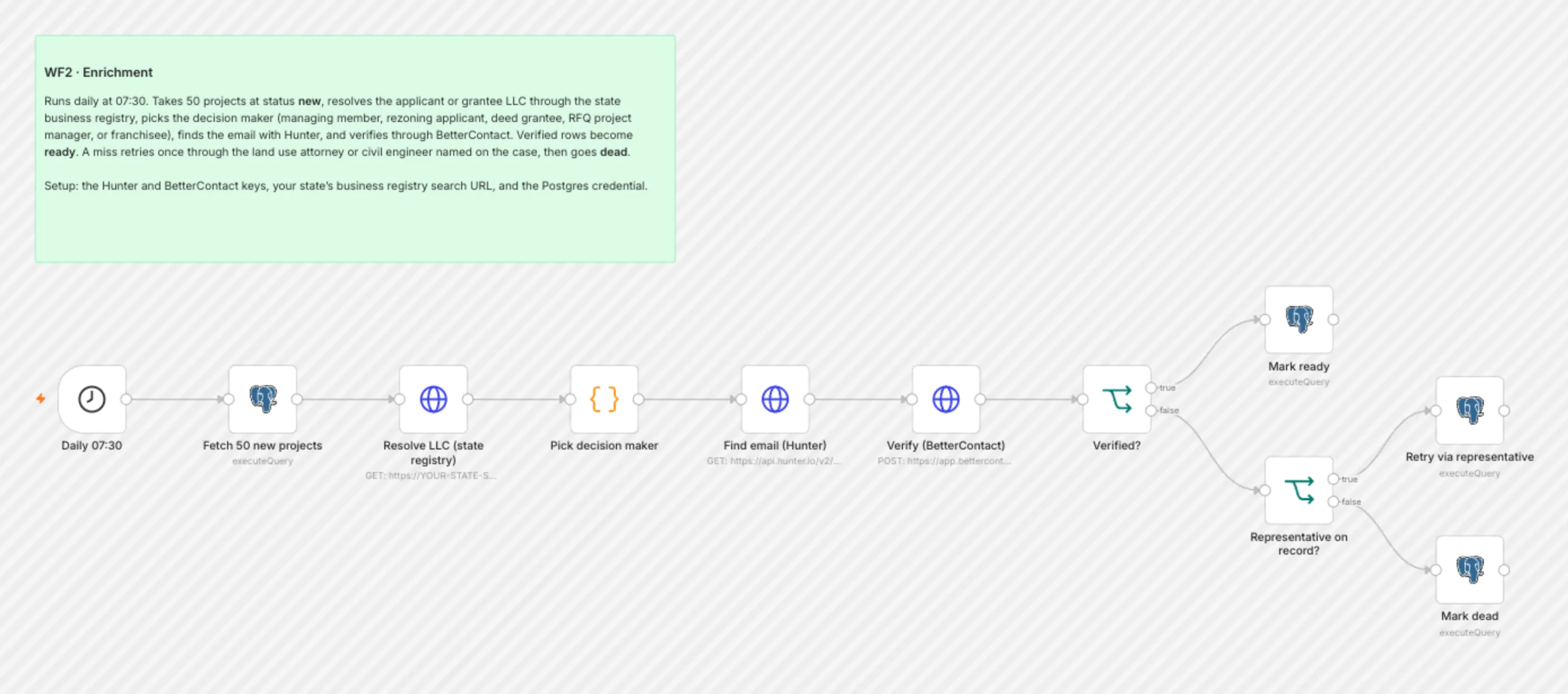
For each qualified project the system works through four steps.
- Resolve the entity. The applicant or grantee LLC through the state business registry and the deed’s mailing address.
- Identify the person. The owner, development manager, director of real estate, or franchisee.
- Find the email. Hunter finds the work address.
- Verify it. A BetterContact waterfall check confirms it.
4. Outreach
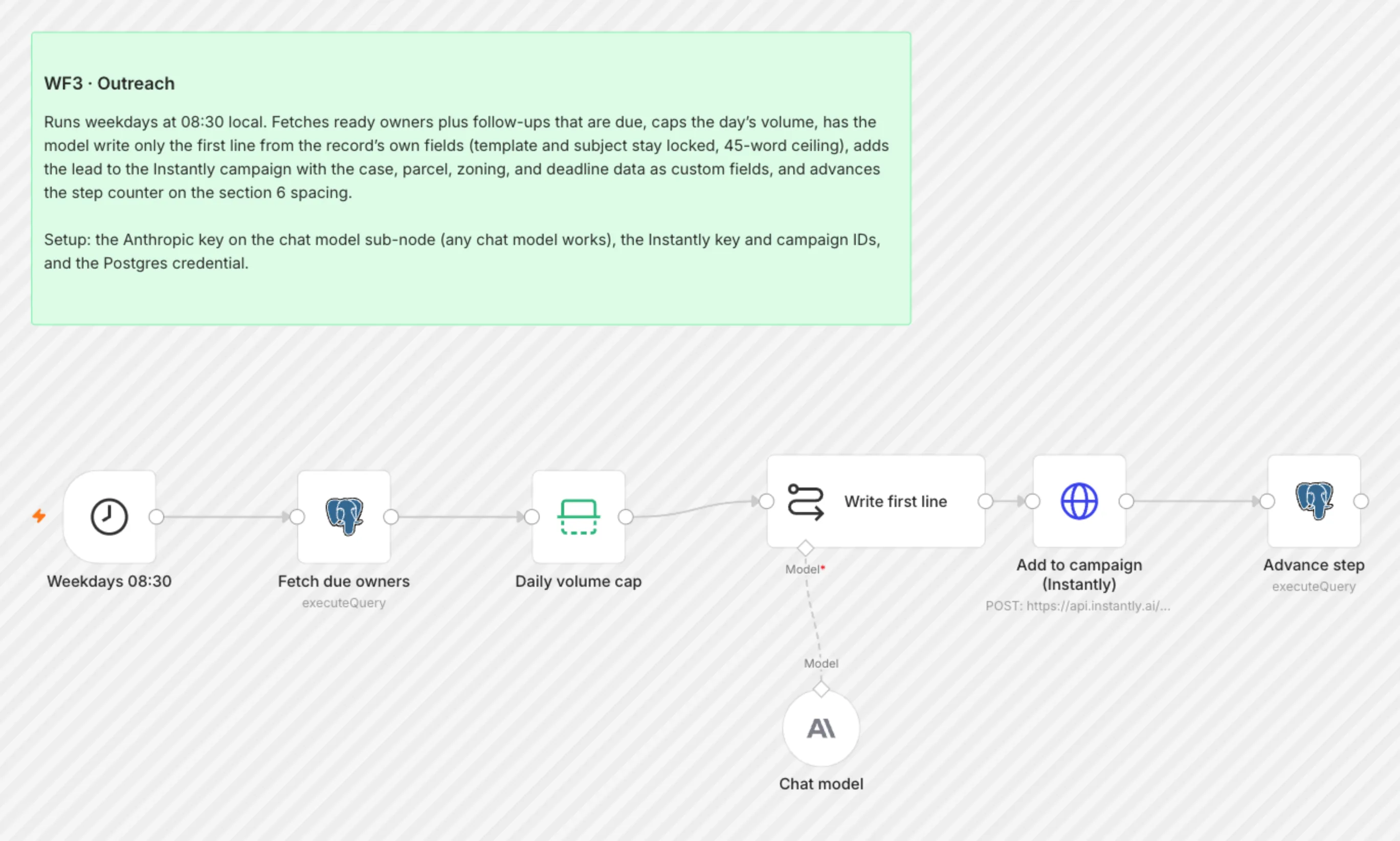
Four emails spaced across two weeks, timed to land before the hearing date or RFQ deadline on the record.
Each opener quotes the filing the owner made: the rezoning case number and parcel, the recorded deed and sale price, the pre-application date, the RFQ number, or the announced franchise location count.
5. Book, propose, and track
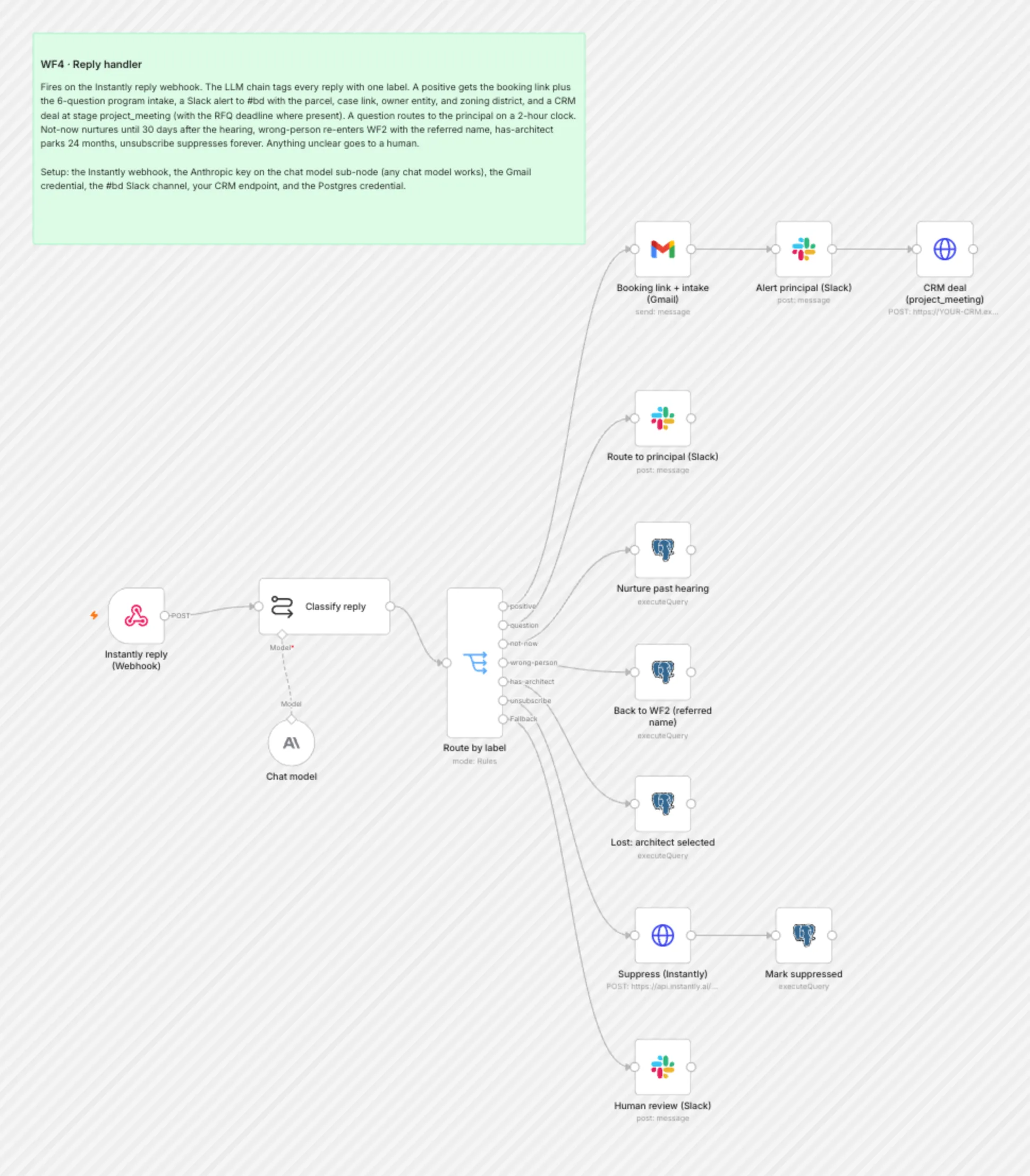
Claude classifies each reply as positive, question, not-now, wrong-person, has-architect, or unsubscribe.
- Positive reply. Sends a booking link plus a 6-question program intake: use, target square footage, stories, site status, budget range, target entitlement date.
- Principal alert. A Slack alert carrying the parcel id, the case or deed link, the owner entity, and the zoning district.
- CRM deal. Stores the parcel id, trigger type, trigger date, proposed use, and every email sent.
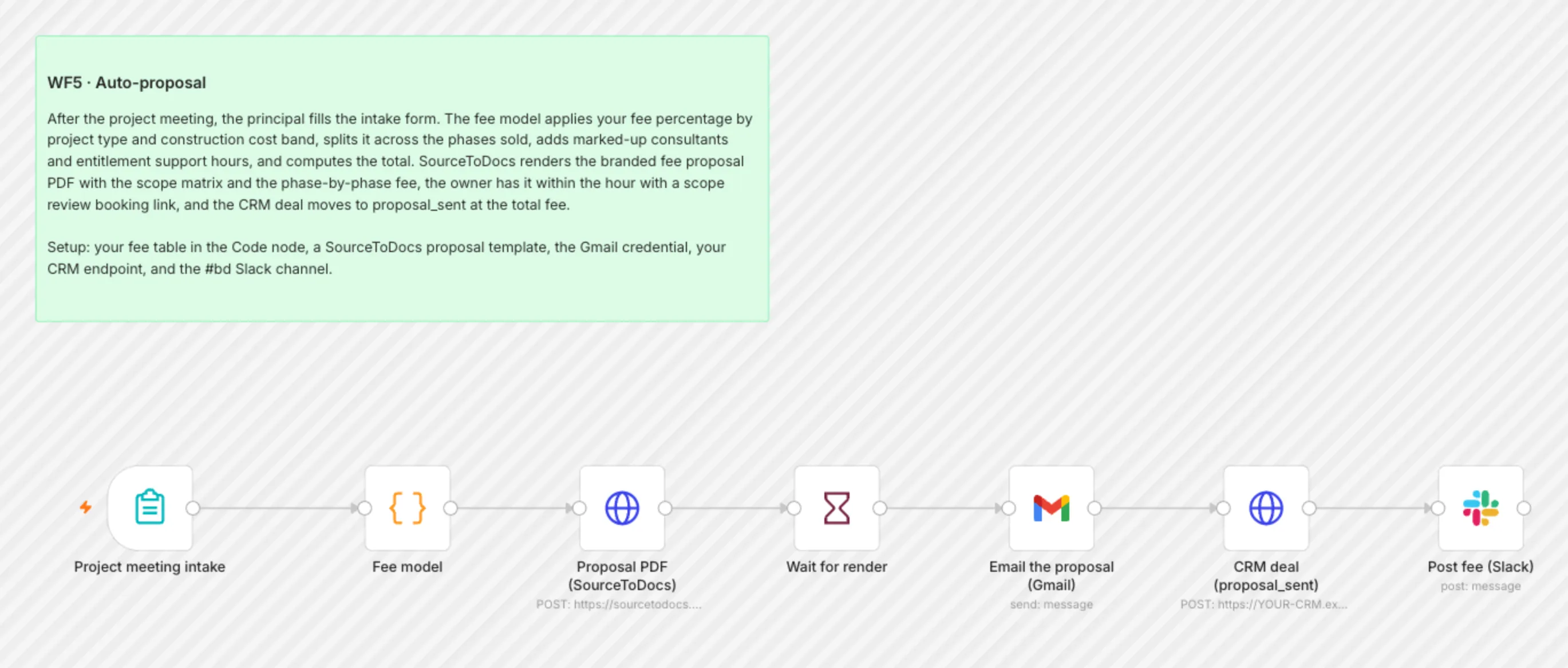
- Proposal intake. After the project meeting the principal enters program, square footage, construction budget, phases, and consultant scope into a form.
- The PDF. SourceToDocs returns a branded fee proposal PDF with a scope matrix and a phase-by-phase fee.
- Delivery and stage. n8n sends that PDF to the owner inside 60 minutes of the form submission, with a scope review booking link, and advances the CRM deal to the proposal_sent stage with the total fee as the deal amount.
SourceToDocs is built by 2V Automation, the team behind this library.
Lead sources for architecture firms
Ranked by signal quality:
1. Rezoning and variance applications
An owner who files for a rezoning, a conditional use permit, or a variance has a site and a program and usually no architect yet, because the land use attorney or civil engineer handles entitlement.
The owner will hire a design firm 3 to 9 months later, once the case is approved.
| Feed | What it gives | Pulled |
|---|---|---|
| Legistar web API | A public web API covering the 300 or so US cities on it | Weekly |
| Planning commission and zoning board agenda PDFs | The agendas of cities not on Legistar, through an Apify scraper | Weekly |
Claude extracts the case number, applicant, parcel, current and requested zoning, proposed use, and hearing date from the agenda text.
The record names the applicant and often the representative, and the filter keeps only cases where the representative is an attorney, engineer, or the owner.
Highest intent, lowest competition, because most firms only learn about a project when the GC asks for a bid set.
2. Land purchases by development LLCs
A deed transfer of a commercial or multifamily zoned parcel to an LLC with “Development”, “Partners”, “Holdings”, or a project-style name means a project is being planned 6 to 18 months out and no design team exists.
| Feed | What it gives | Pulled |
|---|---|---|
| County recorder document search | Deed transfers filtered by zoning code and a sale price above $400,000 | Weekly |
| Assessor monthly sales CSV | The alternative source for the same transfers | Weekly |
The grantee name and mailing address lead to the developer.
Longest horizon of the five, but the owner has no shortlist, no program document, and no bid list yet.
3. Pre-application filings and design review submittals
A pre-application conference request means the owner is 30 to 90 days from needing drawings, and many cities publish the pre-app log with applicant, address, and proposed use.
| Feed | What it gives | Pulled |
|---|---|---|
| City pre-app log page (Apify scraper) | Applicant, address, and proposed use | Weekly |
| Accela public search (Apify scraper) | Design review submittals | Weekly |
Design review submittals are lower value because most carry stamped drawings, so the filter keeps only submittals where the drawings are a franchisor prototype or the listed architect is out of state, which means a local architect of record is still needed.
4. Public-sector design RFQs
A city, school district, transit agency, or federal agency posting a design services RFQ has a budgeted project and a deadline.
| Feed | What it gives | Pulled |
|---|---|---|
| City and county procurement portals | BidNet, Bonfire, PlanetBids, or the city’s own page | Daily |
| SAM.gov | A free public API | Daily |
Both are filtered by NAICS 541310 and the firm’s registered disciplines.
Explicit demand, but 8 to 20 firms respond to each one, so the system treats an RFQ as a conversation opener with the project manager named on the posting and flags the submission deadline in the CRM.
5. Franchise and multi-site expansion announcements
A franchisee signing a 5-unit development agreement, or a regional chain announcing 10 locations in your state, needs a local architect of record to adapt the prototype and pull permits at each site, at fees of $15,000 to $60,000 per location.
Sourced weekly through an Apify scraper:
- Business journal openings columns.
- Franchisor press releases.
- Franchise disclosure document updates.
Smallest fees per project, but 5 to 10 repeat projects from one relationship.
ICP definition
Filter logic the workflow applies.
What starts a row
| Filter | Rule |
|---|---|
| Case type | Rezoning, planned development, conditional use, variance, site plan pre-app, design review, design RFQ, franchise expansion, deed transfer |
| Proposed use | Multifamily of 5+ units, mixed use, office, retail, restaurant, hospitality, medical, light industrial, self storage, religious, private education, public facility |
| Size | 0.5+ acres, or 8,000+ sq ft proposed, or a $400,000+ deed sale price, or a $100,000+ estimated RFQ fee, or 3+ franchise units |
| Architect of record | None listed, or licensed out of state (pre-app and design review cases only) |
| Representative | Owner, attorney, civil engineer, broker, or none (rezoning and variance cases only) |
| Grantee name | Matches development, partners, holdings, ventures, capital, properties, or an LLC named for the project (deeds only) |
| RFQ discipline | NAICS 541310 with the discipline among the firm’s registrations (RFQs only) |
What keeps a row
| Filter | Rule |
|---|---|
| Radius | Within 100 km of base; RFQs anywhere in the state |
| Trigger window | Last 30 days for rezonings, pre-apps, and RFQs; last 90 days for deeds and franchise announcements |
| Contact | Owner, principal, managing member, development manager, director of real estate, director of construction, franchisee, public project manager |
| Excluded | Single-family, duplex, and townhome cases, accessory dwelling units, signage and fence variances, cases with a licensed in-state architect listed, developers with an in-house design studio, current clients (CRM match), competitors, projects over $50M construction cost (the shortlist runs through national firms), RFQs due in under 10 days |
Outreach sequence
The four steps
| Step | Day | Channel | Goal |
|---|---|---|---|
| 1 | 0 | Reference the rezoning case, deed, or RFQ and offer a site and program study before the shortlist forms | |
| 2 | 3 | Short bump with the hearing date or recorded date | |
| 3 | 7 | Value angle: one specific pain (entitlement redesign, unit count lost to parking, schedule slipped by a second hearing) | |
| 4 | 14 | Breakup, door open, 5-day fee proposal offer |
Example step 1 (rezoning trigger)
Subject: [parcel address] rezoning
Hi [Name], the rezoning case for [parcel address] ([case number], [current zoning] to [requested zoning]) is on the [hearing date] planning commission agenda under [owner entity]. The filing lists [representative] and no design firm.
We have taken [N] [proposed use] projects through entitlement in [city] and can produce a site and program study in 5 business days, so the drawings match what the commission approves.
Worth a 30-minute project meeting in [week]?
Expected reply rate
Expected reply rate: 2 to 5% on trigger sources (rezoning cases, deeds, pre-app filings, RFQs, franchise announcements). Treat these as estimates.
Development signals move with interest rates and the hearing calendar.
- Rising construction loan rates. A quarter with rising rates can cut developer replies in half.
- A monthly commission hearing. It produces one fat week of cases and three thin ones.
- A 10-unit franchise program. One of them can double a month’s meetings.
Your portfolio, your metro, and the lending climate will move them.
Stack and running costs
| Tool | Purpose | Monthly |
|---|---|---|
| n8n Cloud | Orchestration | $24 |
| Apify | Agenda, recorder, pre-app, procurement portal, and franchise news scraping | $30 |
| Hunter | Decision-maker email finding | $34 |
| BetterContact | Waterfall enrichment + verification | $15 |
| Instantly | Sending, warmup, reply webhook | $37 |
| Claude API | Agenda extraction, first lines, reply classification | $10 |
| SourceToDocs (Starter) | Branded fee proposal PDF generation | $19 |
| Sending domain | Deliverability | $1 |
| Supabase (free tier) | Prospect database | $0 |
| Total | ~$170 |
The Legistar web API, the SAM.gov Opportunities API, state business registry searches, and most county recorder searches are free. Counties that charge for bulk deed data run $25 to $100 a month, which is on top of the total. Costs are current public starter tiers.