How it works
1. Source
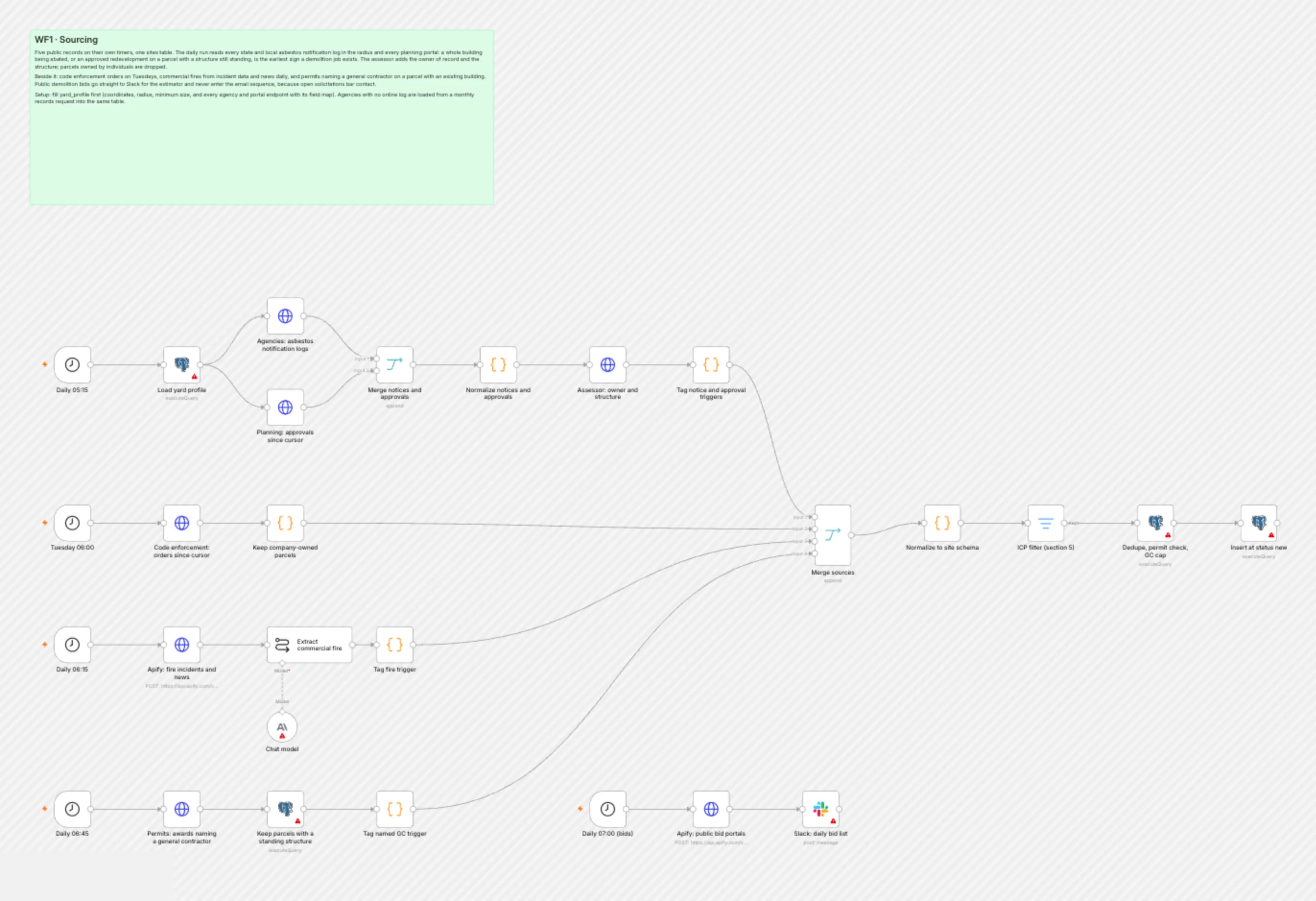
Five feeds, each on its own schedule, write into a single sites table.
| Feed | What it gives | Pulled |
|---|---|---|
| State and local asbestos notification logs | Address, owner, abatement contractor, building size, and planned dates | Daily where published, monthly by records request elsewhere |
| Planning and zoning portals | Approved site plans and rezonings on parcels with existing structures | Daily |
| Code enforcement records | Unsafe structure, condemnation, and demolition orders on commercial parcels | Weekly |
| Fire incident and news feeds | Commercial structure fires with the address and the extent of damage | Daily |
| Public bid portals | City, county, and land bank demolition solicitations | Daily, sent to Slack only |
Each row holds the address, the parcel’s owner of record, the building type and square footage from the assessor, the trigger type, the trigger date, and the fact the first email will cite.
2. Qualify
Nothing is enriched until the row clears these checks.
- Radius. The site sits inside the yard’s working radius.
- Owner type. The owner of record is a company, a trust, or a public body; parcels owned by individuals are dropped.
- Size. At least 2,000 square feet of structure, or any industrial use.
- Stage. No demolition permit has been issued yet for the parcel.
- Company. The owner and any named general contractor are absent from the customer, open-bid, and suppression tables.
- Duplicate. One live row per parcel, whatever the number of triggers.
A parcel that fails only on stage is still recorded, because a permit issued to another contractor names the general contractor for the next job.
3. Enrich
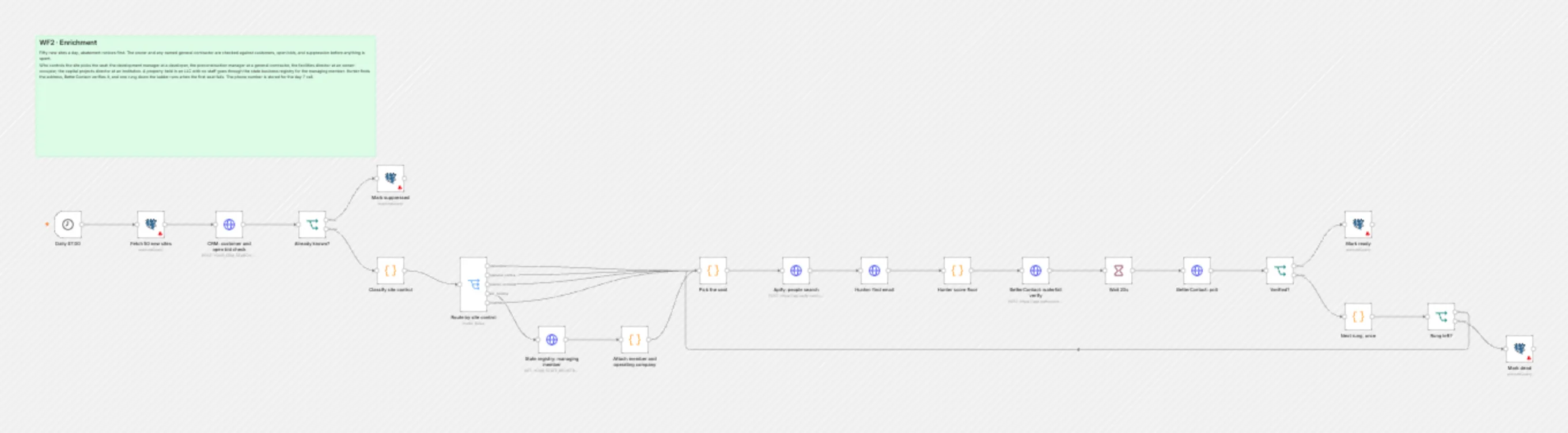
Who awards the demolition depends on who controls the site.
| Site controlled by | The seat |
|---|---|
| A developer with an approved project | The development manager, then the project manager |
| A general contractor already named | The preconstruction manager, then the chief estimator |
| An owner-occupier or a REIT | The facilities or real estate director |
| A property held in an LLC with no staff | The managing member named in the state filing |
| A hospital, university, or school district | The capital projects or facilities planning director |
Hunter looks up the address from the name and domain, BetterContact confirms it, and the system tries one rung further down the list when the first seat fails.
4. Outreach
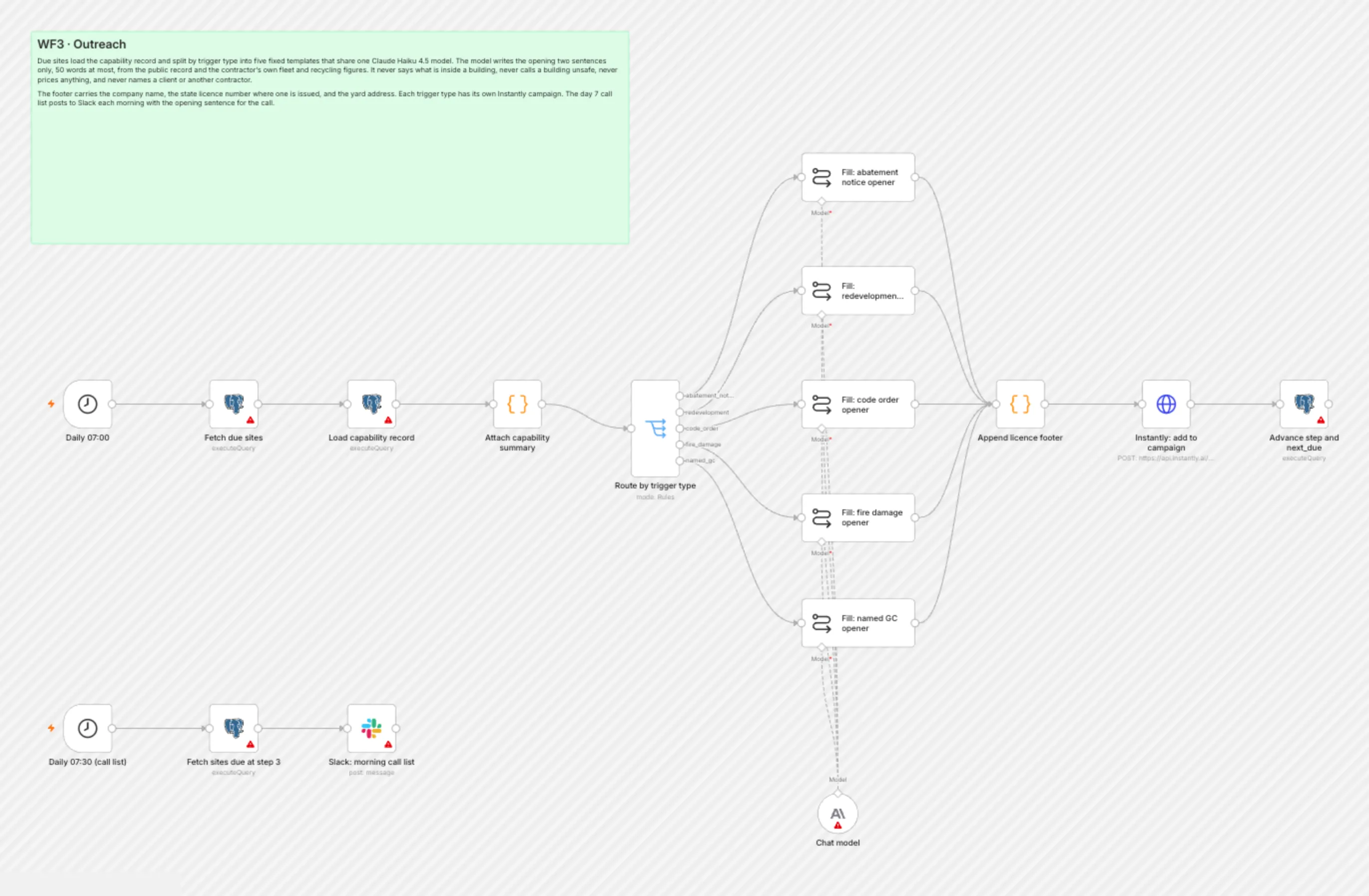
Five touches over 18 days: four emails and one call, each built from a fixed template per trigger type.
The language model writes only the opening two sentences, using the trigger record and the contractor’s own fleet and project history.
Three things the model is barred from:
- Asserting what is in the building. No statement about asbestos, lead, or any hazard the record does not state.
- Calling a building unsafe. A code order is cited by its date and type only.
- Pricing anything. Numbers come from the estimate workflow after a site walk.
Every email asks for the same thing: a 30-minute site walk and a budget number within three days.
5. Book and track
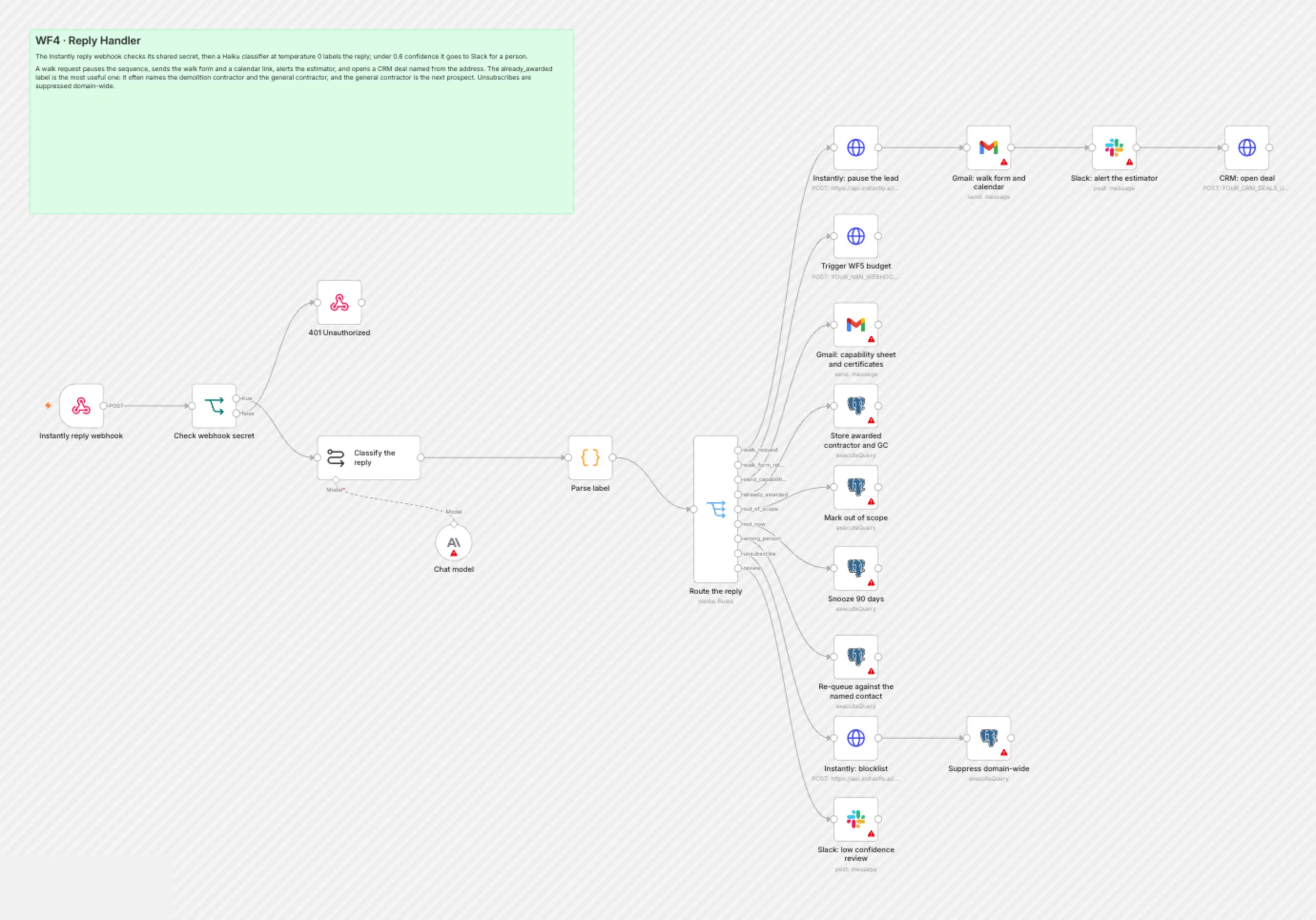
A webhook receives each reply, and a classifier sorts it into eight routes.
- A site walk request. Pauses the sequence, sends the walk form and a calendar link, alerts the estimator in Slack, and opens a CRM deal keyed on the parcel.
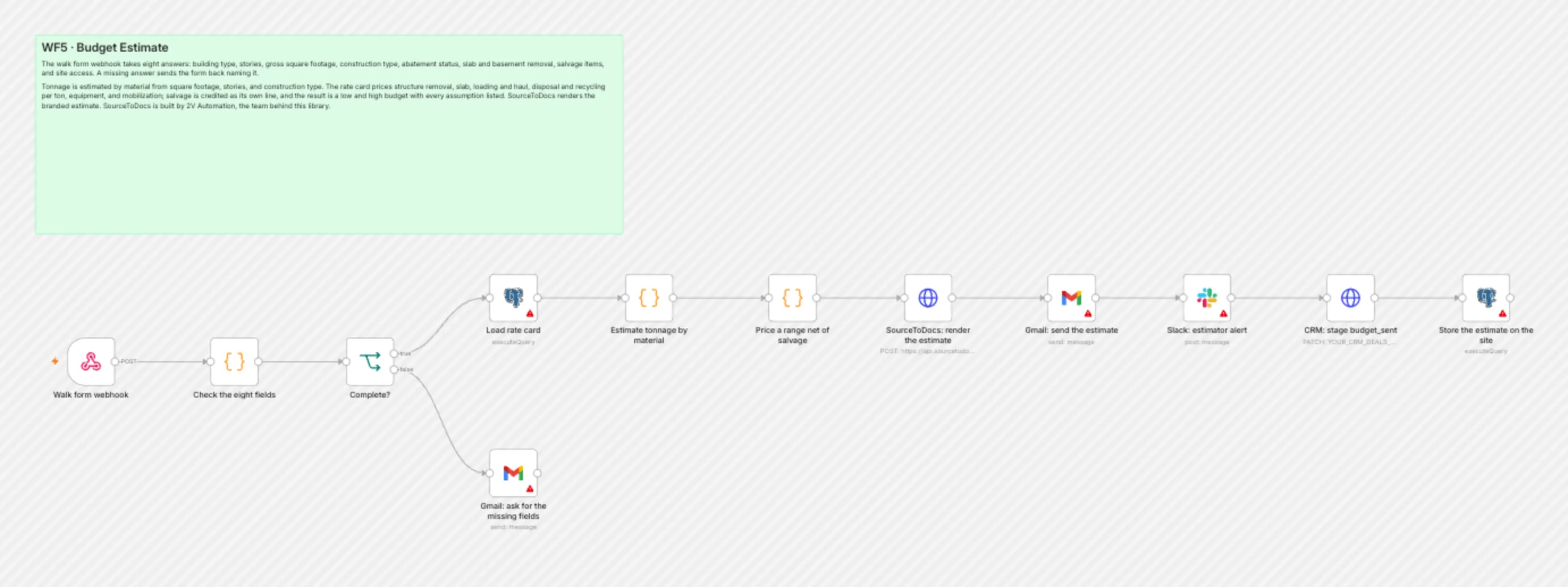
- A completed walk form. Triggers the budget estimate, a branded PDF built from square footage, structure type, stories, abatement status, salvage, and disposal tonnage.
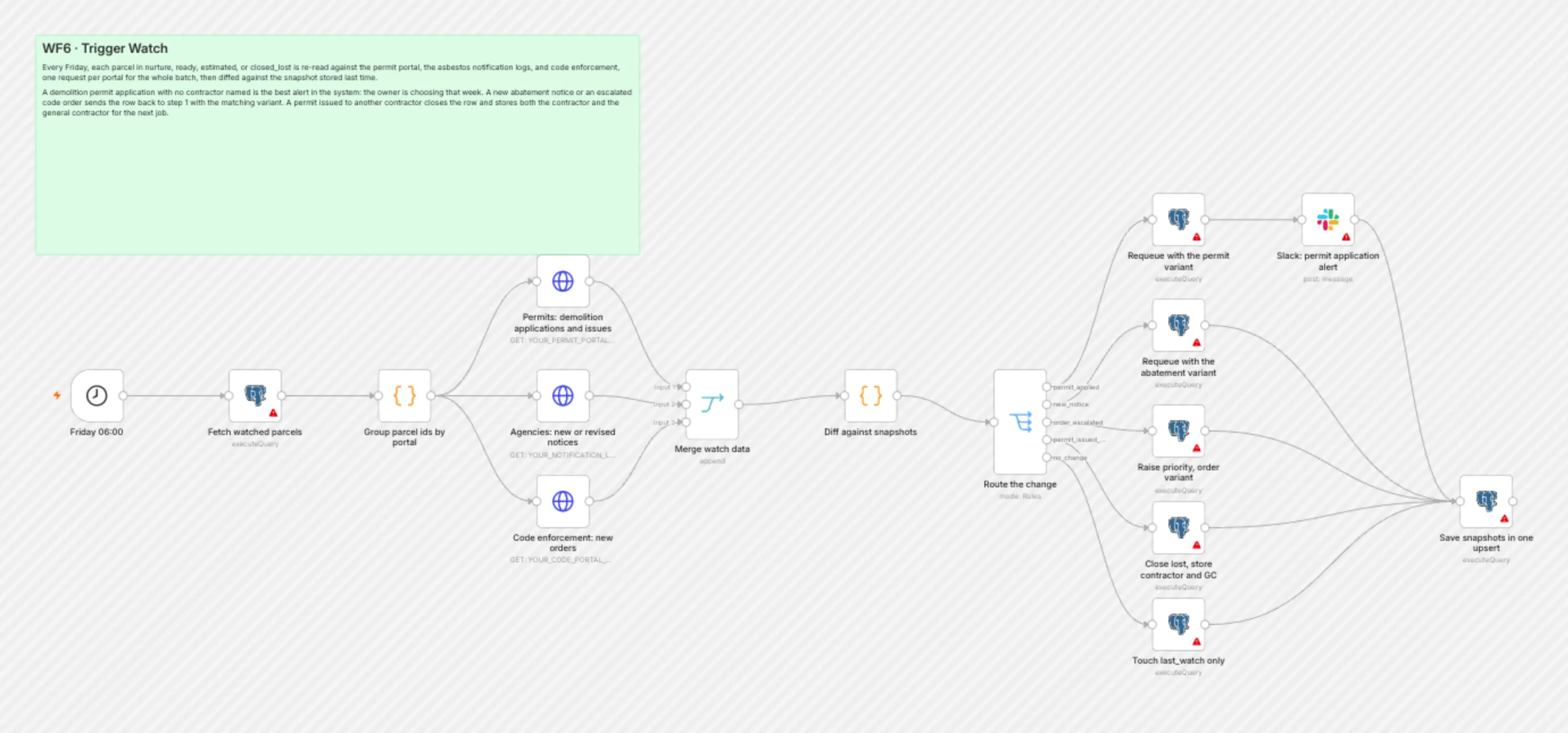
- A change at a watched parcel. Each watched parcel is re-checked, and a permit application, a new order, or an abatement completion sends the row back out with the matching variant.
Public bids never enter the email sequence. They go to the estimator as a daily Slack list with the due date and the pre-bid meeting.
Lead sources for demolition contractors
1. Asbestos abatement notifications for whole buildings
This is the source competitors overlook, and it exists because federal asbestos rules require notice to the regulator before a regulated demolition or a large renovation starts.
Under the asbestos NESHAP, the owner or operator files a notification with the state or local agency at least 10 working days ahead. Many agencies publish these logs or release them on request.
The notices worth a row:
- Scope. Whole-building removal, or removal across most floors of the structure.
- Building. Commercial, industrial, or institutional, over 2,000 square feet.
- Demolition contractor. Blank, or the same firm as the abatement contractor with no demolition licence.
- Timing. Abatement start date inside the next 90 days.
A building being fully abated is almost always a building about to be demolished or gutted, and the abatement start date sets the clock.
Highest intent of the five, because the owner has already paid to prepare the structure for removal.
Expect 50 to 90 qualifying notices a month in a metro of 1 to 3 million people, an estimate that depends heavily on the state’s publication habits.
2. Approved redevelopments on occupied land
A site plan or rezoning approval on a parcel that still has a building on it is a demolition job with an owner, an architect, and a budget already attached.
The planning portal gives the applicant, the project description, the parcel, and the approval date. The assessor record adds the existing structure’s age, use, and square footage.
Why this row is valuable:
- It is early. Approval often lands 3 to 9 months before construction starts.
- The developer is still assembling the team. The general contractor may not be chosen, which puts the demolition contractor in the conversation directly.
- Early work packages. Developers often let demolition and site clearance as a separate early contract to hold the schedule.
Expect 40 to 80 rows a month.
3. Unsafe structure and condemnation orders
Code enforcement publishes orders requiring an owner to repair or remove a dangerous building, and many cities put these lists online.
| Order type | What it usually means |
|---|---|
| Unsafe structure notice | Repair or demolish within a set period, often 30 to 90 days |
| Condemnation order | Occupancy prohibited until the structure is repaired or removed |
| Demolition order | The city will demolish at the owner’s cost if the owner does not |
Only commercial parcels and parcels owned by companies qualify. Houses owned by individuals are excluded at the filter.
High intent with a deadline. Expect 30 to 60 rows a month.
4. Commercial fire damage
A commercial fire leaves an owner, an insurer, and usually a structure that has to come down in part or in whole.
Fire department incident data and local news give the address and a description of the damage. The assessor gives the owner of record.
The first message goes to the owner, never to a tenant, and it offers a site walk for the insurance scope. Timing matters: the owner hears from restoration firms within days, and demolition is usually decided within the first month.
Expect 20 to 40 rows a month.
5. Public demolition bids
Cities, counties, and land banks let blight demolition in batches, and those solicitations are public.
These rows skip outreach entirely. Procurement rules usually bar contact with the buying agency while a solicitation is open, so the system lists each bid for the estimator with the due date, the pre-bid meeting, and the bonding requirement.
Expect 10 to 30 solicitations a month, often covering several structures each.
The remaining prospect volume, 210 to 330 rows a month, comes from permit and planning records that name a general contractor for a project with existing structures on site.
ICP definition
Filter logic the workflow applies.
What starts a row
| Filter | Rule |
|---|---|
| Abatement notice | Whole-building or most-floors removal, commercial or institutional use, abatement start inside 90 days |
| Redevelopment approval | Site plan or rezoning approved inside 60 days on a parcel with a structure over 2,000 square feet |
| Code order | Unsafe structure, condemnation, or demolition order inside 45 days on a parcel owned by a company or public body |
| Fire damage | Commercial structure fire inside 30 days with reported structural damage |
| Named general contractor | A building permit or bid award inside 60 days naming a general contractor, on a parcel with an existing structure |
| Public bid | A demolition solicitation from a public body inside the radius, due in 7 days or more |
What keeps a row
| Filter | Rule |
|---|---|
| Radius | Inside the yard’s working radius, default 60 miles |
| Owner type | Owner of record is a company, trust, or public body; individual owners are dropped |
| Size | 2,000 square feet or more of structure, or any industrial use |
| Stage | No demolition permit issued for the parcel |
| Exclusions | Owner and general contractor absent from the customer, open-bid, and suppression tables on a 270-day window |
| Duplicate guard | One live row per parcel on a 180-day window |
| Volume cap | 15 rows per general contractor per quarter, so a busy builder hears from the contractor about its best-fit jobs only |
Outreach sequence
The five steps
| Step | Day | Channel | Goal |
|---|---|---|---|
| 1 | 0 | Opener citing the abatement notice, the approval, the order, or the fire; offer a 30-minute site walk | |
| 2 | 3 | Send the capability sheet: fleet, recycling rate, disposal partners, insurance limits, and safety rate | |
| 3 | 7 | Phone | Call the development or preconstruction desk with a one-line reason and the offer of a budget number |
| 4 | 12 | Send a price-per-square-foot range for that building type, clearly labeled as a budget before any walk | |
| 5 | 18 | Breakup offering a free pre-purchase or pre-design walk for any future site |
Example step 1 (abatement notice trigger)
Subject: [Address] after abatement
Hi [First name], the asbestos notification for [address] shows removal starting on [date] across [square footage] of [building type]. Once abatement clears, the structure itself still has to come down and leave the site.
We run [N] excavators out of [yard city], [N] miles away, and recycled [N]% of material by weight on last year’s commercial jobs.
Worth a 30-minute walk so you have a demolition number before abatement finishes?
Expected reply rate
| Row type | Expected reply rate |
|---|---|
| Abatement notice rows | 4 to 7% |
| Redevelopment approval rows | 3 to 6% |
| Code order rows | 3 to 5% |
| Fire damage rows | 3 to 6% |
| Named general contractor rows | 2 to 4% |
The 3 to 6% headline is an estimate for a warmed domain writing to development managers, facilities directors, and preconstruction staff.
Timing decides more than copy here.
An abatement notice written to in the week it is filed replies well. The same owner written to after the demolition permit is issued replies at roughly half that, because by then the demolition contract has been let.
Stack and running costs
| Tool | Purpose | Monthly |
|---|---|---|
| n8n Cloud | Orchestration | $24 |
| Asbestos notification logs | Whole-building abatement notices | $0 |
| Planning, permit, code enforcement, and assessor open data | Approvals, orders, permits, owner of record | $0 |
| Apify | Fire incidents, news, bid portals, people search | $39 |
| Hunter | Decision-maker email finding | $34 |
| BetterContact | Waterfall enrichment + verification | $15 |
| Instantly | Sending + warmup | $37 |
| Claude API | Opening lines, fire item extraction, reply classification | $9 |
| SourceToDocs (Starter) | Branded budget estimate generation | $19 |
| Sending domain | Deliverability | $1 |
| Supabase (free tier) | Sites, yard profile, rate card, snapshots, suppression | $0 |
| Total | ~$179 |
SourceToDocs is built by 2V Automation, the team behind this library.
Why the records cost nothing
Every signal in this system comes from a public body that is required to keep the record, so the data line is free.
- Asbestos notifications. Filed with the state or local agency under federal rules, and published or released by many of them.
- Planning, permits, and code orders. Public by statute in every US state, and online in most large cities.
- What the paid tools buy. Finding the right person, verifying the address, sending, and producing the estimate.
Construction project data services cover some of the same projects from roughly $300 to $1,500 a month, usually after the demolition contractor has been chosen.