How it works
1. Source
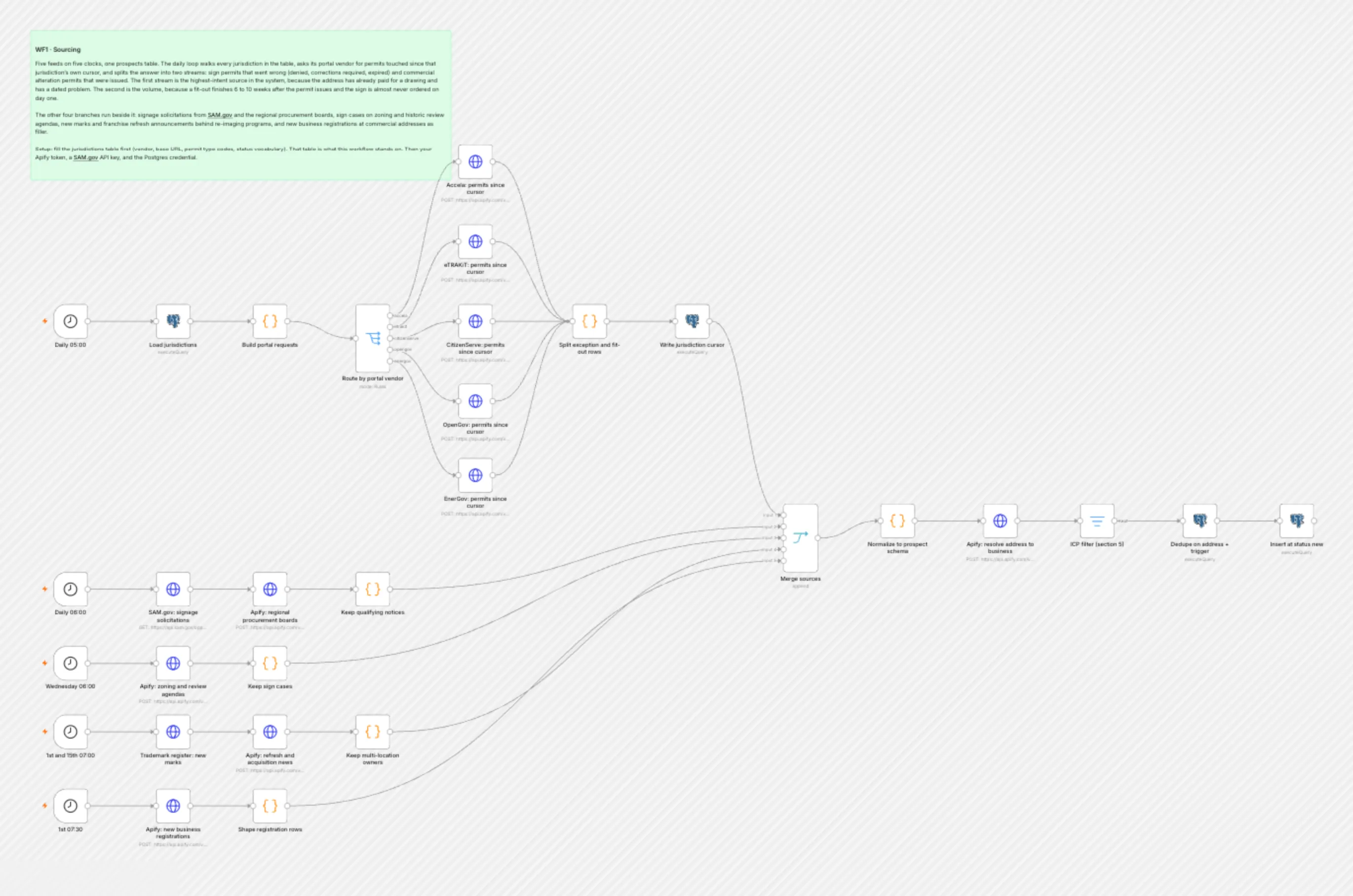
Five feeds run on separate clocks.
- Daily, the permit portals. Every jurisdiction in the service radius, pulling sign permits whose status moved to denied, corrections required, or expired, and pulling tenant improvement and commercial alteration permits that were issued.
- Daily, the bid feeds. The federal opportunities API and the watched state and local procurement boards, for solicitations naming signage.
- Weekly, the agendas. Zoning board and historic review agendas, where sign variance requests are listed by address before the hearing.
- Twice a month, the marks. The trademark register for new wordmark and design mark filings by companies with locations in the radius, plus franchise press and development announcements.
- Monthly, the registrations. New business license registrations at commercial addresses.
Every row lands in one prospects table carrying the address, the trigger type, the trigger date, the jurisdiction, and the detail the first email will quote.
2. Qualify
Filters drop residential addresses and anyone already in the CRM, plus:
- Competitor permits. Permits whose applicant is already a competing sign company with an issued permit.
- Undersized jobs. Jobs whose face area falls under the shop’s minimum.
- Out of reach. Addresses outside the install radius, and jurisdictions the shop is not licensed or bonded in.
- Closing too soon. Solicitations closing in under 10 days.
Roughly 45% of raw permit rows leave here, an estimate from three metros.
3. Enrich
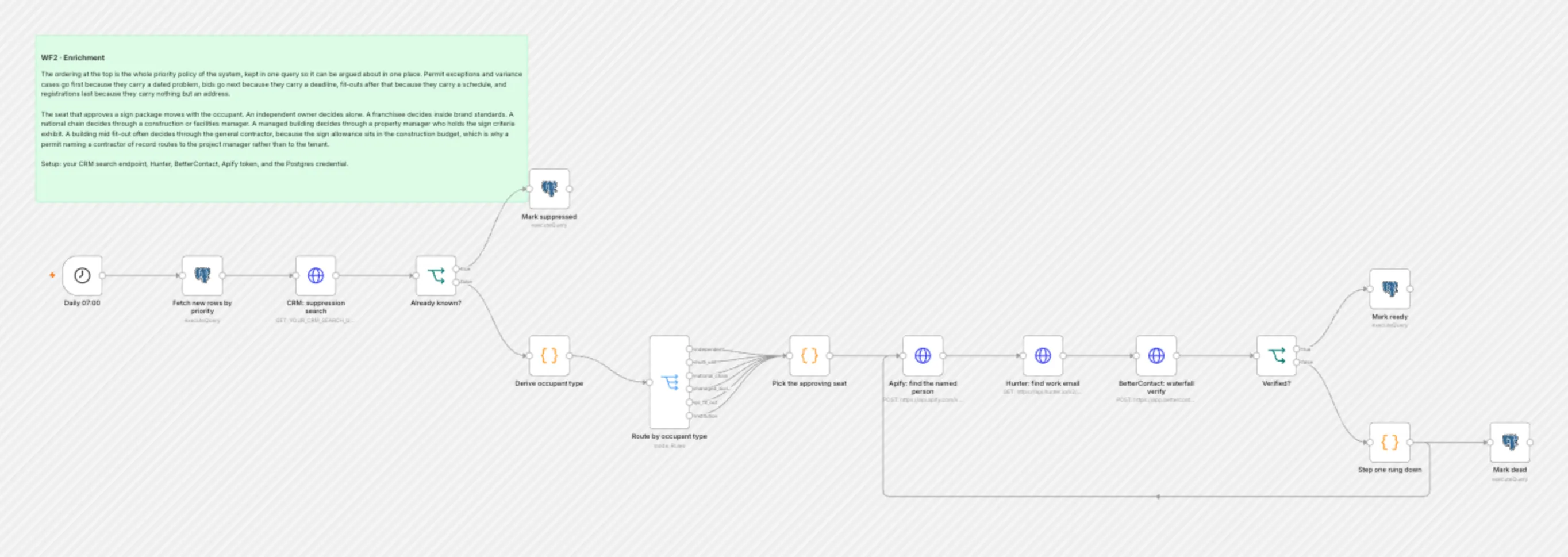
For each qualified address the system picks the seat that approves a sign package, which changes with the type of occupant.
- Independent business. The owner.
- Multi-unit operator. The franchisee or director of operations.
- National chain. The construction or facilities manager.
- Managed building. The property or asset manager.
- General contractor mid fit-out. The project manager.
- Institution. The facilities or capital projects director.
Hunter finds the work email from the name and the company domain, BetterContact verifies it through its waterfall, and one directory lookup covers the rows where the permit record named only a business.
4. Outreach
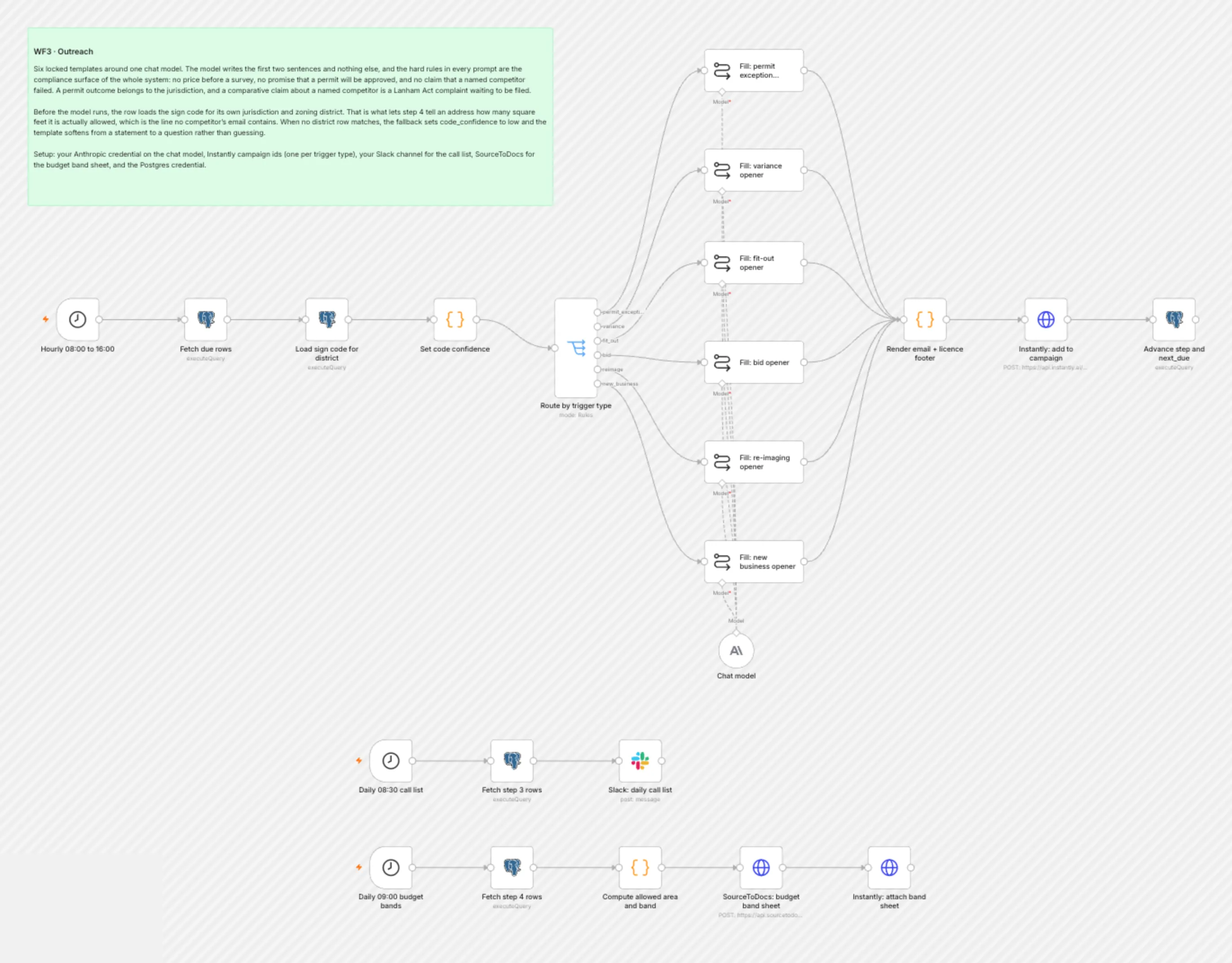
Four emails and one phone call over 18 days.
- The opening line. Cites the address and its own record: the permit status and the date it changed, the fit-out finishing next month, the solicitation number and its close date, or the mark the company just filed.
- The offer. A 20-minute site survey that ends in a written budget range.
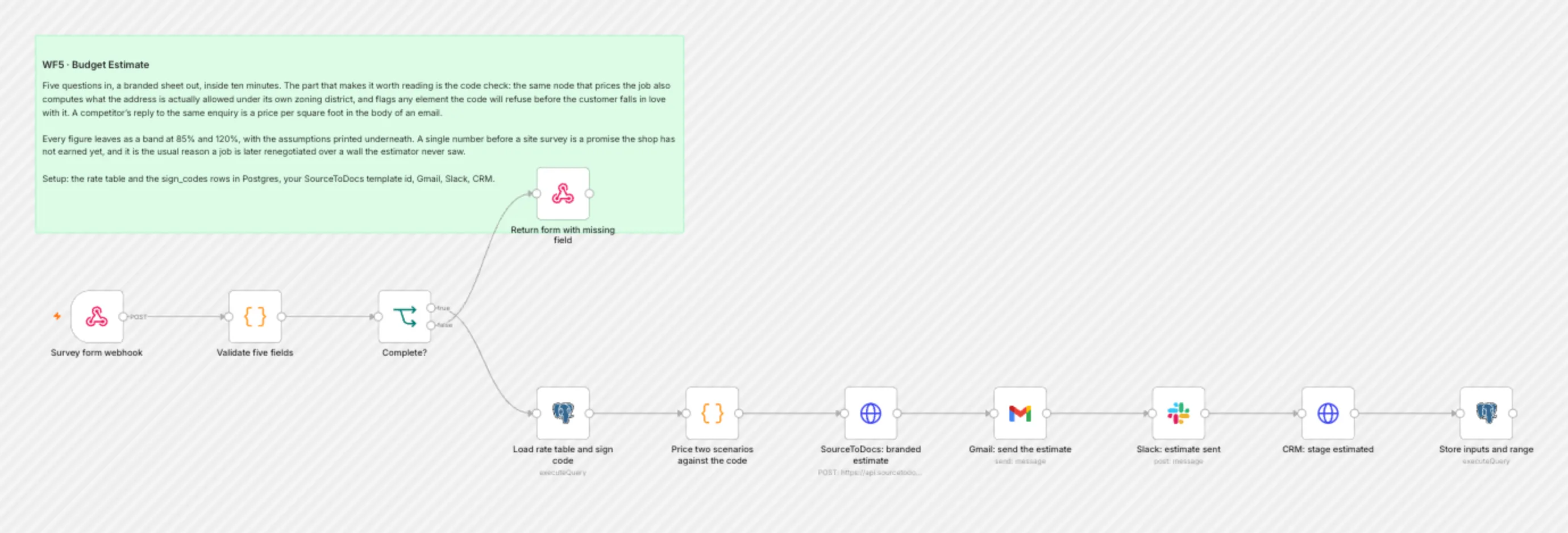
- Step 4. Sends a budget band for the sign package the address will need under its own zoning district, before anyone has agreed to anything.
5. Book and track
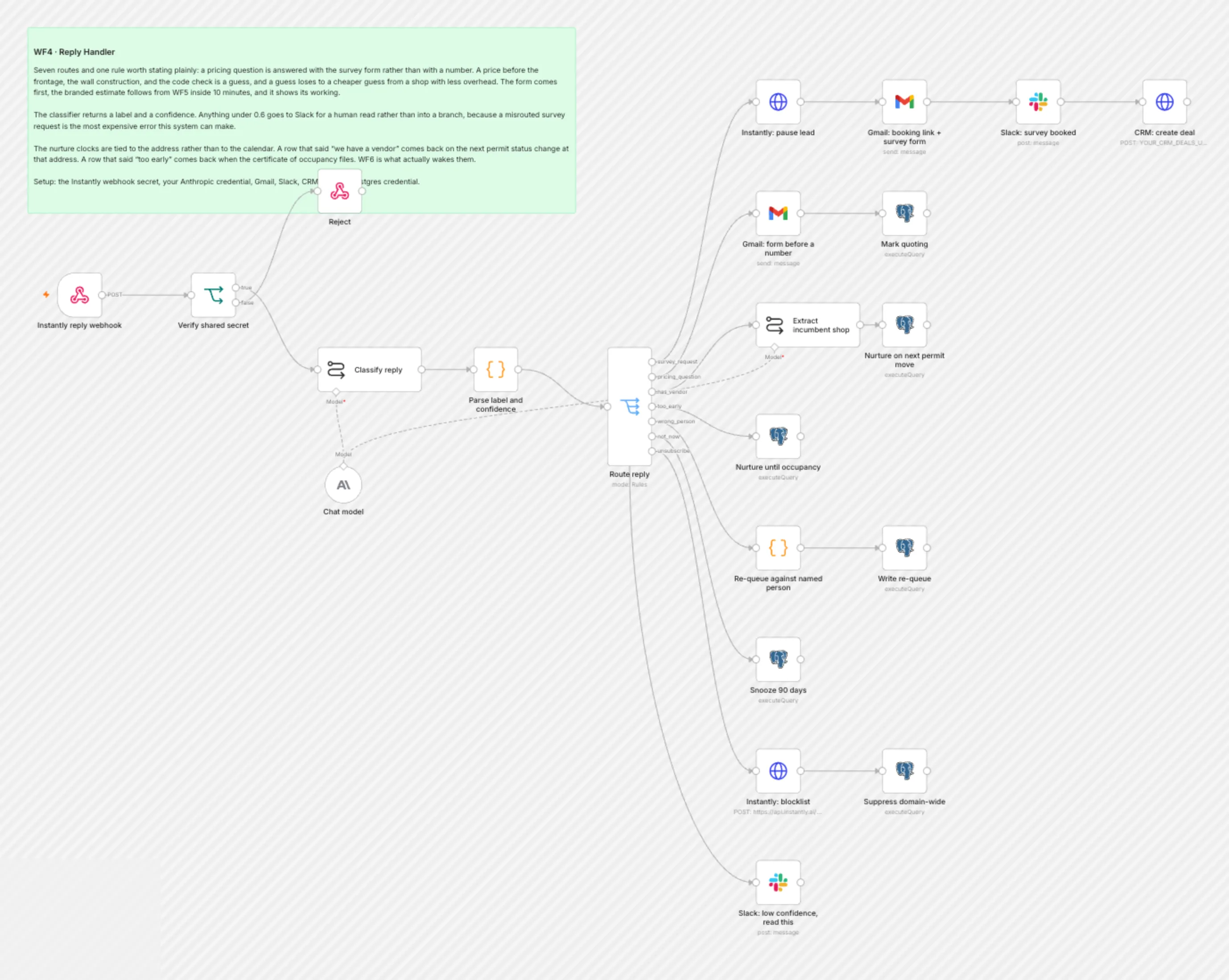
Replies are classified, survey requests route to a booking link and a five-question form, the form fires a branded budget estimate PDF inside 10 minutes, and every outcome writes back to the CRM.
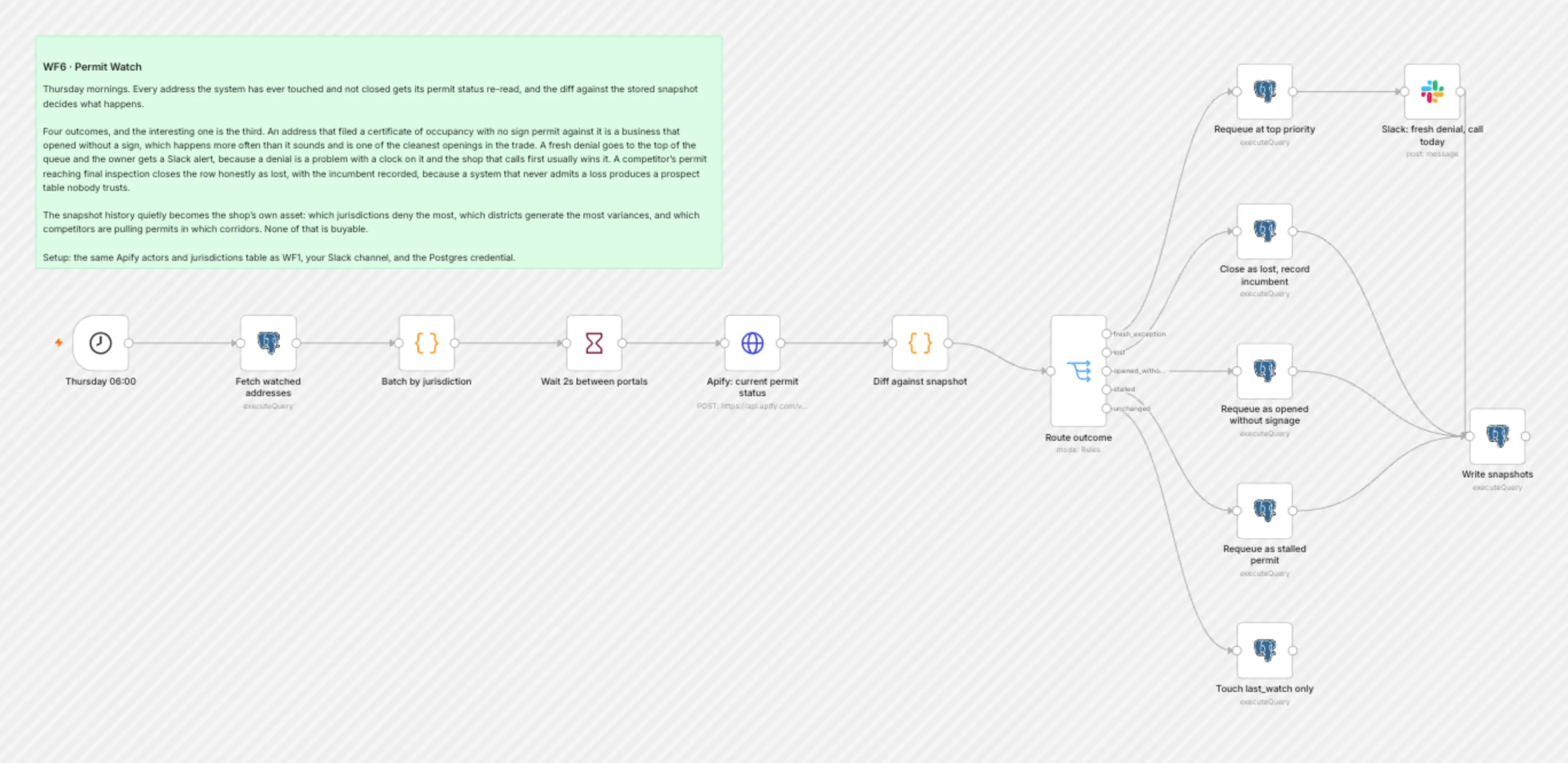
Addresses that are too early sit on a clock tied to their own permit, and the permit watch reopens them the day the status moves.
Lead sources for commercial signage companies
Ranked by signal quality:
1. Sign permit exceptions: denials, corrections, expirations, and variance agendas
This is the source no other trade can use.
A sign permit is filed per address and names the applicant, the sign type, the face area, the illumination, and the zoning district, and its status is public through the same portal that issued it.
The valuable rows are the ones that did not go smoothly.
| Record | What it means |
|---|---|
| Permit marked denied or corrections required | A drawing failed the code, usually on face area against linear frontage, overall height, setback, illumination limits, or an electronic message center restriction. The business now has a sign it cannot install and a vendor who could not get it through |
| Permit left to expire without an inspection | The job stalled or the vendor walked |
| Sign variance request on a zoning board of adjustment agenda | The address is publicly asking for an exception, and the hearing date is printed next to it |
| Sign case on a historic preservation or architectural review agenda | The same, under a design review board |
The portals: Accela Citizen Access, eTRAKiT, CitizenServe, OpenGov, and Tyler EnerGov in most US jurisdictions, each read by a scheduled Apify actor against the permit type codes for SIGN, SGN, sign face change, wall sign, monument, and EMC.
Highest intent of the five, because the address has already decided to buy a sign, has already spent money on a drawing, and has a dated problem a shop that knows the code can solve.
A metro produces 70 to 110 qualifying exception rows a month, an estimate from three metros.
2. Tenant improvement permits and certificates of occupancy
A commercial alteration or tenant improvement permit issued at a retail, office, or medical address means a fit-out is running, and signage is one of the last trades on the job.
The useful window opens when the permit is issued and closes when the certificate of occupancy is filed, which is typically 6 to 10 weeks later, and almost nobody has ordered the sign at the start of it.
- What the record carries. The address, the valuation, the occupancy class, the contractor of record, and the tenant where the application names one.
- What the system keeps. Commercial occupancy classes with a valuation above $40,000.
- Rows whose tenant is named. They go to the tenant seat.
- Rows naming only a general contractor. They go to the project manager, because on a fit-out the general contractor often carries the sign allowance.
Volume driver of the five with a dependable lead time, because the sign is a known future line item with a date attached to it.
3. Public and institutional signage solicitations
Wayfinding packages, ADA and tactile signage replacement programs, monument and campus entry signs, and facility-wide sign standards are bid publicly by cities, counties, school districts, transit agencies, universities, hospital systems, and state facilities departments.
| Feed | What it gives |
|---|---|
| SAM.gov opportunities API | Federal notices, free, filtered on the sign and wayfinding product codes and the relevant NAICS |
| State and local procurement boards | A watched list for the region, read by scheduled Apify actors |
What is kept: solicitations whose text names wayfinding, ADA or tactile signage, monument, pylon, channel letters, sign standards, or a sign replacement program, with a response date 10 or more days out.
Medium-high intent and the largest ticket after a re-imaging program, because an institutional wayfinding package runs $15,000 to $200,000 and campuses phase them over several budget years.
A region produces 40 to 70 qualifying notices a month, an estimate.
4. Rebrands, mergers, and franchise expansion behind re-imaging programs
When a company changes its name or its mark, every sign it owns becomes obsolete at once, and a multi-location operator turns into a program worth more than any single storefront.
Three public records carry it:
- Trademark applications. New wordmark and design mark applications are filed months before a rollout and name the applicant and the goods and services, read free through the register’s API.
- Franchisor announcements. Brand refreshes and image update requirements appear in trade press and in development announcements, and a refresh requirement gives every franchisee a deadline.
- Acquisitions. Announced by regional operators, they produce the same work, because the acquired locations need the acquirer’s mark.
The system keeps applicants and announcers with 3 or more locations inside the install radius and an announcement dated inside 120 days.
Medium intent with the longest fuse and the highest value per win, because a 30-location face change program runs $60,000 to $250,000 and repeats on a schedule the franchisor sets.
5. New business license registrations at commercial addresses (volume filler)
City and county business tax registrations and new entity filings at commercial addresses, refreshed monthly, with no other trigger attached.
These are the single storefront jobs that fill the shop between program work.
Lowest intent of the five, capped at one third of sends, and worth keeping because an independent owner who was not planning a sign this quarter still needs one before opening and converts on the second or third contact.
ICP definition
Filter logic the workflow applies.
What starts a row
| Filter | Rule |
|---|---|
| Permit exception source | Permit type in the sign code list; status moved to denied, corrections required, or expired inside 21 days; or a sign case listed on a zoning board of adjustment, historic preservation, or architectural review agenda with a hearing date ahead |
| Fit-out source | Commercial alteration, tenant improvement, or new commercial permit issued inside 45 days; occupancy class retail, office, medical, hospitality, or institutional; declared valuation above $40,000; no certificate of occupancy filed yet |
| Bid source | Solicitation text names wayfinding, ADA or tactile signage, monument, pylon, channel letters, sign standards, or sign replacement; response date 10 or more days out; estimated value above $8,000; the shop is registered or can register as a vendor in that system |
| Re-imaging source | New wordmark or design mark application, franchisor image update announcement, or an acquisition announcement dated inside 120 days; applicant or announcer operates 3 or more locations inside the install radius |
| License source | New business tax registration or entity filing at a commercially zoned address inside 60 days; occupancy class retail, office, medical, or hospitality |
What keeps a row
| Filter | Rule |
|---|---|
| Geography | Jurisdictions inside the install radius the crew reaches and returns from in one day, plus any jurisdiction where the shop holds a sign contractor licence or an electrical sign endorsement |
| Job floor | Face area above the shop’s minimum, or an estimated package value above $3,500, or a bid value above $8,000 |
| Permit status | Addresses whose sign permit is already issued to a competing applicant and inspected are dropped; addresses whose permit is issued but stale by more than 120 days are kept as a stalled row |
| Contact | A named owner, franchisee, facilities manager, construction manager, property manager, or project manager, resolved and verified; permit clerk, info, and general mailboxes are dropped |
| Excluded | Residential addresses, temporary and event signage requests, current and former clients (CRM match), competing sign companies, sign brokers and national program managers who resell the install, addresses inside a jurisdiction where the shop cannot pull a permit, domains on the suppression list |
Outreach sequence
The five steps
| Step | Day | Channel | Goal |
|---|---|---|---|
| 1 | 0 | Opener citing the permit status, the fit-out, the solicitation, or the mark filing; offer a 20-minute site survey | |
| 2 | 3 | Send the capability sheet: sign types fabricated in house, UL listing, engineering and stamped drawings, install fleet and crane access, permit record by jurisdiction | |
| 3 | 7 | Phone | Call the business line, reference the email, ask for the survey or the name of whoever owns the build-out |
| 4 | 12 | Send a budget band for the package that address will need, with the face area and height the zoning district actually allows | |
| 5 | 18 | Breakup offering to read the sign code for the address and send back what is permitted, at no charge |
Example step 1 (denied sign permit trigger)
Subject: [Business] sign permit at [address]
Hi [First name], the sign permit for [address] came back [status] on [date]. In [jurisdiction] that is usually face area against linear frontage, and the fix is either a redraw inside the limit or a variance with a hearing date.
We have pulled [N] permits in [jurisdiction] and can tell you inside a day which of the two is faster for your frontage. Twenty minutes on site gets you a drawing that passes and a budget.
Worth a survey this week?
Expected reply rates
| Row type | Expected reply rate |
|---|---|
| Permit exception and bid rows | 3 to 6% |
| Fit-out and re-imaging rows | 2 to 4% |
| Business license rows sent between triggers | 1 to 2% |
The 3 to 6% is an estimate for a warmed domain writing to owners, facilities managers, and construction managers.
Timing moves the number more than the copy does.
- A permit exception row contacted inside 10 days of the status change. It replies at the top of the range.
- A fit-out row contacted in the first half of its window. It beats the same address contacted a week before the certificate of occupancy, because by then the general contractor has already placed the sign order.
Stack and running costs
The monthly line
| Tool | Purpose | Monthly |
|---|---|---|
| n8n Cloud | Orchestration | $24 |
| Apify | Permit portals, procurement boards, zoning and review agendas, trade press, registrations, directory lookups | $47 |
| SAM.gov + trademark register APIs | Federal signage solicitations and new mark filings | $0 |
| Hunter | Decision-maker email finding | $34 |
| BetterContact | Waterfall enrichment + verification | $15 |
| Instantly | Sending + warmup | $37 |
| Claude API | First-line generation + reply classification | $8 |
| SourceToDocs (Starter) | Branded budget estimate and proposal PDF generation | $19 |
| Sending domain | Deliverability | $1 |
| Supabase (free tier) | Prospects, jurisdiction and sign code rows, rate table, permit snapshots, suppression | $0 |
| Total | ~$185 |
What the table assumes
SourceToDocs is built by 2V Automation, the team behind this library.
The SAM.gov opportunities API and the trademark register API are free and ask only for a registered API key and a User-Agent header naming the company.
Apify carries the heaviest load in this system, because permit portals have no shared standard and each vendor needs its own actor. That is also why the jurisdiction table in section 10 is the file that decides whether the build takes a day or a week.
Paid construction data services such as Dodge and ConstructConnect cover the fit-out source from roughly $400/month and are left out, because the permit portals carry the same records for the cost of the scrape and they carry the sign permits the paid services do not.