How it works
1. Source
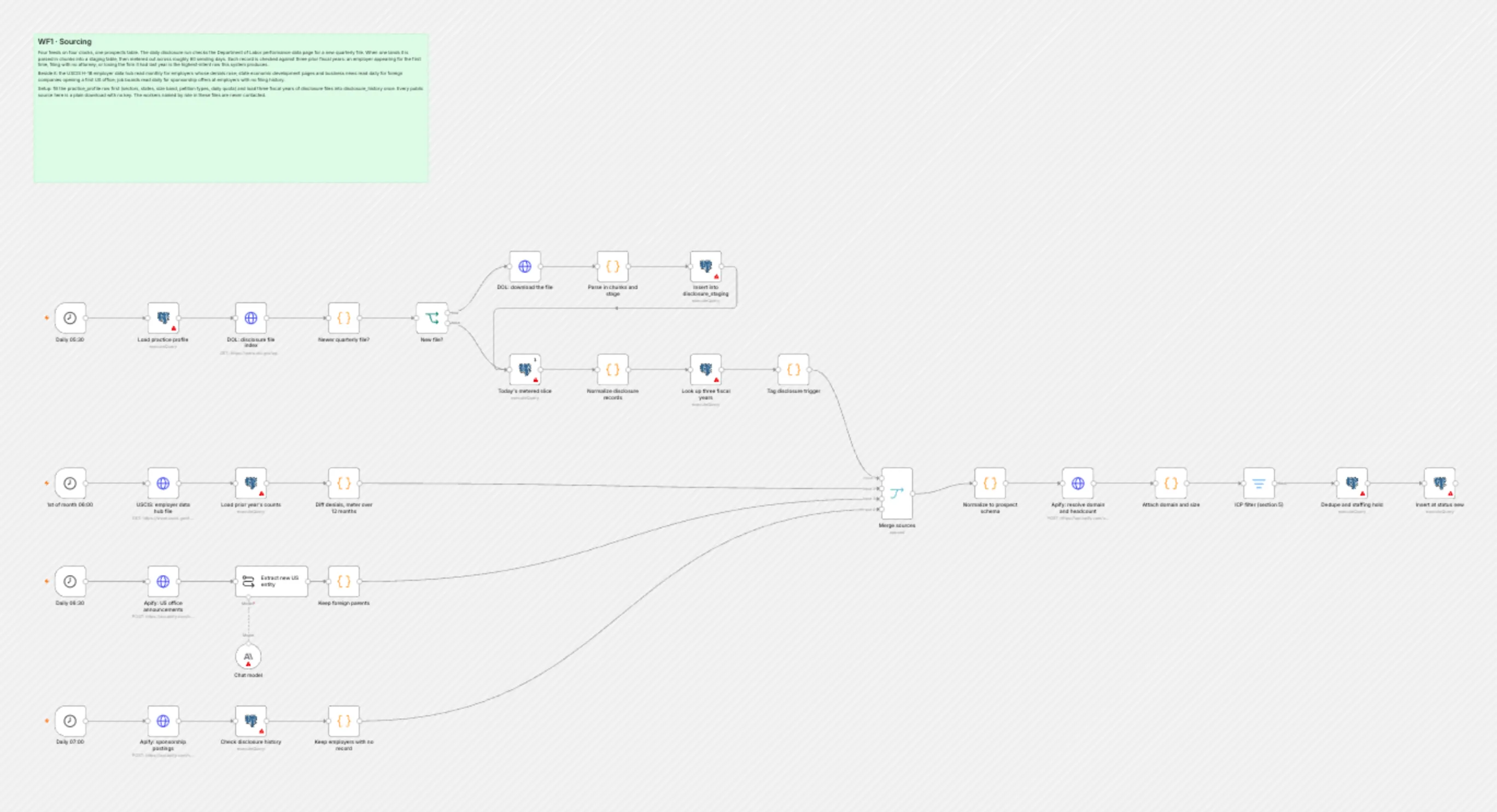
Five feeds run on separate clocks and land in one prospects table.
| Feed | What it gives | Pulled |
|---|---|---|
| Department of Labor disclosure files | Every Labor Condition Application and PERM case, with employer, role, worksite, wage level, and attorney of record | Quarterly, metered out daily |
| USCIS H-1B employer data hub | Initial and continuing approvals and denials by employer and fiscal year | As each fiscal year publishes |
| Economic development and business news | Foreign companies announcing a first US office, subsidiary, or plant | Daily |
| Job boards | Postings that offer visa sponsorship or H-1B transfer | Daily |
| The watch list | Every employer already in the table, re-read against the newest files | Quarterly |
Every row carries the employer, its domain, the trigger type, the trigger date, the job titles and worksites involved, and the detail the first email will quote.
2. Qualify
The filter runs before any credit is spent. A row survives only when all of these hold.
- Size. The employer has 10 to 2,000 employees.
- Industry. Its industry code sits inside the firm’s chosen sectors.
- Geography. The worksite state is on the firm’s list, which can be every state.
- Company. Absent from the client, former client, open-matter, and suppression tables.
- Standing. No willful violator flag on the disclosure record.
- Representation. The row is a first filing, a self-filed record, or a new entrant, never an employer with the same firm of record on every case.
Rows that fail on size alone are held in a second table, because a 7-person startup that raises a round next year becomes a sponsor worth writing to.
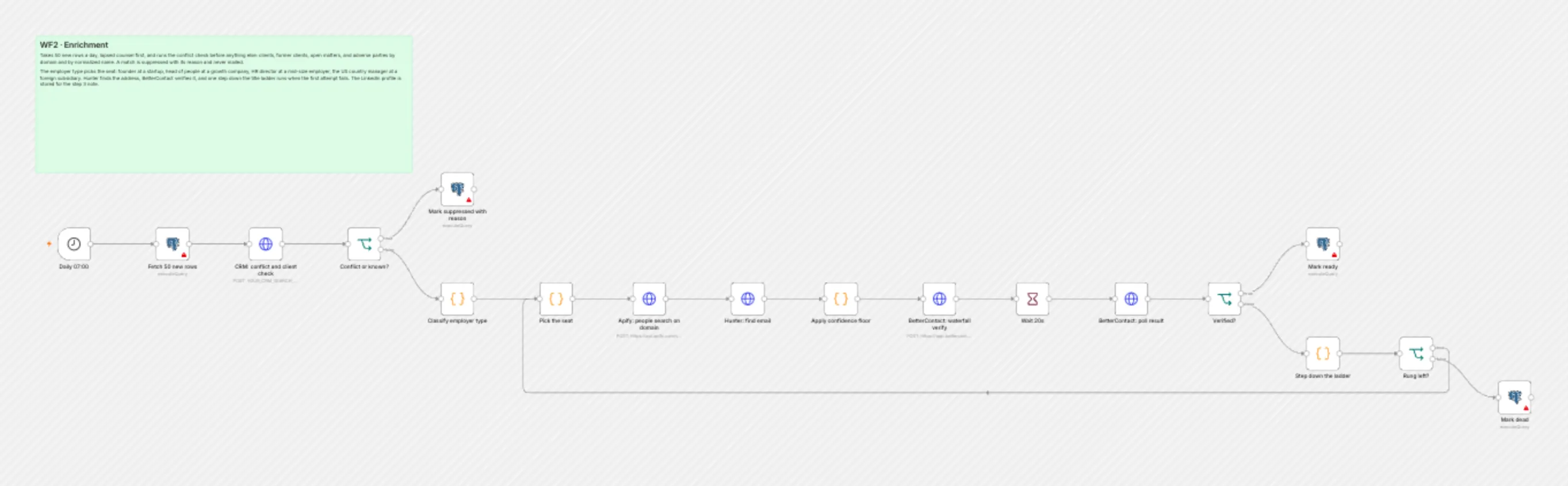
3. Enrich
The company’s stage decides which seat to look for.
| Employer type | The seat |
|---|---|
| Startup under 50 staff | The founder or CEO, then the operations lead |
| Growth company, 50 to 500 staff | The head of people, then the talent acquisition lead |
| Mid-size employer, 500 to 2,000 staff | The HR director, then the global mobility or HR operations manager |
| US subsidiary of a foreign parent | The US country manager, then the HR lead, then the parent’s group HR contact |
| Hospital, clinic, or school group | The HR director, then the recruitment manager |
Hunter finds the address from the name and domain, BetterContact verifies it, and one step down the title ladder runs when the first attempt fails.
4. Outreach
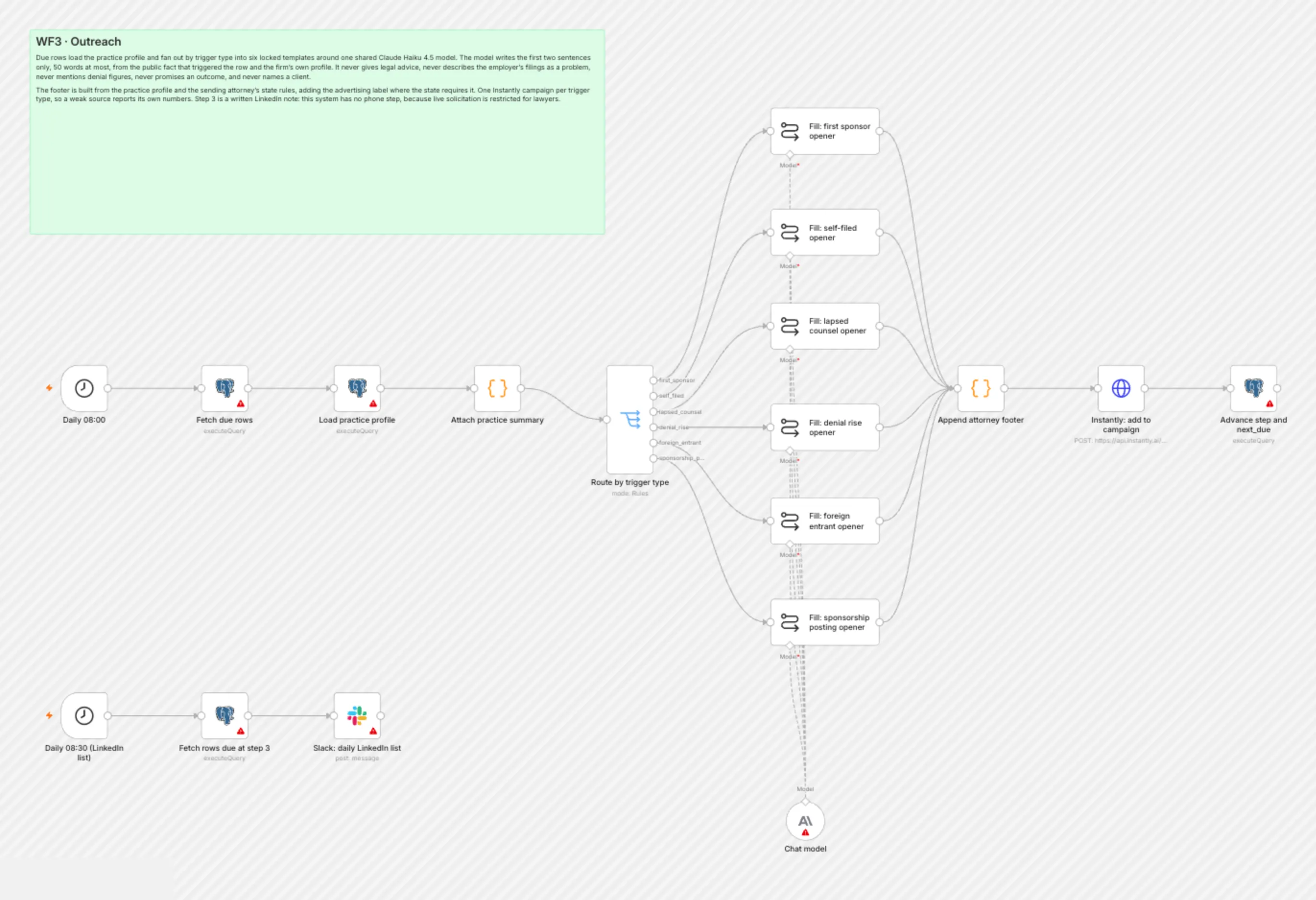
Five steps over 20 days, four by email and one written LinkedIn note, each from a locked template for the trigger type.
The model fills the first two sentences only, from the trigger record and the firm’s own practice profile.
What the model may never do:
- Give legal advice. No statement about what the employer must, should, or is required to do in its own case.
- Characterize the employer’s filings. Denial counts and missing attorneys are read for timing and never quoted back.
- Promise an outcome. No approval rates, no guarantees, no named clients.
The offer is always the same: a 20-minute employer consultation, with a conflict check run before it is booked.
5. Book and track
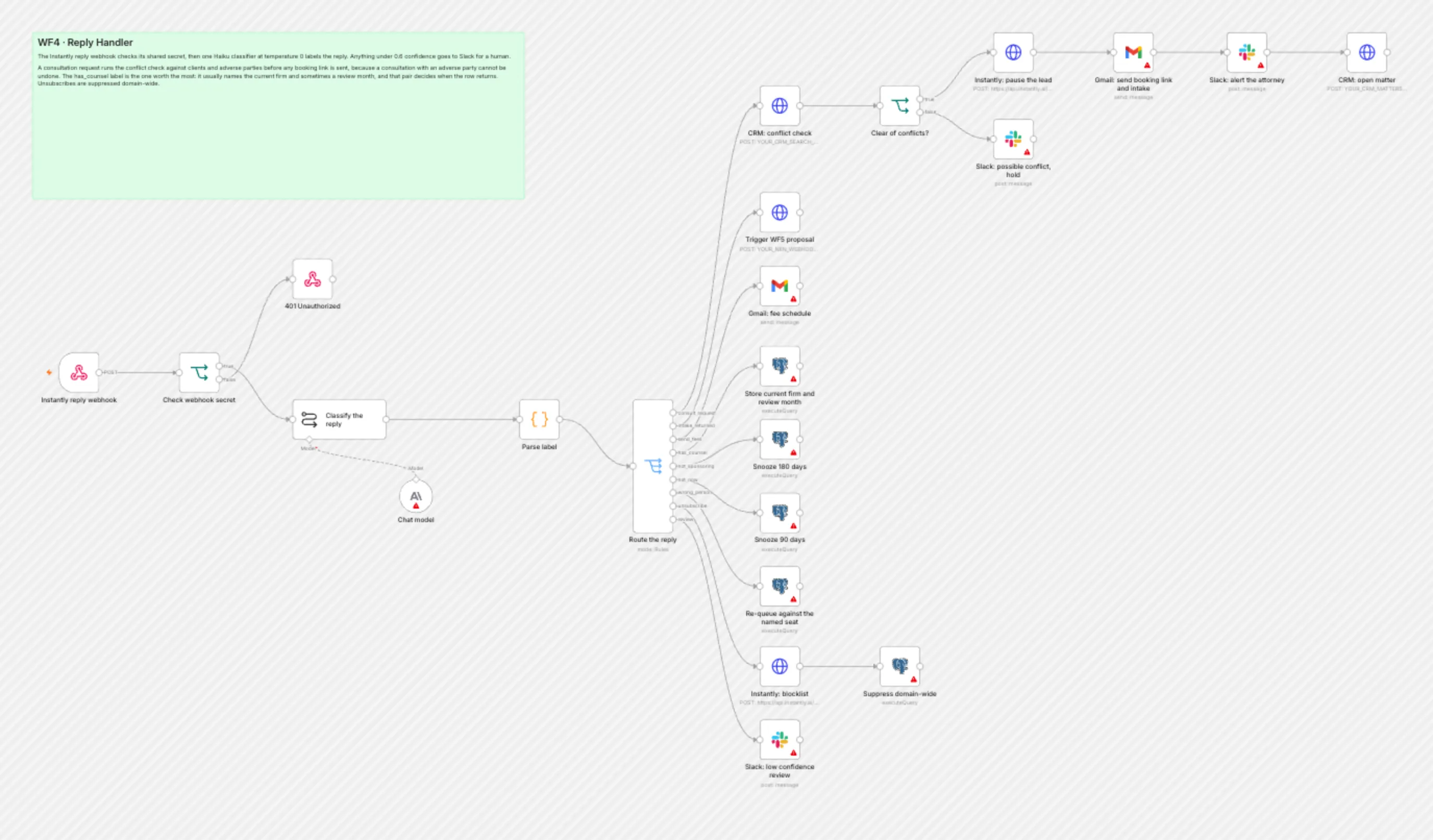
Replies arrive on a webhook and are classified into eight routes.
- A consultation request. Runs the conflict check, then pauses the sequence, sends the booking link and the intake form, alerts the attorney in Slack, and creates a CRM matter keyed on the employer.
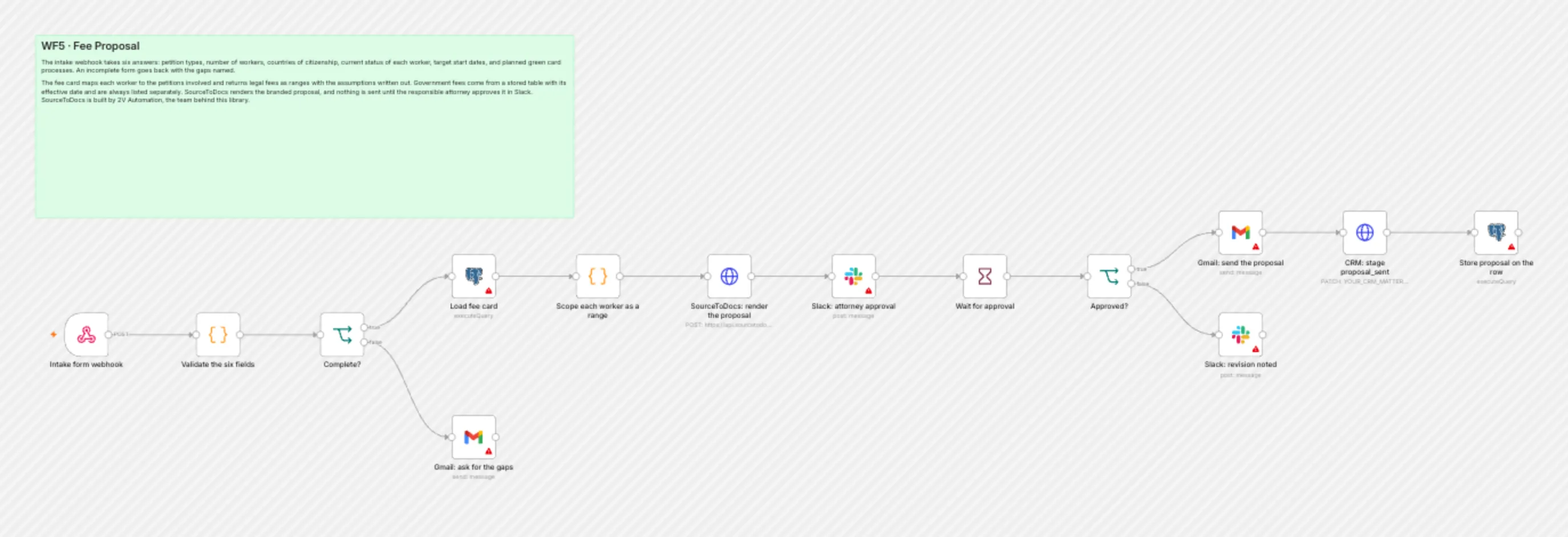
- A completed intake form. Triggers the fee proposal, a branded PDF built from the petition types, headcount, and timeline, held for attorney approval before it is sent.
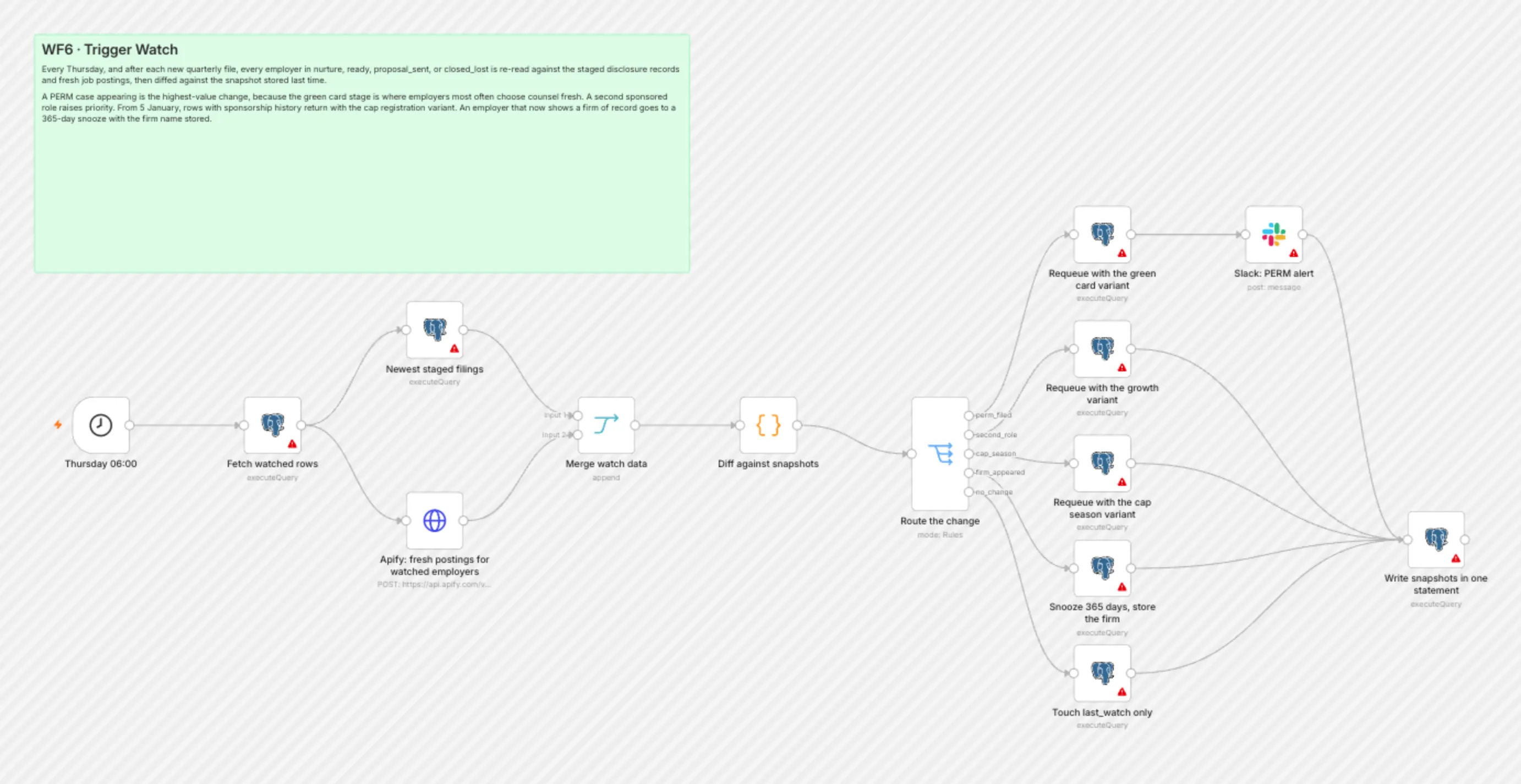
- A change at a watched employer. Every watched employer is re-read against the newest quarterly file, and a change puts the row back in the queue with the variant that fits it.
Lead sources for business immigration law firms
1. First-time sponsors in the Labor Condition Application files
This is the trigger the market misses, and it exists because an employer cannot file an H-1B petition until the Department of Labor certifies a Labor Condition Application for the role.
The Office of Foreign Labor Certification publishes every application in quarterly disclosure files. Each record names the employer, the address, the job title, the occupation code, the worksite, the offered wage, the prevailing wage level, and the attorney or agent of record where one exists.
The qualifying slice is narrow:
- First appearance. The employer’s identifier is absent from every disclosure file in the prior three fiscal years.
- Size. The employer passes the size filter once its domain resolves.
- Status. The application was certified inside the last 120 days.
- Fit. The occupation code and worksite state sit inside the firm’s chosen sectors and states.
A first-time sponsor has one foreign hire in motion, a petition deadline, and no settled relationship with counsel.
Highest intent of the five sources, because the need is dated, named, and filed by the buyer itself.
Nationally, first-time sponsors run to a few thousand employers a quarter. After the firm’s sector and state filters, expect 150 to 250 qualifying rows a month, an estimate.
2. Employers filing without an attorney
The same disclosure files show whether an agent or attorney represented the employer, and a large share of applications list none.
What a self-filed record usually means:
- A small HR team doing it by hand. Common at companies with one to five sponsored workers.
- A former firm that was let go. Visible when the prior year’s records named counsel and this year’s do not.
- A company that has not reached the green card stage yet. PERM labor certification is where self-filers most often bring in counsel.
Second highest intent, and the source with the longest client life, because a self-filer that retains a firm usually moves its entire program across.
Expect 80 to 140 rows a month after filters.
3. Rising denials in the USCIS employer data hub
USCIS publishes H-1B petition outcomes by employer and fiscal year: initial approvals, initial denials, continuing approvals, and continuing denials, with the employer’s city, state, and industry code.
An employer whose denials rose year on year is having a harder time with its filings, and it often knows that before its current counsel says so.
This source is read for timing only. No message ever mentions the employer’s denial figures, which is both a professional conduct rule and the difference between a reply and a complaint.
Medium to high intent. The data publishes once a fiscal year, so the rows are metered out across the year at 40 to 80 a month.
4. Foreign companies opening a first US office
A foreign company opening its first US entity has to move people before it has a US track record, and that is a specialist’s problem.
Where the announcements appear:
| Source | What it names |
|---|---|
| State economic development agency announcements | Company, parent country, city, jobs committed, investment amount |
| Business news and press wires | New subsidiary, first US office, plant or facility opening |
| State business registries | A newly registered entity with a foreign parent address |
The first managers usually arrive on an L-1A new office petition or, for treaty countries, an E-2 or E-1 visa, and both need counsel who has done them before.
Medium intent with a long client life. Expect 40 to 80 rows a month.
5. Sponsorship offers at employers with no filing history
A job posting that says “visa sponsorship available” or “H-1B transfer considered” at a company with no disclosure record is a first sponsorship about to happen.
An Apify job-board actor pulls postings by sponsorship phrase across the firm’s states, and each record gives the company, the title, the location, the posting date, and the exact sponsorship wording.
This is the highest-volume source and the lowest intent of the five, because a posting that offers sponsorship does not always end in a sponsored hire.
Expect 140 to 200 rows a month.
ICP definition
Filter logic the workflow applies.
What starts a row
| Filter | Rule |
|---|---|
| First-time sponsor | Employer identifier absent from all disclosure files in the prior 3 fiscal years, with a certified application inside 120 days |
| Self-filed record | No agent or attorney represented the employer on any application in the current fiscal year |
| Lapsed counsel | A firm of record in the prior fiscal year and no firm of record in the current one |
| Denial rise | Initial plus continuing denials up by 2 or more year on year, with at least 3 petitions decided in the current year |
| Foreign entrant | A first US office, subsidiary, or plant announced inside 60 days, with a parent company outside the US |
| Sponsorship posting | A posting inside 30 days that offers visa sponsorship or H-1B transfer, at an employer with no disclosure record |
What keeps a row
| Filter | Rule |
|---|---|
| Company size | 10 to 2,000 employees, from the enrichment record or the resolved domain |
| Sector | Industry code inside the firm’s chosen sectors, which default to technology, engineering, life sciences, healthcare, finance, and manufacturing |
| Geography | Worksite state on the firm’s list, which defaults to all states |
| Exclusions | Domain absent from the client, former client, open-matter, and suppression tables on a 365-day window |
| Standing | No willful violator flag and no debarment listing for the employer |
| Staffing guard | Employers flagged H-1B dependent with more than 50 applications a year are held for manual review |
| Duplicate guard | One live row per employer on a 180-day window, however many triggers fire |
Outreach sequence
The five steps
| Step | Day | Channel | Goal |
|---|---|---|---|
| 1 | 0 | Opener citing the filing, the new office, or the sponsorship posting; offer a 20-minute employer consultation | |
| 2 | 4 | Send the one-page sponsorship calendar: what the next twelve months of filings involve and when each one is due | |
| 3 | 8 | A written connection note to the same person, naming the trigger in one line | |
| 4 | 13 | Send the flat-fee shape: the petition types, the fee per petition, and what the first engagement covers | |
| 5 | 20 | Breakup offering a free annual calendar reminder for the cap registration window |
Example step 1 (first-time sponsor trigger)
Subject: [Company]‘s first H-1B filing
Hi [First name], [Company] had its first Labor Condition Application certified this quarter, for a [job title] in [worksite city]. The first sponsorship is where the record habits get set, from the public access file to the wage documentation.
We run employer programs for [N] companies from [office city], on flat fees per petition with a named attorney on every case.
Worth 20 minutes on what the next twelve months of filings usually involve?
Expected reply rate
| Row type | Expected reply rate |
|---|---|
| First-time sponsor rows | 3 to 5% |
| Self-filed and lapsed counsel rows | 3 to 6% |
| Denial rise rows | 2 to 4% |
| Foreign entrant rows | 3 to 5% |
| Sponsorship posting rows | 1 to 3% |
The 2 to 5% headline is an estimate for a warmed domain writing to founders, heads of people, and HR directors.
Timing decides more than copy here.
A first-time sponsor written to inside 6 weeks of certification replies well. The same employer written to after its petition is approved replies at roughly half that, because by then somebody has already done the work.
Stack and running costs
| Tool | Purpose | Monthly |
|---|---|---|
| n8n Cloud | Orchestration | $24 |
| Department of Labor disclosure files | Labor Condition Application and PERM records | $0 |
| USCIS H-1B employer data hub | Approvals and denials by employer | $0 |
| Apify | Job boards, announcement pages, domain resolve, people search | $39 |
| Hunter | Decision-maker email finding | $34 |
| BetterContact | Waterfall enrichment + verification | $15 |
| Instantly | Sending + warmup | $37 |
| Claude API | First-line generation, announcement extraction, reply classification | $12 |
| SourceToDocs (Starter) | Branded fee proposal generation | $19 |
| Sending domain | Deliverability | $1 |
| Supabase (free tier) | Prospects, staged filings, practice profile, fee card, snapshots, suppression | $0 |
| Total | ~$181 |
SourceToDocs is built by 2V Automation, the team behind this library.
Why the two data lines are free
The records that carry the timing in this market are published by the government, because the programs themselves require it.
- The disclosure files. The Department of Labor publishes Labor Condition Application and PERM records every quarter as downloadable files, with no account needed.
- The employer data hub. USCIS publishes H-1B petition outcomes by employer as open data.
- What the paid lines buy. Enrichment, verification, sending, and the proposal document, which is where the work actually is.
Visa data resellers package the same public files with a search screen from roughly $100 to $500 a month.