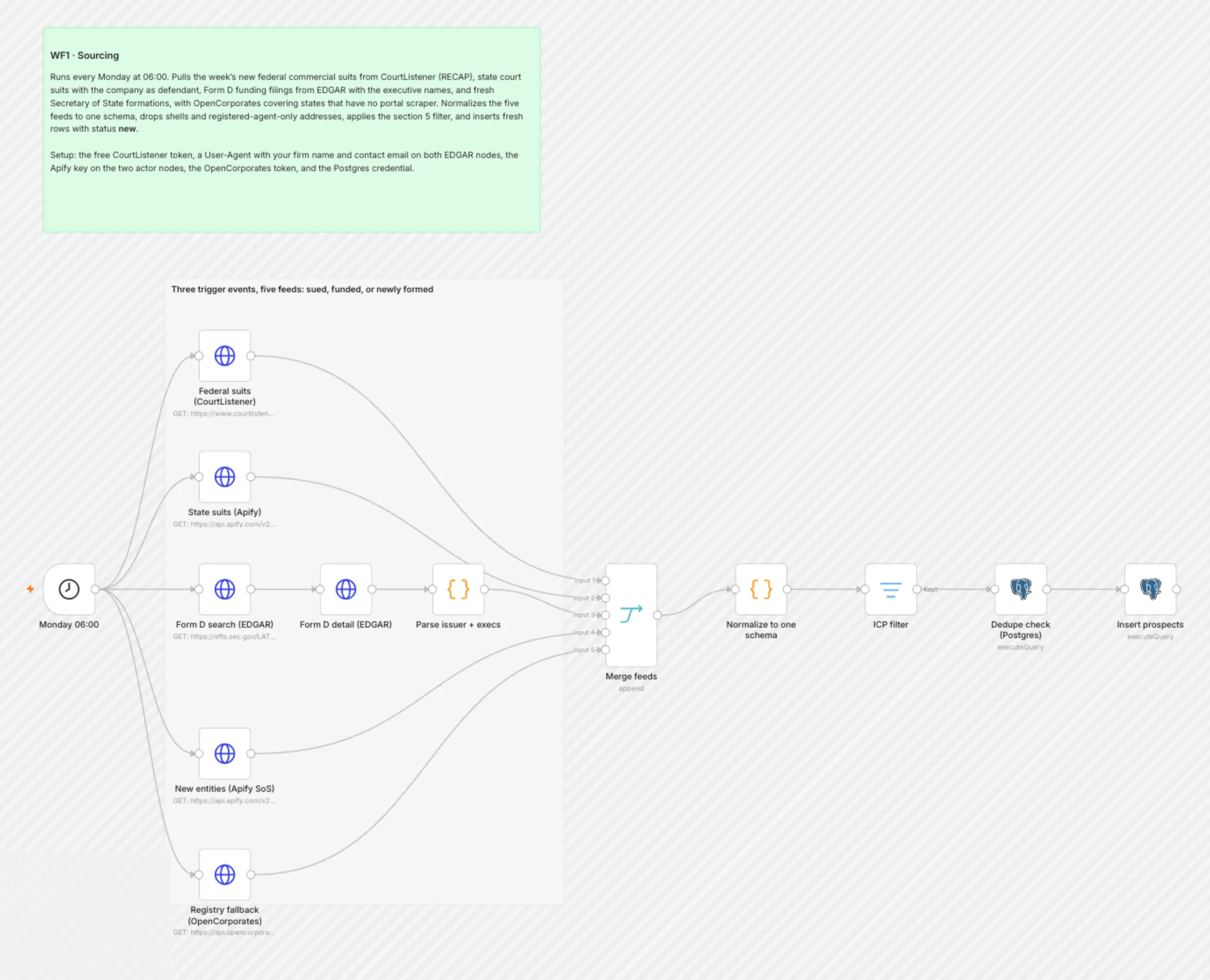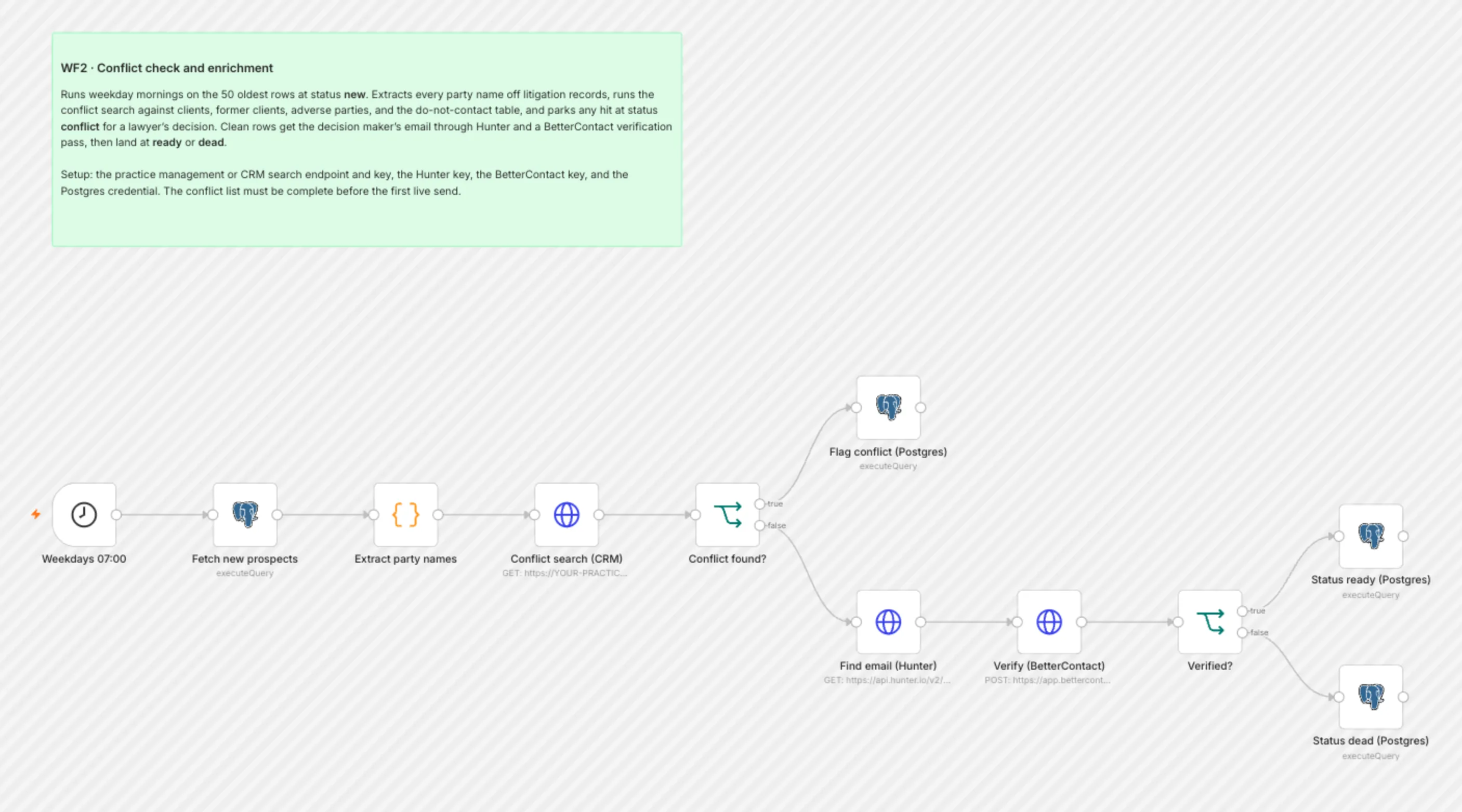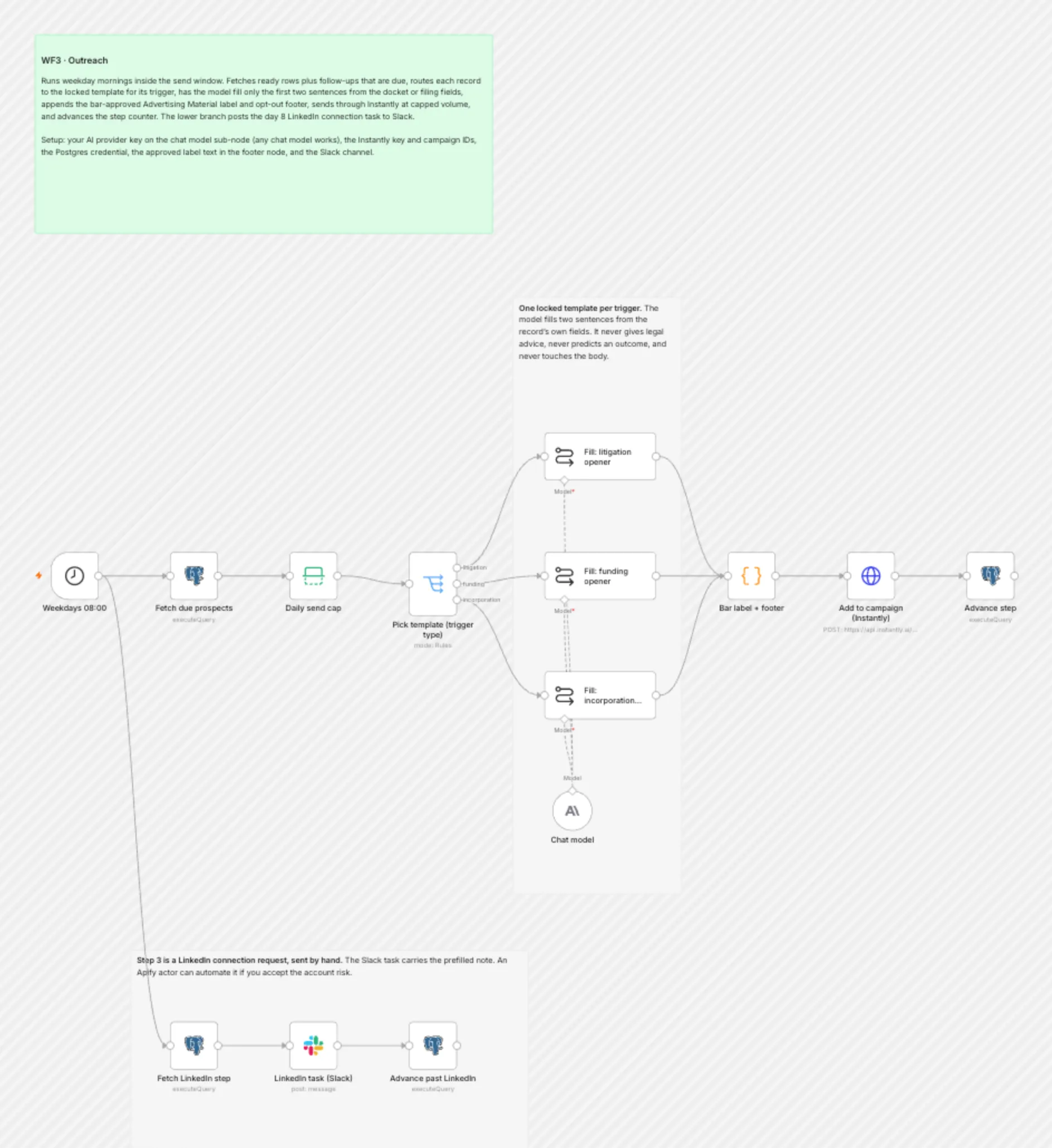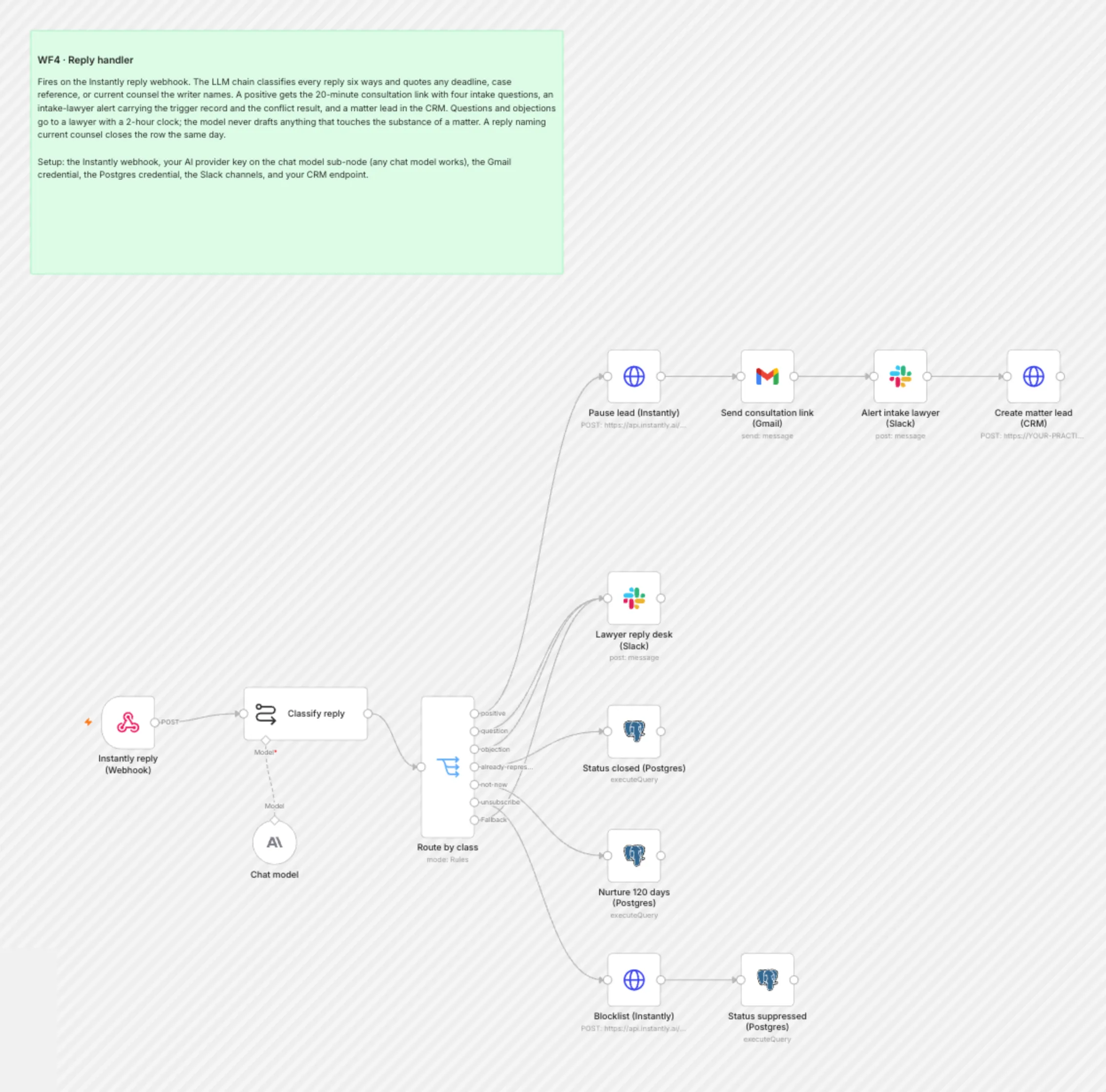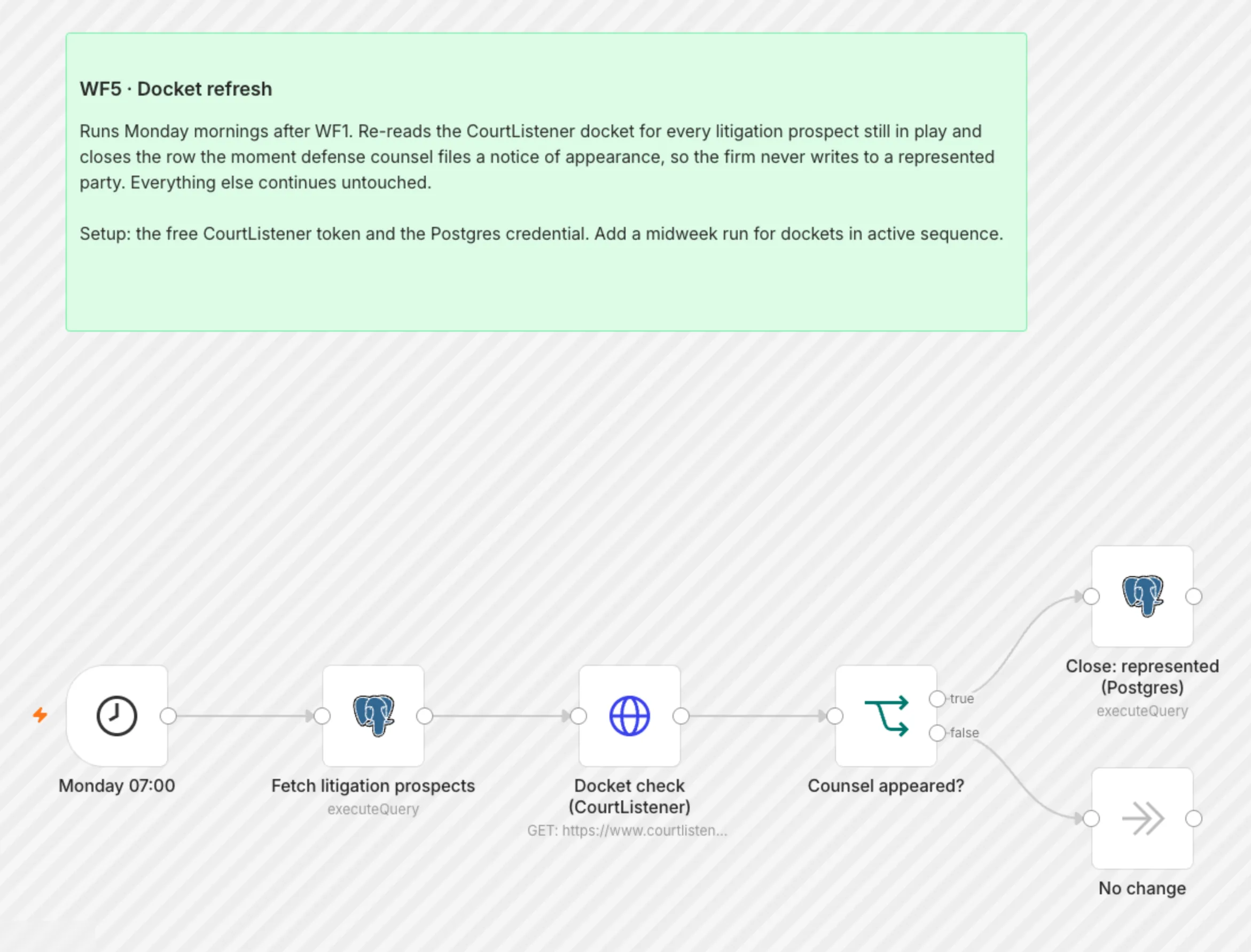
How it works
1. Source
Three public-record feeds run weekly.
- New business entity filings. From the Secretary of State registry.
- Form D funding notices. From SEC EDGAR.
- New commercial lawsuits. From federal and state court dockets.
- A fourth list. In a month when those three feeds run short, established companies in the state top up the count.
2. Qualify
Filters remove:
- Shell entities. Anything with no web presence.
- Out of territory. Companies outside the state or target industries.
- Out of practice. Matters outside your practice areas.
- Already known. Anyone already in your CRM or conflict list.
The conflict check against opposing party names runs at this stage, so no enrichment credit goes to a matter the firm cannot take.
3. Enrich
For each qualified company, the system finds the founder, CEO, or general counsel by name from the filing or docket, then locates a business email with Hunter and confirms it through a BetterContact waterfall.
4. Outreach
Three emails plus a LinkedIn connection request, spread across 16 days.
The opener cites the filing, the raise, or the case number, and the ask is a 20-minute consultation with a fixed-fee scope.
5. Book & track
The Claude API reads each reply and labels it positive, question, objection, already-represented, not-now, or unsubscribe.
- A positive reply. Receives a 20-minute consultation slot from the intake calendar.
- The intake alert. The intake lawyer gets a Slack message carrying the case number or filing, the opposing party, and the conflict-check result.
- The CRM record. Holds the docket or filing that started the thread, each email sent, and the conflict-check outcome, so the consultation opens on the matter itself.
Lead sources for business law firms
Ranked by signal quality:
1. Commercial litigation dockets
A company that was served a complaint in the last 7 days has 21 days to answer in federal court and a similar window in most states.
It is choosing counsel this week.
| Feed | What it gives | Pulled |
|---|---|---|
| CourtListener RECAP API (PACER) | New federal civil filings, with a free key, filtered by PACER nature-of-suit (NOS) code | Weekly |
| State court portals: Texas re:SearchTX, Florida county clerk sites, New York NYSCEF | The same filings at state level, through an Apify scraper | Weekly |
NOS codes kept: 190 Other Contract, 195 Contract Product Liability, 840 Trademark, 820 Copyright, and 442 Employment.
The record gives the defendant name, case number, court, filing date, and plaintiff’s counsel.
Highest intent, shortest sales cycle.
2. Funding rounds
A Form D filing means a company sold securities in the last 15 days and now has cash plus a list of new obligations.
- The new obligations. Option plans, board consents, employment agreements, and investor reporting.
- SEC EDGAR. Publishes Form D filings as a free daily index with issuer name, amount sold, offering date, and executive names.
- Crunchbase. Adds press-announced rounds that have not yet hit EDGAR.
Companies that just raised $500K to $10M rarely have in-house counsel and often outgrow the lawyer who did their formation.
3. New business incorporations and state filings
A new LLC or corporation formed in the last 30 days needs an operating agreement, founder agreements, IP assignments, and often a first commercial contract within 90 days.
- Secretary of State registries. Most states expose a searchable registry: Delaware, California bizfile, Texas SOSDirect, Florida Sunbiz, and New York DOS.
- OpenCorporates. Its API covers 140 jurisdictions in one call, and Apify scrapers handle the rest.
- What the filing gives. Entity name, formation date, entity type, registered agent, and the organizer or principal address.
Volume is high, so the filter in section 5 removes single-member shells and registered-agent-only addresses.
4. Employment and hiring signals
A company posting 5 or more roles in 30 days, or its first HR role, is about to write offer letters, handbooks, and contractor agreements. Job feeds from LinkedIn and Indeed are pulled by title and company size.
Medium intent, useful for employment-law practices.
5. Company inventory (volume filler)
Established businesses in the state with 10 to 200 employees and no outside counsel visible on their site or LinkedIn, found through Google Maps and LinkedIn company pages.
Lowest intent of the five sources, and drawn on only in a month when the dockets, the Form D index, and the registry together produce fewer than 400 prospects.
ICP definition
Filter logic the workflow applies:
| Filter | Rule |
|---|---|
| Filing source | LLC, corporation, or LP formed within the last 30 days |
| Funding source | Form D amount sold $250,000 to $25,000,000, first sale within the last 45 days |
| Litigation source | Company is the defendant, nature of suit is PACER code 190, 195, 840, 820, or 442 (contract, trademark, copyright, employment), filed within the last 14 days |
| Activity check | 5 to 250 employees, or a website (removes shells and inactive filings) |
| Geography | Licensed states, or dockets in courts where the firm is admitted |
| In-house counsel | None (proxy: no General Counsel or Legal title on the LinkedIn company page) |
| Excluded | Publicly traded companies, law firms, registered-agent-only addresses, current and former clients (CRM match), any party on the conflict list, plaintiffs in cases where a current client is a party |
Outreach sequence
The four steps
| Step | Day | Channel | Goal |
|---|---|---|---|
| 1 | 0 | Cite the docket, Form D, or formation filing; ask for a 20-minute consultation | |
| 2 | 3 | Two-line follow-up with the consultation slot and the fixed fee for the first 30 days | |
| 3 | 8 | Connection request that mentions the case number or the filing date | |
| 4 | 16 | Breakup with a specific deadline (answer date, 83(b) window, or first-contract timing) |
Example step 1 (litigation trigger)
Subject: [case number] in [court]
Hi [First name], I saw [Company] was named in [case number], filed [filing date] in [court], a [nature of suit] claim by [plaintiff]. The answer is due in roughly [days] days.
We defend [nature of suit] matters for [N] companies your size in [state]. Fixed fee for the first 30 days, including the answer and early motion practice.
Open to a 20-minute call this week to map your options?
Expected reply rates
| Row type | Expected reply rate |
|---|---|
| Docket, Form D, and registry rows | 2 to 5% |
| Company inventory rows | 1 to 2% |
Both figures are estimates.
A served defendant has an answer due in 21 days, so docket replies sit near 5%. A founder who filed an LLC last month has no deadline and sits near 2%.
Court filings slow in late December and in August, and reply volume dips with them.
Stack and running costs
| Tool | Purpose | Monthly |
|---|---|---|
| n8n Cloud | Orchestration | $24 |
| Apify | Secretary of State and state court scrapers | $30 |
| CourtListener RECAP API | Federal docket feed | $0 |
| SEC EDGAR full-text search | Form D funding feed | $0 |
| Hunter | Decision-maker email finding | $34 |
| BetterContact | Waterfall enrichment + verification | $15 |
| Instantly | Sending + warmup | $37 |
| Claude API | First-line generation + reply classification | $7 |
| Sending domain | Deliverability | $1 |
| Supabase (free tier) | Prospect database | $0 |
| Total | ~$150 |
Crunchbase Pro ($49/month) and OpenCorporates API (from $20/month) are optional additions for firms outside Delaware, California, Texas, Florida, and New York, where the free feeds cover less.