How it works
1. Source
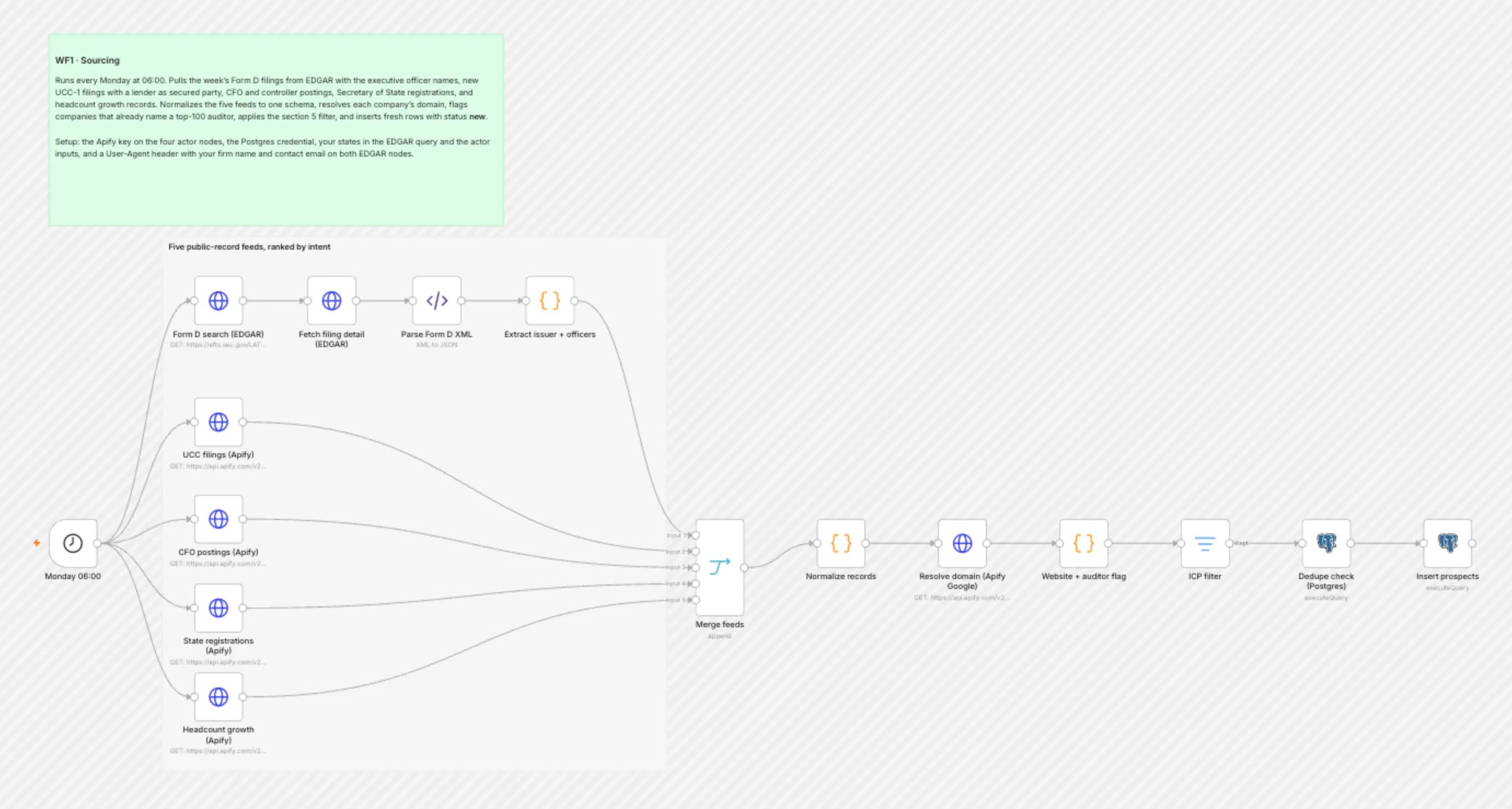
The system pulls companies from five feeds weekly.
- Priced rounds. New Form D filings from SEC EDGAR.
- New bank debt. New UCC-1 filings with a bank or SBA lender as secured party, from the state UCC index.
- Finance hires. CFO and controller job postings from LinkedIn and Indeed.
- Registrations. New foreign qualifications and new entities in regulated sectors, from the Secretary of State.
- Headcount growth. Companies whose open job count crossed 10 in the last 90 days.
2. Qualify
Filters drop:
- Investment vehicles. Funds, SPVs, and real estate syndications.
- Outside the band. Companies outside the revenue band.
- Already covered. Companies that already list a Big Four or top-100 auditor.
- Wrong type. Public companies, and anyone already in the CRM.
About 6 in 10 Form D issuers are investment vehicles and go out here, which is an estimate from EDGAR samples, so the Hunter spend goes only to operating companies.
3. Enrich
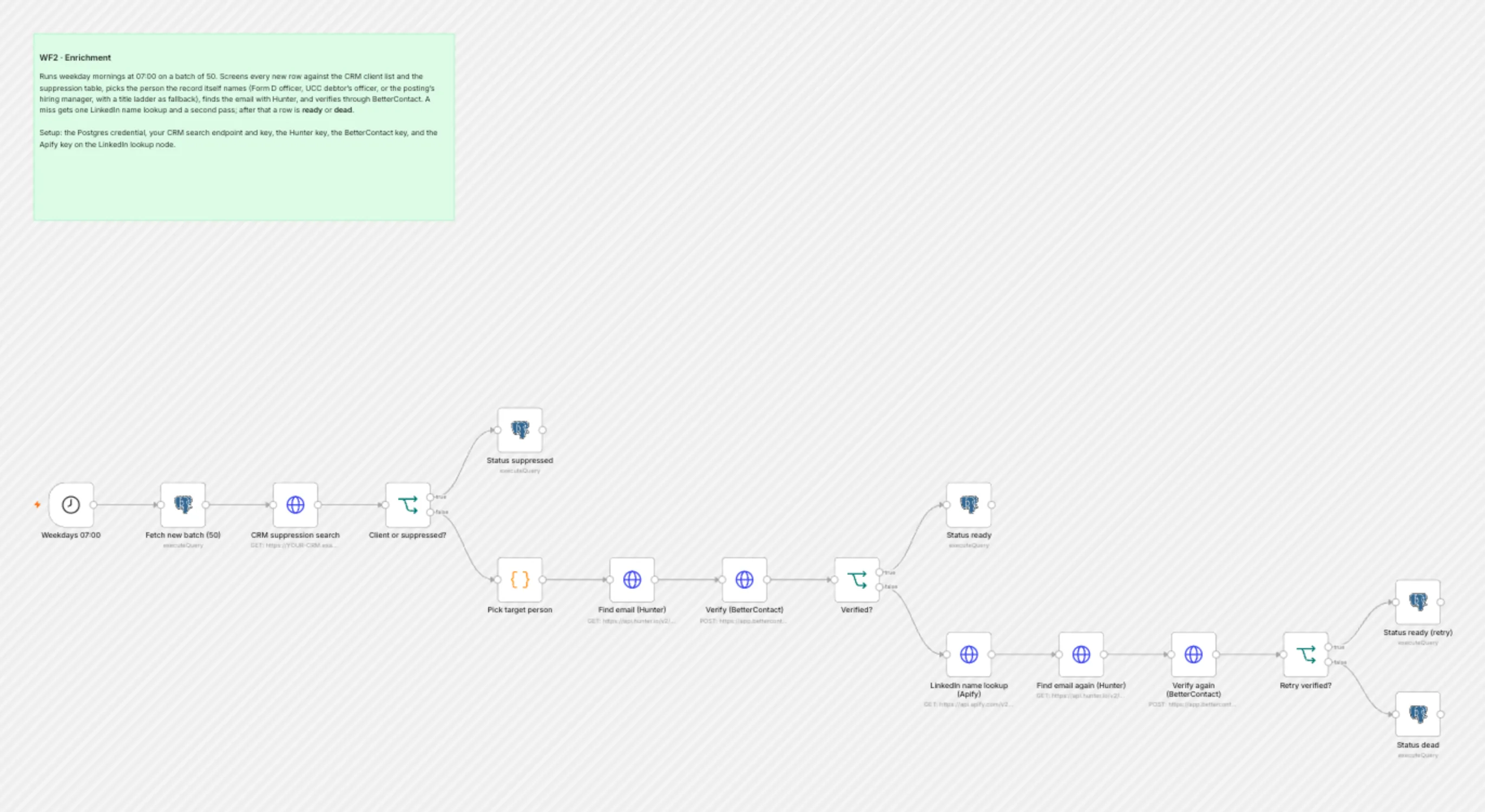
For each qualified company the system takes a person from the record.
- Where the name comes from. The executive officer names on the Form D related persons list, the debtor name from the UCC record, or the hiring manager from the job post.
- Find the email. The system finds the company domain and locates the founder’s or CEO’s email with Hunter.
- Verify it. The BetterContact waterfall confirms the address.
- Where the record has no person. It searches for CEO, Founder, President, or COO.
4. Outreach
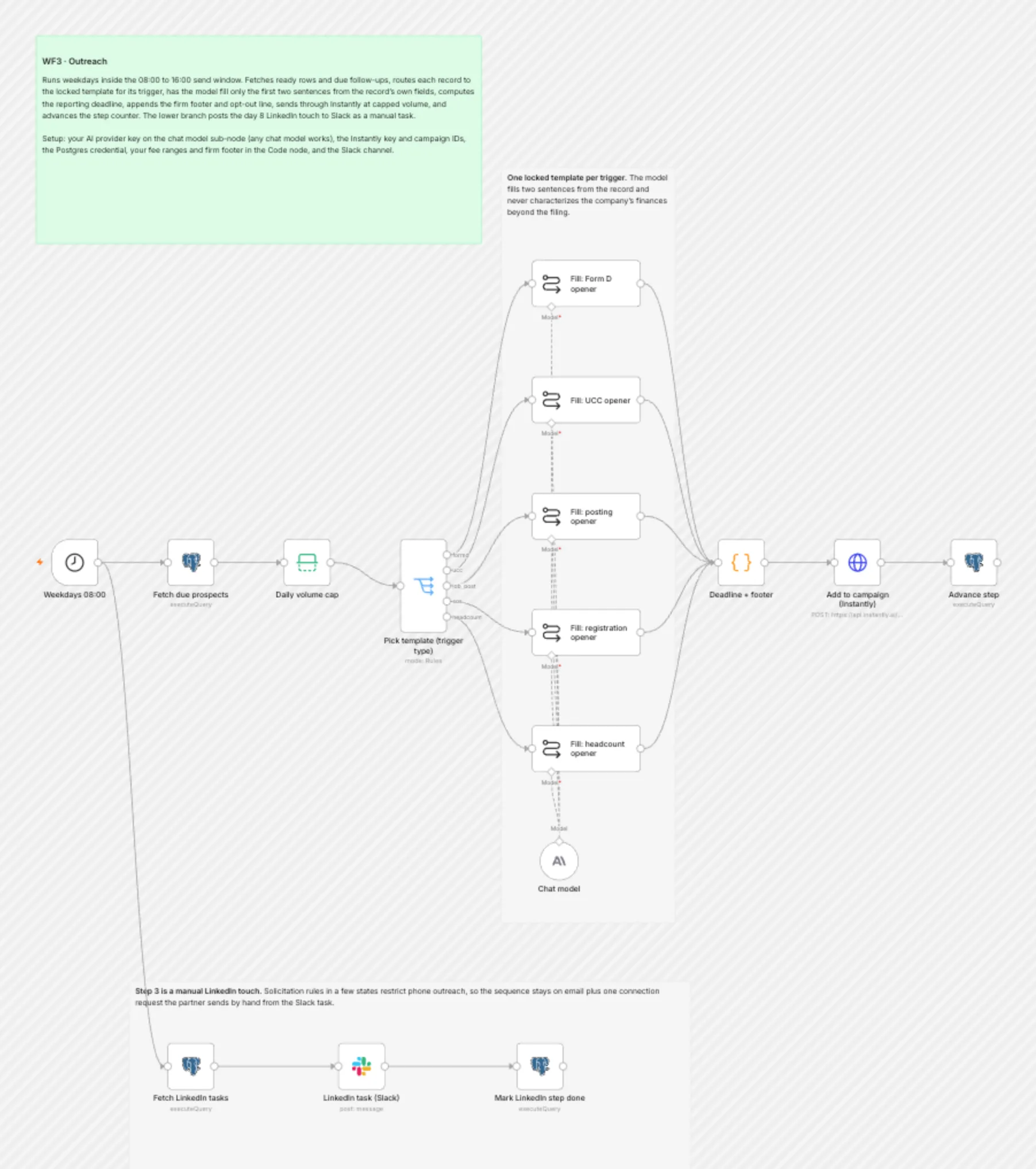
Three emails and one LinkedIn touch spread over 16 days.
- The opening line. Cites the Form D amount and date, the lender on the UCC filing, the CFO posting, or the new state.
- The offer. A 25-minute scoping call, with a fee range quoted on the call.
5. Book & track
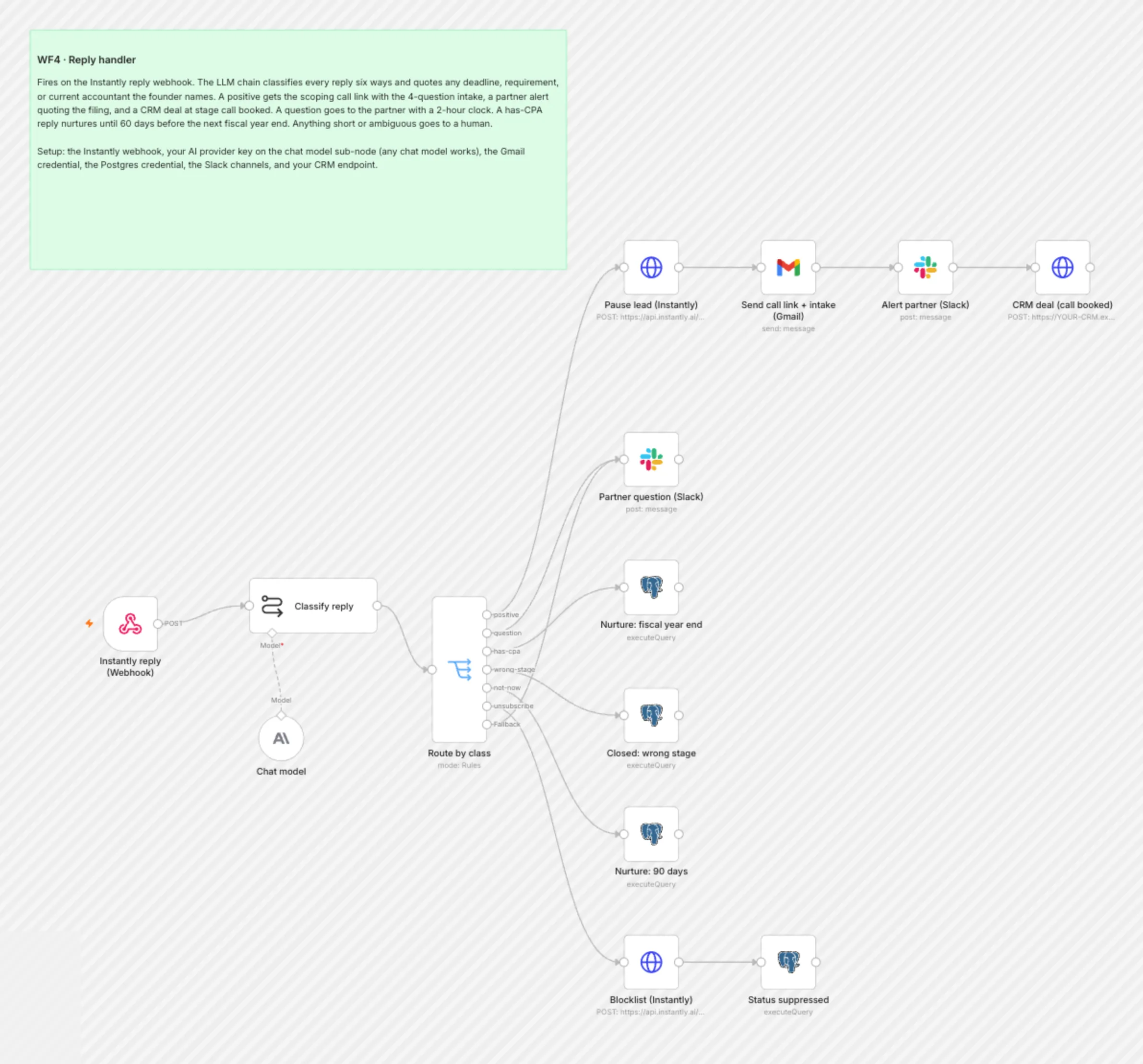
The Claude API sorts each reply into positive, question, has-CPA, wrong-stage, not-now, or unsubscribe.
- Positive reply. Receives the scoping call link plus a 4-question intake: entity type, revenue band, current CPA, investor or lender reporting requirement.
- Partner alert. A Slack alert that quotes the filing or posting that started the thread.
- CRM deal. Stores the Form D amount, the lender name, or the job title plus the reporting deadline, so the partner opens the call on the requirement the company now has.
Lead sources for accounting firms
Ranked by signal quality:
1. Priced funding rounds (SEC Form D on EDGAR)
A company that sells equity to outside investors files Form D within 15 days of the first sale. Almost every institutional term sheet requires annual audited or reviewed financials, a 409A valuation, and a tax provision within 12 months of close.
| Feed | What it gives | Pulled |
|---|---|---|
| EDGAR full-text search API and the daily index at sec.gov | Issuer name, state, industry group, revenue range, total offering amount, amount sold, date of first sale, and the related persons (executive officers and directors) with their roles. Free, returns XML | Every Form D filed in the last 7 days, by an n8n HTTP Request node |
| Crunchbase Basic API (paid, optional) | The lead investor name, for personalization | Alongside the Form D record |
A filter keeps issuers in the firm’s states with an industry group outside pooled investment funds.
Highest intent, because the investor rights agreement puts an audit or review on the calendar.
National volume is about 2,000 to 2,800 Form D filings a month, which is an estimate from EDGAR counts; one state yields 40 to 150 after the fund filter.
2. New bank debt (UCC-1 filings, state Secretary of State UCC index)
A company that borrows from a bank or SBA lender signs covenants that require annual CPA-reviewed or audited statements at loan sizes that most community banks set between $1M and $3M. The lender files a UCC-1 against the borrower within days of closing.
- Every state runs a searchable UCC index. States like Texas, Florida, California, and New York expose it online with filing date, debtor name and address, secured party, and collateral description.
- What the actor pulls. An Apify actor pulls filings from the last 14 days where the secured party name matches a bank, credit union, SBA lender, or equipment finance list.
- What it drops. Consumer and vehicle liens, screened out by the collateral text.
Medium-high intent, because the first covenant compliance certificate is due within 90 to 120 days of the fiscal year end.
Volume per state runs 150 to 300 operating-company filings a month after the filter, an estimate.
3. CFO and controller job postings (LinkedIn, Indeed, ZipRecruiter via Apify)
A company posting its first controller, VP Finance, or CFO role has a board, a lender, or a tax bill that the bookkeeper cannot handle, and the search takes 60 to 120 days.
- What the actor pulls. An Apify job-board actor pulls postings weekly by title, filtered to companies with 20 to 300 employees.
- The first-hire check. It confirms the company has no other finance posting older than 90 days.
- What the record gives. Company name, title, posting date, location, and the hiring manager when shown.
Medium-high intent, and the pitch is concrete: a fractional CFO and tax strategy engagement covers the gap until the hire starts, and often replaces the hire at the controller level.
4. Multi-state expansion and regulated-sector registrations (Secretary of State)
A company that files a foreign qualification in a second state has created income tax nexus, payroll registrations, and apportionment questions in the same quarter.
A new entity registered in a regulated sector (a licensed lender, a cannabis operator, a healthcare group, a government contractor) needs tax structuring and often a compliance audit in year one.
- State registries. Florida Sunbiz, Texas SOSDirect, California bizfile, and Delaware are scraped weekly by filing type and date with an Apify actor.
- States without a usable portal. OpenCorporates covers them.
- What the record gives. Entity name, home state, filing date, filing type, registered agent, and officer names where the state publishes them.
Medium intent, strongest when the foreign qualification pairs with a job posting in the new state.
5. Headcount growth (job posting counts from Apify job-board actors and LinkedIn company pages)
A company whose open role count crossed 10 in the last 90 days, or whose LinkedIn headcount grew 25% or more in 6 months, is usually crossing $5M revenue, adding benefits plans, and crossing state payroll thresholds.
- Where the count comes from. The system counts postings per company from the section 3 job feed.
- Where the headcount comes from. An Apify company-page actor pulls the LinkedIn headcount figure.
- What it is for. Keeping volume stable when the filing feeds run thin in a small state.
Lowest intent of the five.
ICP definition
Filter logic the workflow applies.
What starts a row
| Filter | Rule |
|---|---|
| Form D source | First sale within the last 30 days, industry group excludes pooled investment funds, REITs, business trusts, and other banking and financial services, total offering $500,000 to $50,000,000, issuer in a served state |
| UCC source | Filed within the last 14 days, secured party matches bank, credit union, SBA, financial, capital, or leasing, collateral excludes vehicles, VINs, consumer goods, crops, and livestock, debtor is an organization |
| Job post source | Title is CFO, Chief Financial Officer, VP Finance, Controller, Corporate Controller, or Director of Finance, posted within the last 21 days, company has 20 to 300 employees |
| Secretary of State source | Foreign qualification or certificate of authority filed within the last 30 days, or a formation with NAICS 522 credit, 621 healthcare, 5417 R&D, 2362 commercial construction, 3254 pharma, 4542 cannabis retail, or 5416 government contracting |
| Headcount growth source | 10 or more open jobs in 90 days, or LinkedIn headcount growth of 25% or more in 6 months |
What keeps a row
| Filter | Rule |
|---|---|
| Revenue | $2,000,000 to $50,000,000 estimated (proxy: Form D revenue range field, employee count times $150,000, or UCC loan size times 5) |
| Size | 10 to 300 employees |
| Geography | States where the firm is licensed or has mobility, or anywhere in the US for remote engagements |
| Auditor | No Big Four or top-100 firm named (checked against the Form D text and the company website) |
| Excluded | Public companies (CIK with 10-K filings), SPVs and funds, real estate syndications, nonprofits, franchisors’ corporate entities, government bodies, current and former clients (CRM match), domains on the suppression list |
Outreach sequence
The four steps
| Step | Day | Channel | Goal |
|---|---|---|---|
| 1 | 0 | Opener citing the Form D, UCC filing, CFO posting, or new state; offer a 25-minute scoping call | |
| 2 | 4 | Short bump with the booking link and a fee range for the review, audit, or fractional CFO engagement | |
| 3 | 8 | Connection request naming the filing or posting and the firm’s client count at the same stage | |
| 4 | 16 | Breakup naming the reporting deadline (first audit due date, covenant certificate, first multi-state return) |
Example step 1 (Form D trigger)
Subject: [Company]‘s [round amount] round and the first audit
Hi [First name], I saw [Company]‘s Form D on [filing date] for [amount sold] of the [total offering] round. Most investor agreements at that size require reviewed or audited statements within 12 months, plus a 409A and a tax provision.
We handle the first audit, the R&D credit study, and the tax plan for [N] venture-backed companies in [state].
Open to a 25-minute call this week to map what the investors will ask for and when?
Expected reply rates
Expected reply rate: 2 to 4% on trigger sources, an estimate for a warmed domain writing to founders and CFOs.
| Row type | Where it lands | Why |
|---|---|---|
| Form D issuers and CFO-posting companies | High end of the range | A named requirement has a date |
| Foreign qualification and headcount-growth companies | Low end of the range | The deadline is vague |
The rate moves with the calendar.
- The 90 days before a December year end. Sends land at the high end, because the founder has just been asked for statements.
- The 6 weeks after the March 15 and April 15 deadlines. Sends land at the high end, because the founder has just paid for a late return.
- The middle of filing season. Sends land at the low end, because the reader’s current CPA is the only accountant they have time for.
Stack and running costs
| Tool | Purpose | Monthly |
|---|---|---|
| n8n Cloud | Orchestration | $24 |
| SEC EDGAR full-text search and archives | Form D feed | $0 |
| Apify | UCC index, Secretary of State, job board, and LinkedIn company scrapers | $30 |
| Hunter | Decision-maker email finding | $34 |
| BetterContact | Waterfall enrichment + verification | $15 |
| Instantly | Sending + warmup | $37 |
| Claude API | First-line generation + reply classification | $8 |
| Sending domain | Deliverability | $1 |
| Supabase (free tier) | Prospect database | $0 |
| Total | ~$150 |
Crunchbase Basic API (from $49/month) is an optional addition that adds the lead investor name to Form D records. OpenCorporates API (from $20/month) is optional for states without a usable Secretary of State portal. Neither is in the total.