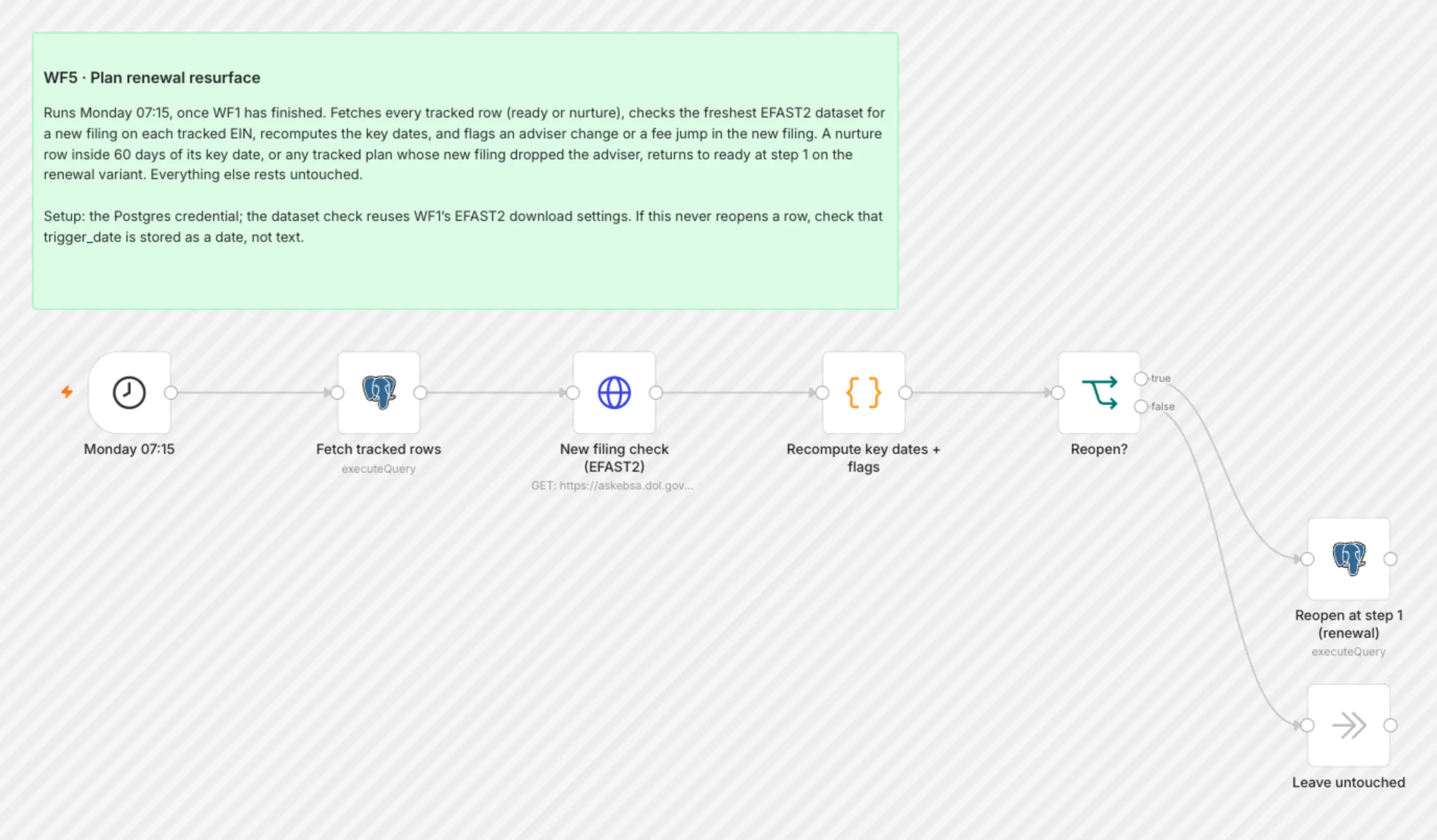
How it works
1. Source
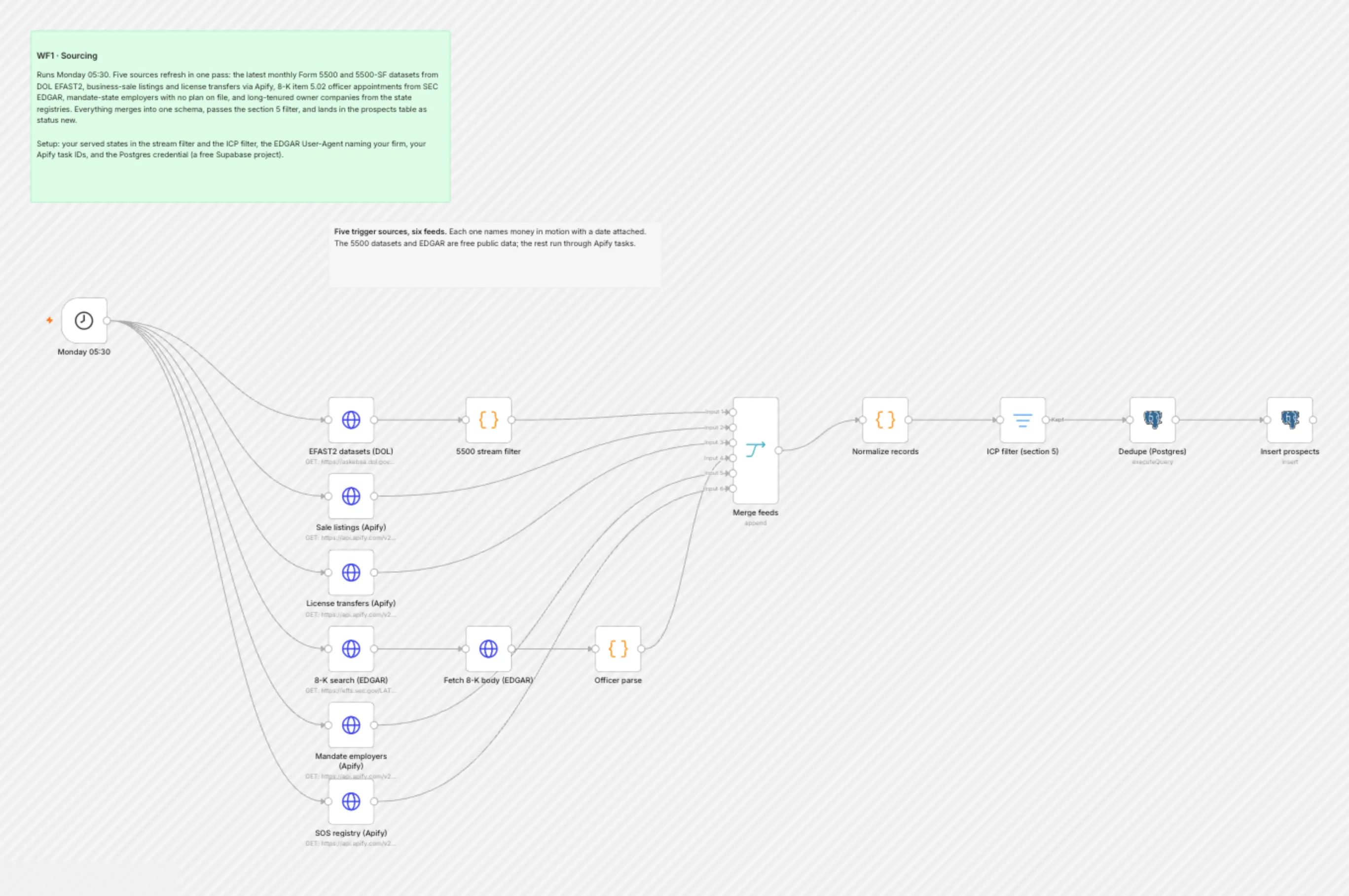
The system pulls prospects from five feeds weekly.
- New and advisor-light 401(k) plans. From the DOL EFAST2 Form 5500 datasets.
- Businesses listed for sale. From marketplace and license-transfer records.
- New officer appointments. From SEC 8-K filings.
- Employers crossing a state retirement mandate deadline. With no plan on file.
- Long-tenured owner-operated companies. A volume stabilizer.
2. Qualify
Filters drop:
- Plans outside the bands. Anything outside the participant and asset ranges.
- Anonymous sale listings. No named business or broker to write to.
- Government and union plans. Out of scope for the plan-outreach track.
- Companies outside the served states. Where the adviser is not registered.
- Already known. Anyone in the CRM.
Junk dies here, before enrichment spends money.
3. Enrich
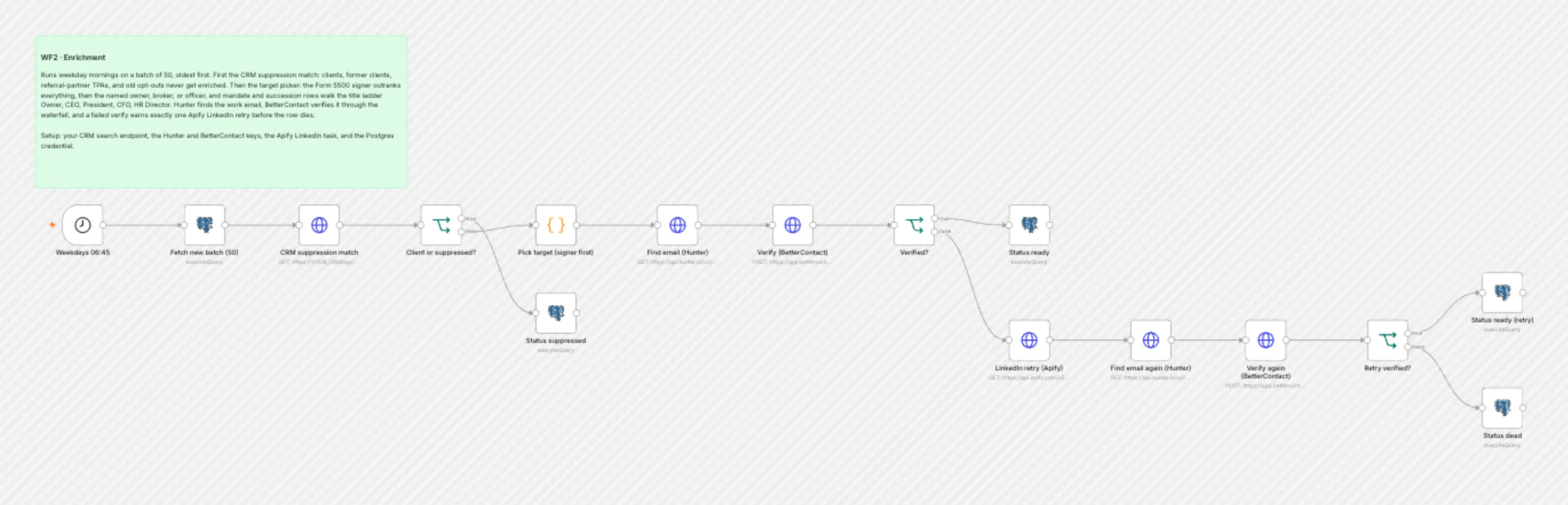
For each qualified record the system takes the person the record already names.
- Form 5500 rows. The plan administrator who signed the filing.
- Sale listings and transfers. The owner behind the listing.
- 8-K rows. The officer named in the filing.
It then finds the company domain, locates a verified work email with Hunter, and confirms it through the BetterContact waterfall.
4. Outreach
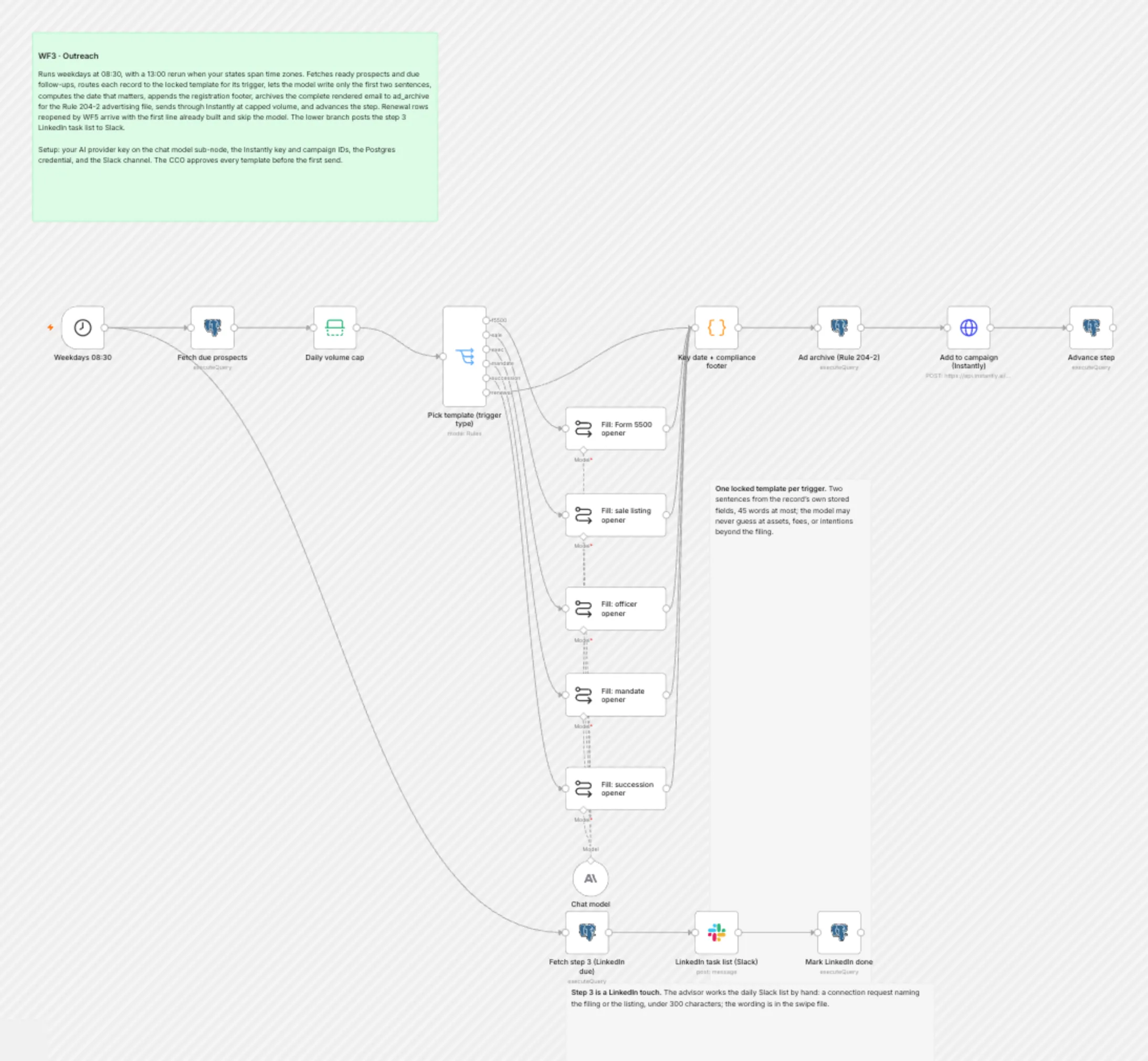
Three emails and one LinkedIn touch spread over 16 days.
- The opening line. Cites the filing, the listing, or the appointment.
- The offer. A 20-minute discovery meeting anchored to something free and concrete: a plan fee benchmark, an exit checklist, or an equity compensation review.
5. Book & track
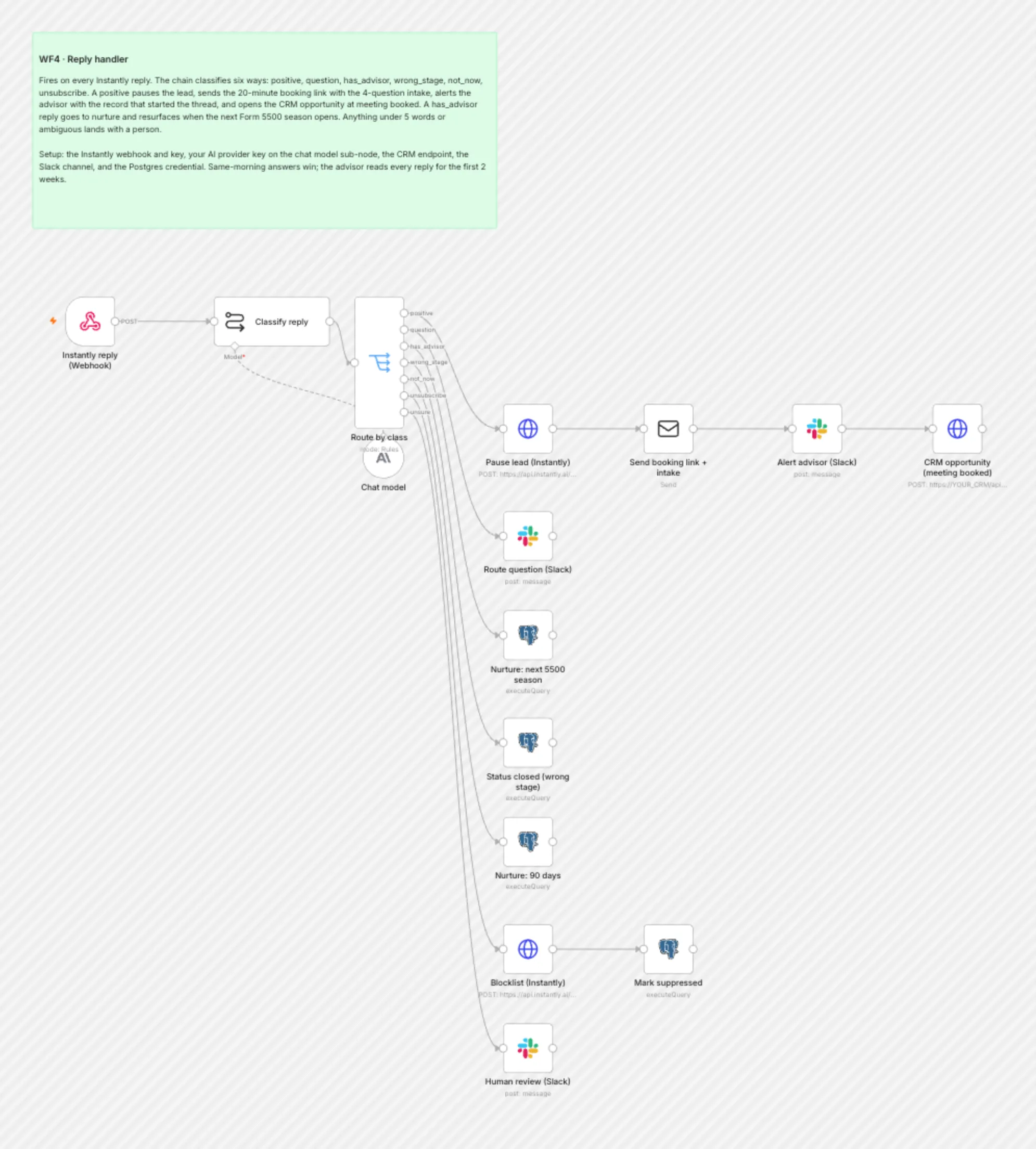
The Claude API sorts each reply into positive, question, has-advisor, wrong-stage, not-now, or unsubscribe.
- Positive reply. It receives the booking link plus a short intake.
- Advisor alert. A Slack message quoting the record that started the thread.
- The advertising file. Every outbound email is archived the moment it sends.
Lead sources for financial advisors
Ranked by signal quality:
1. New and advisor-light 401(k) plans (Form 5500, DOL EFAST2)
Every employer retirement plan files Form 5500 or 5500-SF annually with the Department of Labor, and the DOL publishes the complete datasets as free CSV downloads, refreshed monthly.
What each row carries: sponsor name, EIN, address, plan name, plan effective date, plan year dates, participant count, total assets, the administrator who signed, and on larger plans the Schedule C service providers and their compensation codes.
Three triggers hide in this data:
- A new plan. Its effective date falls inside the last 24 months, so it was sold at setup by a payroll company or recordkeeper and is rarely attached to an independent advisor yet.
- A small plan paying retail. Assets crossed $1M with no investment adviser listed, which is retail pricing on an institutional balance.
- A fee benchmark waiting to be run. Per-participant cost sits far above the size band, and ERISA makes the sponsor personally responsible for those fees.
Filings are due 7 months after the plan year ends (July 31 for calendar-year plans, October 15 on extension), so fresh rows cluster from August to October.
Highest intent, because the filing itself documents the obligation the advisor helps with.
National volume is roughly 800,000 filings a year, an estimate from DOL release notes; one state yields 150 to 250 qualified sponsors a month in season.
2. Businesses listed for sale (marketplace listings and license transfers)
An owner who lists a company at a $1M to $25M asking price has a liquidity event 6 to 12 months out.
Decisions that expire at closing: entity structure, installment terms, tax sequencing, and where the proceeds land in the first 90 days.
| Feed | What it gives |
|---|---|
| Marketplace listings, pulled weekly by state by an Apify actor | Listing date, asking price, cash flow, and industry, keeping only listings that name the business or broker |
| State license transfer applications (liquor, contractor, dealer) | Sales the marketplaces never see, and the records name both transferor and transferee |
High intent inside a narrow window, and the advisory relationship that starts before the sale usually keeps the proceeds after it.
3. New officer appointments with equity grants (SEC 8-K item 5.02, EDGAR)
A public company that appoints a CEO, CFO, or president files an 8-K within 4 business days, and the appointment almost always comes with an equity package.
What comes with that package: concentrated stock, vesting dates, a 10b5-1 plan to design, and a tax bill that arrives on schedule.
The EDGAR full-text search API is free and returns the filing, the officer’s name, the title, and the effective date, which makes enrichment unusually precise because the prospect is named in the source record.
An n8n HTTP Request node pulls the last 7 days of item 5.02 filings for companies headquartered in the served states.
Medium-high intent, and the account that starts with an equity review often becomes the household’s full portfolio.
4. State retirement mandate deadlines (CalSavers and its siblings)
California, Illinois, Oregon, Colorado, and a growing list of states require employers above a headcount threshold to offer a retirement plan or enroll in the state IRA program by fixed deadlines, with penalties per employee for missing them.
The system builds the target list by inversion:
- Collect the employers. An Apify actor gathers employers in mandate states with 5 to 100 employees.
- Remove everyone who already has a plan. The EIN and sponsor-name match against the Form 5500 dataset takes them out.
- What remains. A list of employers legally required to act by a known date.
A 401(k) opened with an advisor satisfies the mandate while beating the state program on contribution limits and employer match.
Medium intent with a statutory deadline doing the selling.
5. Long-tenured owner-operated companies (Secretary of State records)
A company incorporated 20 or more years ago with the founder still listed as an officer is approaching a succession decision, and most of the owner’s net worth sits inside the business.
Pulled from state registries by incorporation date and officer records via an Apify actor.
Lowest intent of the five, used to keep volume stable when the filing feeds run thin in a small state.
ICP definition
Filter logic the workflow applies.
What starts a row
| Filter | Rule |
|---|---|
| Form 5500 source | Plan effective date within 24 months for the new-plan trigger, or assets above $1,000,000 with no investment adviser listed, or per-participant cost in the top quartile for the size band; participants 10 to 500; assets $500,000 to $25,000,000; sponsor in a served state |
| Sale listing source | Listed within the last 30 days, asking price $1,000,000 to $25,000,000, business or broker named in the listing or transfer record, located in a served state |
| Officer source | 8-K item 5.02 filed within the last 21 days, role is CEO, CFO, President, or COO, company headquarters in a served state |
| Mandate source | Employer in a state with an active retirement mandate, 5 to 100 employees, registration deadline within 12 months, no Form 5500 on file for the EIN or sponsor name |
| Succession source | Incorporated 20 or more years ago, founder or family member still listed as officer, 10 to 200 employees |
What keeps a row
| Filter | Rule |
|---|---|
| Geography | States where the adviser is registered, or within the de minimis exemption for out-of-state clients |
| Plan type | Excludes government plans, church plans, multiemployer and union plans, and plans of publicly traded sponsors for the plan-outreach track |
| Excluded | Current and former clients (CRM match), other advisory firms and TPAs, franchised branch offices of national chains, domains on the suppression list |
Outreach sequence
The four steps
| Step | Day | Channel | Goal |
|---|---|---|---|
| 1 | 0 | Opener citing the Form 5500, sale listing, appointment, or mandate deadline; offer a 20-minute discovery meeting | |
| 2 | 4 | Short bump with the booking link and what the free fee benchmark, exit checklist, or equity review covers | |
| 3 | 9 | Connection request naming the filing or listing and the firm’s client count at the same stage | |
| 4 | 16 | Breakup naming the date that matters (next Form 5500 due date, mandate deadline, expected closing) |
Example step 1 (Form 5500 trigger)
Subject: [Company]‘s first Form 5500 and the fees inside it
Hi [First name], I saw [Company] filed its first Form 5500 for the [plan name], effective [date], with [participants] participants and [assets] in assets. Most sponsors never benchmark the fees they accepted at setup, and ERISA places that duty on you personally.
We benchmark plan fees and serve as advisor for [N] plans this size in [state]. The benchmark is free and takes one 20-minute meeting.
Open to a slot this week?
Expected reply rates
Expected reply rate: 2 to 4% on trigger sources, an estimate for a warmed domain writing to sponsors, owners, and executives.
The calendar moves the rate.
- Form 5500 rows. They reply best from August through October, when the filing is fresh in the sponsor’s mind.
- Mandate rows. They reply best in the 120 days before a registration deadline.
- Sale listings. They reply at the high end year round, because the owner is already in motion.
- Succession rows. They sit at the low end, because no date forces the decision.
Stack and running costs
| Tool | Purpose | Monthly |
|---|---|---|
| n8n Cloud | Orchestration | $24 |
| DOL EFAST2 datasets + SEC EDGAR | Form 5500 feed and officer filings | $0 |
| Apify | Sale listings, license transfers, registries, employer inventory, LinkedIn lookups | $30 |
| Hunter | Decision-maker email finding | $34 |
| BetterContact | Waterfall enrichment + verification | $15 |
| Instantly | Sending + warmup | $37 |
| Claude API | First-line generation + reply classification | $8 |
| Sending domain | Deliverability | $1 |
| Supabase (free tier) | Prospect database and ad archive | $0 |
| Total | ~$150 |
The EFAST2 datasets and EDGAR are free public sources with no API key; EDGAR asks only for an identifying User-Agent header.
A paid plan-data service like Judy Diamond or Larkspur (from $200/month) adds pre-computed fee benchmarks and is optional. It is left out of the total because the raw 5500 data carries the same fields.