How it works
1. Source
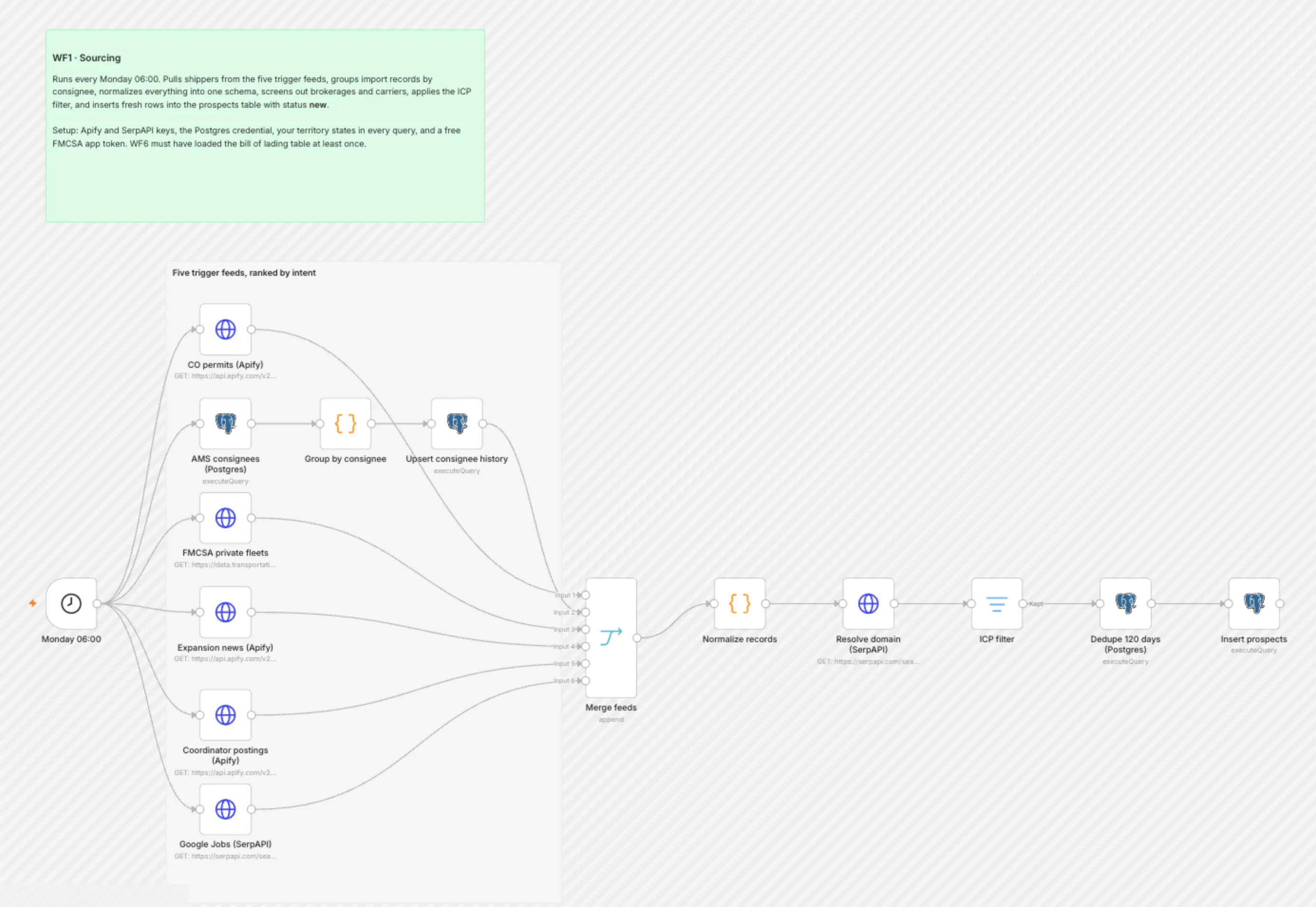
The system pulls shippers from five trigger feeds weekly.
- Certificates of occupancy and final inspections. On warehouse, distribution, and manufacturing buildings, from city and county permit portals.
- New and growing consignees. From the US Customs bill of lading release (CBP AMS, free, 1 to 3 month lag).
- New private property carrier registrations. From the FMCSA Motor Carrier Census file.
- Manufacturing expansion announcements. From state economic development offices and the local business journal.
- Coordinator job postings. For shipping, logistics, and traffic coordinators, from Indeed and Google Jobs.
2. Qualify
Filters drop:
- Small buildings. Anything under 20,000 square feet.
- Thin consignees. Consignees under 3 shipments in 90 days.
- The trade itself. Other brokerages and 3PLs, and carriers.
- Routing-guide retailers. Retailers with a routing guide above 2,000 employees.
- Known or out of reach. Current customers, and anything outside the lane footprint.
Roughly 40 to 60% of raw records leave at this step, an estimate, so Hunter credits are spent only on shippers the broker can serve.
3. Enrich
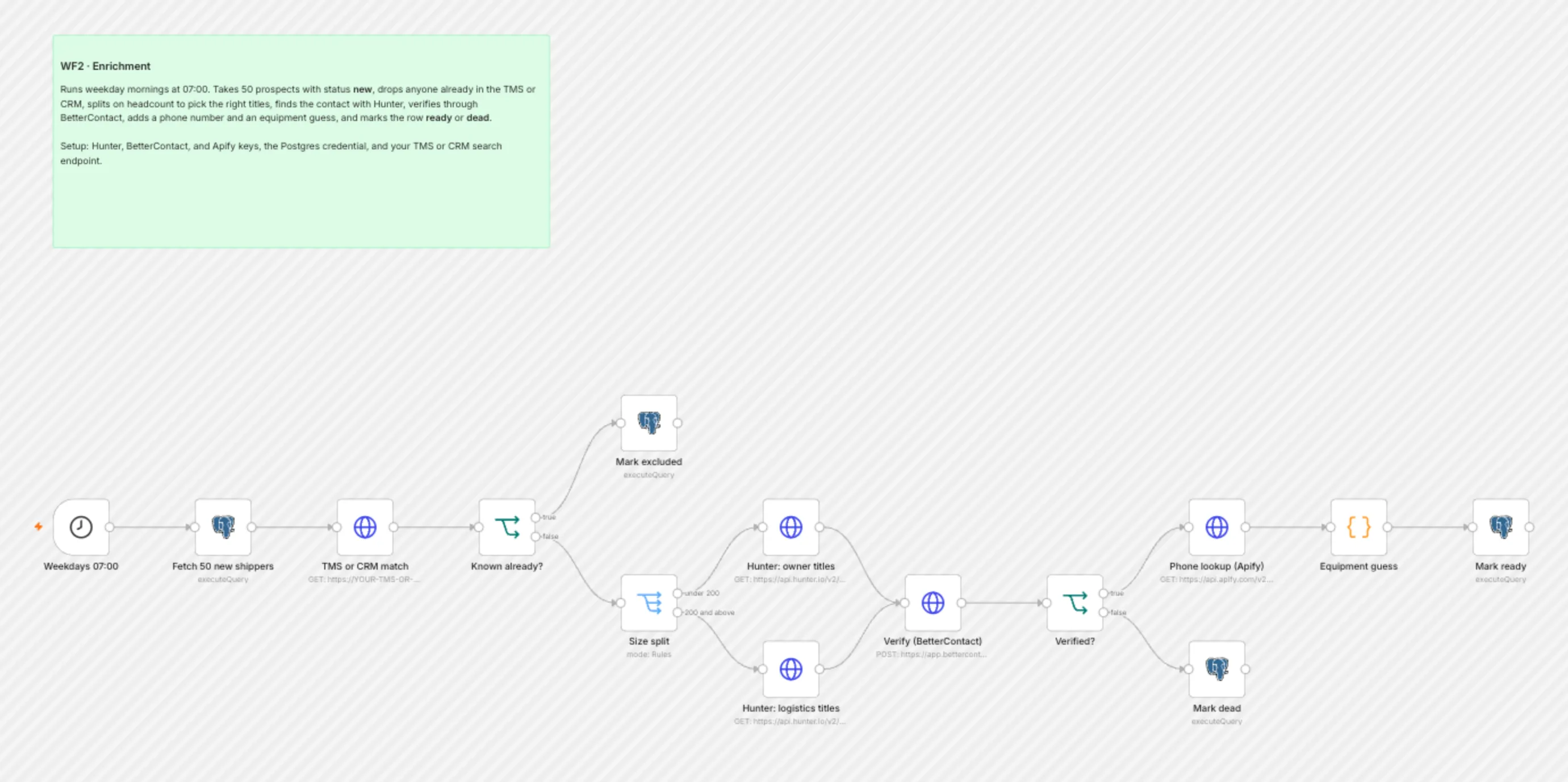
For each qualified shipper the system finds a named person, then the email.
- The seat. The logistics manager, shipping manager, traffic manager, supply chain manager, or owner.
- Shippers with 200 or more employees. Routed to the logistics or supply chain manager.
- Smaller shippers. Routed to the owner or operations manager.
- Find and verify. Hunter finds the email and a BetterContact waterfall verifies it.
4. Outreach
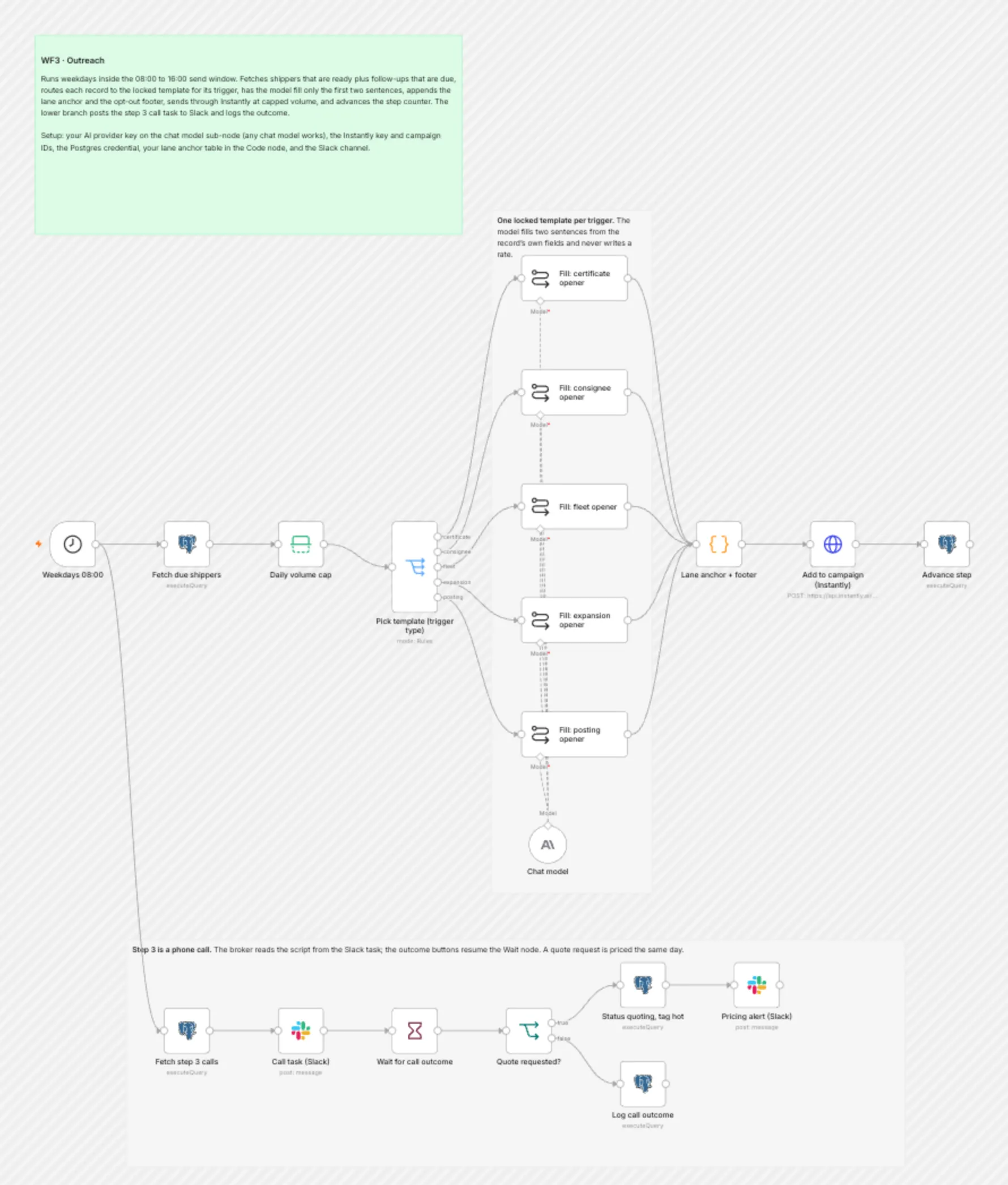
Three emails and one phone call across 14 days. The email opener leads with the shipper’s own record.
- Certificate of occupancy. The address and square footage.
- Bill of lading record. The port and shipment count.
- FMCSA filing. The USDOT number and equipment.
- Expansion announcement. The expansion figure.
- Coordinator posting. The coordinator title.
5. Book & track
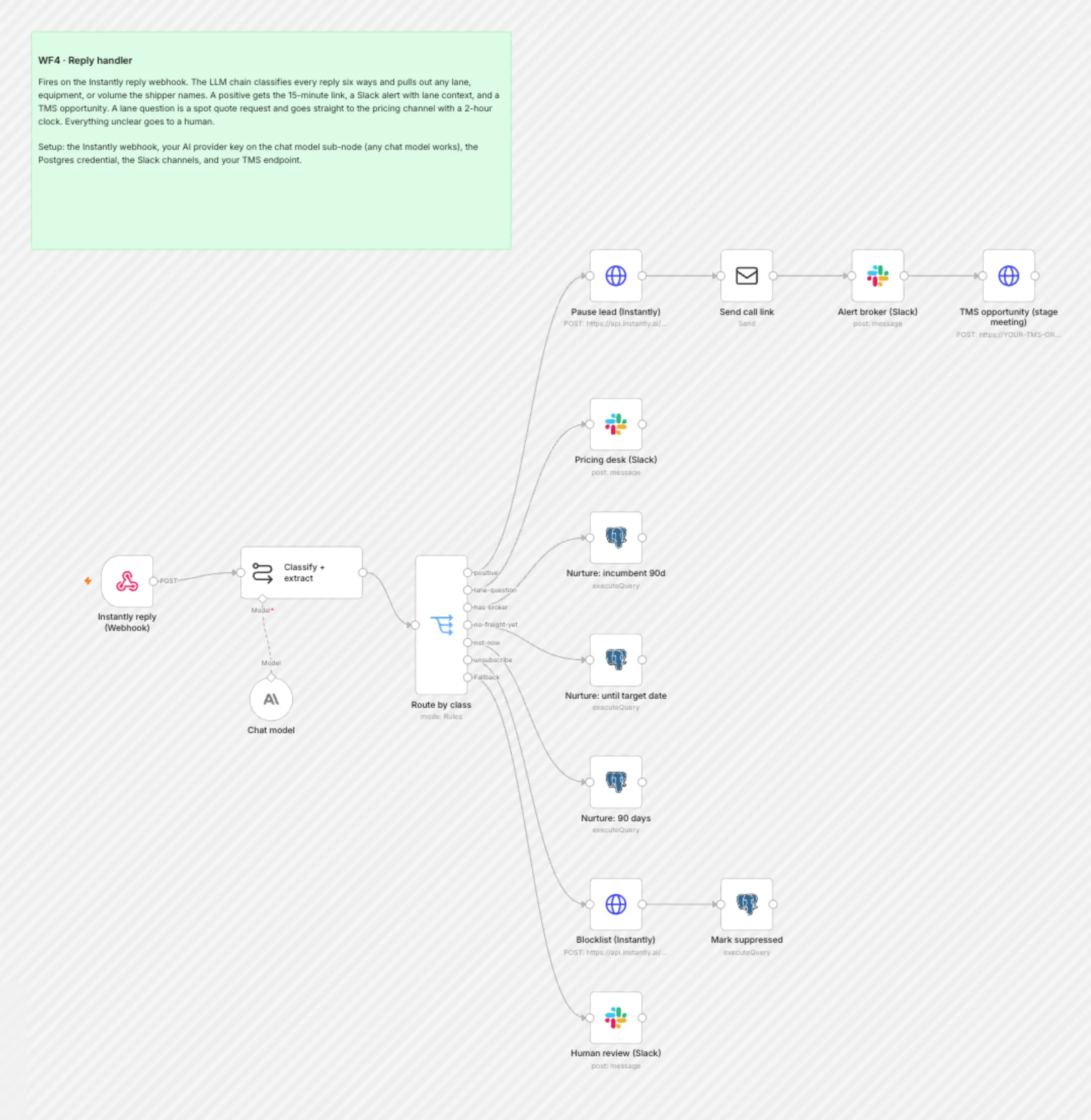
Replies are classified by the Claude API into positive, lane question, has-broker, no-freight-yet, not-now, and unsubscribe.
- Positive reply. The system sends a 15-minute call link and posts a Slack alert to the broker.
- What the alert carries. The lane (origin metro and any destination the shipper named), the volume proxy (container count, square footage, or power units), and the building or filing that triggered the send.
- The CRM record. Holds the shipper, the trigger record with its date, every email and call outcome, and the first lanes discussed.
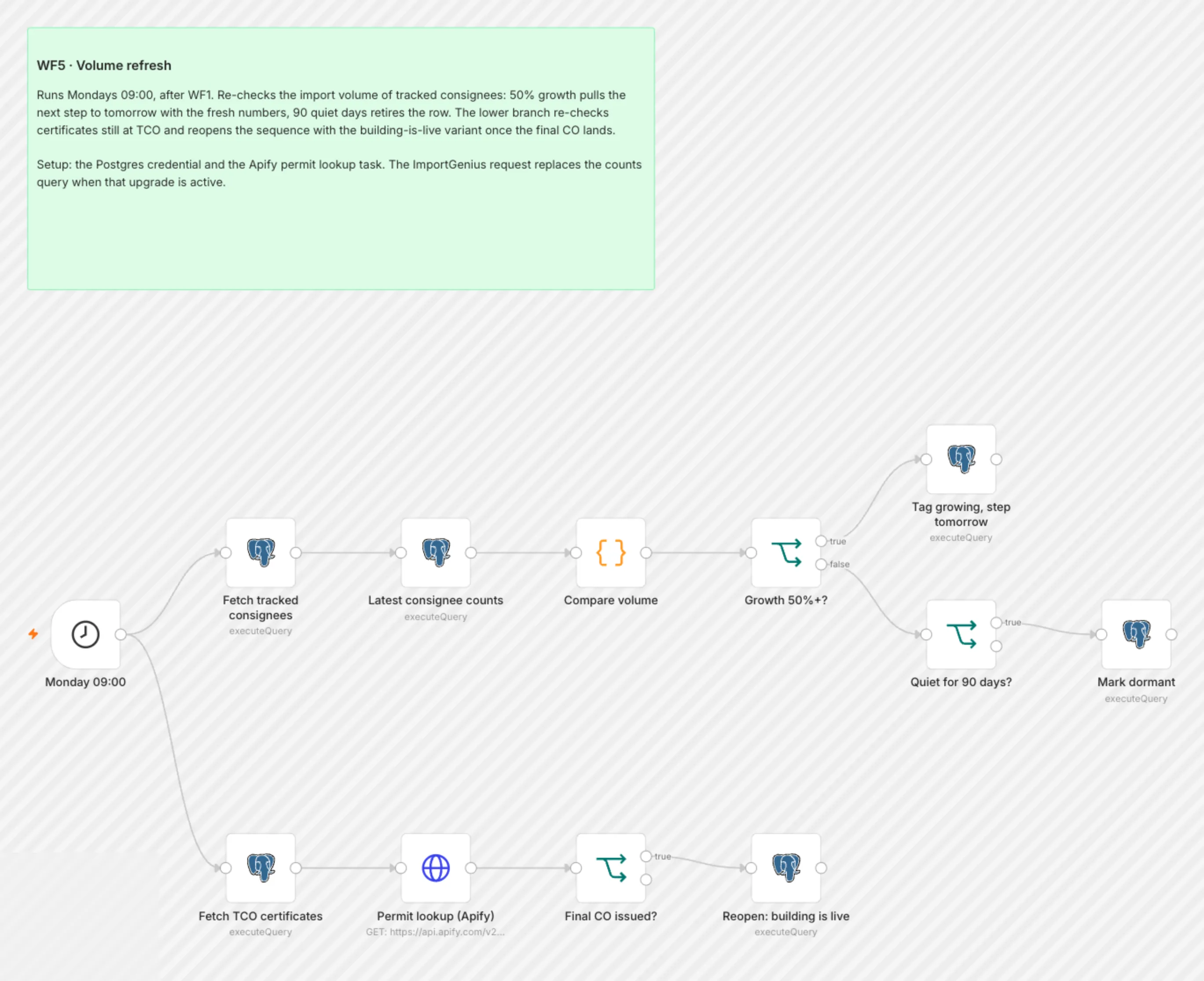
- A shipper lost to an incumbent. Stays in the CRM and reopens when WF5 sees its import volume grow 50% or more.
Lead sources for freight brokers
Ranked by signal quality:
1. Warehouse and distribution center certificates of occupancy
A certificate of occupancy on a 20,000 square foot or larger warehouse, distribution center, or plant means inbound and outbound freight starts within 30 to 90 days, and the carrier list for that building is still being written.
- Where it comes from. City and county permit portals (Accela, Tyler EnerGov, and CityView instances, plus county PDF logs), pulled weekly via scheduled Apify scrapers.
- The filter. Use classes warehouse, distribution, manufacturing, and cold storage.
- What is stored. The address, square footage, applicant, and issue date.
Highest intent and lowest competition, because the building has no routing guide on the day the certificate is issued.
2. Import records by consignee
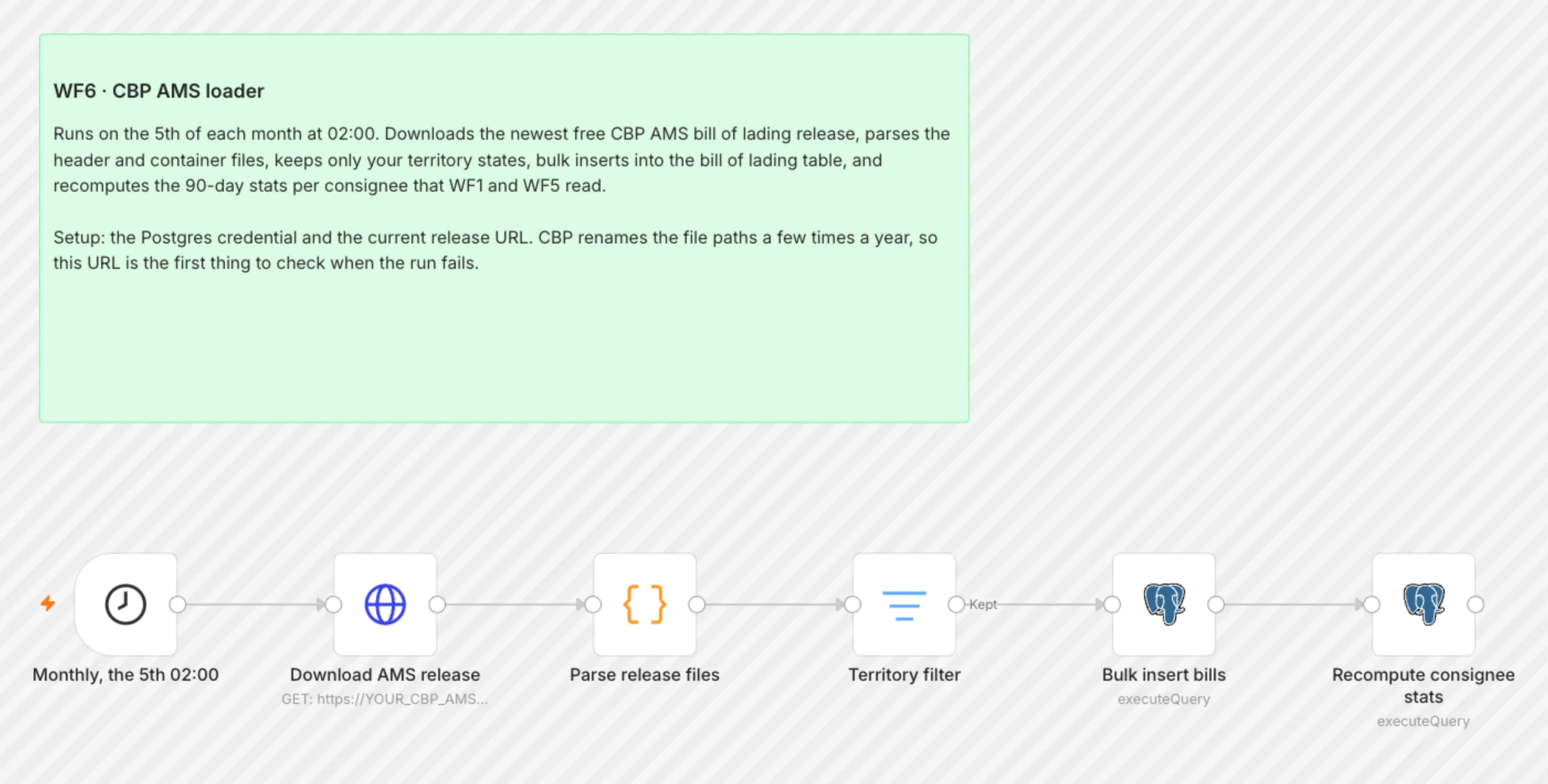
US Customs bill of lading data lists every ocean container entering the country with the consignee name, the shipper abroad, the port, the HS code group, and the container count.
A consignee whose first shipment landed in the last 90 days, or whose monthly container count grew by 50% or more, has drayage and inland truckload it is arranging by hand.
| Feed | What it gives | Lag |
|---|---|---|
| CBP AMS bill of lading release, free, the baseline | Loaded into Postgres monthly and filtered by consignee state and port | 1 to 3 months behind the vessel |
| ImportGenius, $199/month on the month-to-month Essentials tier, the optional upgrade | The same records plus an API for the weekly volume refresh | About a week |
Second-highest intent because the freight already exists and the volume is on the record.
3. FMCSA private fleet registrations
A company that registers a new USDOT number with operation classification “Private (Property)” has enough volume to justify its own trucks, and a private fleet of 1 to 10 power units leaves backhauls empty and peaks uncovered.
- Where it comes from. The FMCSA Motor Carrier Census file, free, updated monthly on data.transportation.gov through the Socrata API.
- The filter. State, add date in the last 60 days, classification private property, and 1 to 25 power units.
- The pitch. Cover the lanes the fleet cannot, and fill the backhaul.
Strong for regional truckload, weaker for drayage.
4. Manufacturing expansion announcements
A manufacturer announcing a $5M or larger expansion, a new line, or a job count of 50 or more in a state economic development press release or the local business journal adds outbound freight within 6 to 12 months, and often changes its logistics staff at the same time.
- Where it comes from. The state economic development office’s news feed and the top 3 regional business journals, via Apify scrapers.
- What is stored. The company, the dollar figure, the job count, and the target date.
Medium intent, because the freight is 6 to 12 months out, and the system times step 4 to that date.
5. Job postings for shipping and logistics coordinators
A company hiring a shipping coordinator, logistics coordinator, or traffic manager is moving enough loads to need a person on it, and the role is often open for 30 to 60 days.
- Where it comes from. Indeed weekly via an Apify actor, and Google Jobs via SerpAPI.
- The filter. By title and by the employer’s own domain, so staffing agencies posting on behalf of clients are dropped.
- The pitch. A broker with tracking and one contact per load covers the gap while the seat is open and after.
Lowest intent of the five and the highest volume, used to keep the feed above 120 shippers a week.
ICP definition
Filter logic the workflow applies.
What starts a row
| Filter | Rule |
|---|---|
| Trigger type | Certificate of occupancy, import consignee, FMCSA private fleet, expansion announcement, coordinator posting |
| Certificate of occupancy | Warehouse, distribution, manufacturing, or cold storage use at 20,000+ sq ft |
| Import consignee | 3+ shipments in 90 days, or 50%+ growth in 90 days; excludes personal effects, private vehicles, and hazmat class 1 |
| Private fleet | Operation classified Private (Property), 1 to 25 power units, added within the last 60 days |
| Expansion | $5M+ announced, or 50+ jobs |
| Coordinator posting | Shipping Coordinator, Logistics Coordinator, Traffic Manager, Transportation Coordinator, Freight Coordinator, or Shipping and Receiving Manager, with no broker phrases in the description (freight broker, carrier sales, book loads, load board, on behalf of our client) |
What keeps a row
| Filter | Rule |
|---|---|
| Shipper type | Manufacturers, distributors, importers, food and beverage producers, building materials, packaging, consumer goods, industrial equipment, agriculture processors |
| Size | 20 to 2,000 employees (proxy: LinkedIn headcount, permit square footage divided by 1,000, FMCSA power units times 8) |
| Volume | 10+ estimated loads a month (proxy: 3+ containers in 90 days, 20,000+ sq ft, 1+ power units, a $5M+ expansion, or a coordinator posting) |
| Lane fit | Origin or destination metro in the lane footprint (within 250 km of base, or a served lane pair) |
| Company name | No logistics, freight, transport, trucking, forwarding, 3PL, or brokerage keywords unless the shipper is a manufacturer |
| Excluded | Current customers (TMS or CRM match), brokerages and 3PLs, motor carriers, freight forwarders, retailers above 2,000 employees with a published routing guide, government entities, shippers already in an active sequence within 120 days |
Outreach sequence
The four steps
| Step | Day | Channel | Goal |
|---|---|---|---|
| 1 | 0 | Opener built on the certificate, bill of lading record, FMCSA filing, expansion, or posting; ask for a 15-minute lane call | |
| 2 | 3 | Short bump with the call link and one lane rate or transit anchor for the shipper’s origin metro | |
| 3 | 7 | Phone | Call the logistics or shipping manager, reference the email, ask for the first lane or a spot quote request |
| 4 | 14 | Breakup with a dated hook (the occupancy date, the next vessel arrival, the expansion target date, or days the coordinator role has been open) |
Example step 1 (certificate of occupancy trigger)
Subject: carriers for [address]
Hi [First name], I saw the certificate of occupancy for [Company]‘s [sq_ft] square foot warehouse at [address] was issued on [co_date]. A new building usually means new outbound lanes and a carrier list that is still being written.
We move [N] loads a month out of [metro] for [N] shippers, mostly [equipment type], with tracking updates every 4 hours and one contact for every load.
Open to a 15-minute call to cover your first 3 lanes?
Expected reply rates
Expected reply rate: 2 to 5% on trigger sources.
This is an estimate, and freight moves it in both directions.
- Produce season, Q4 retail peak, and a tight truck market. These push replies toward 5%, because shippers are short on capacity.
- A soft market with rates below contract. This pushes replies toward 2%.
- Lane mix. A broker whose territory is mostly dry van manufacturers will see more replies than one pitching reefer or flatbed to the same list.
| Row type | Where it lands | Why |
|---|---|---|
| Certificates of occupancy and new consignees | High end of the range | The shipper has freight and no carrier list in the same month |
| Expansion announcements | Low end of the range | Until the build is closer to done |
No inventory source is used, so there is no second range.
Stack and running costs
| Tool | Purpose | Monthly |
|---|---|---|
| n8n Cloud | Orchestration | $24 |
| Apify | Permit portal, business journal, and Indeed scrapers | $30 |
| SerpAPI | Google Jobs feed and company domain lookups | $25 |
| CBP AMS bill of lading release | Import records by consignee, 1 to 3 month lag | $0 |
| FMCSA Motor Carrier Census | Private fleet registration feed | $0 |
| City and county permit portals | Certificate of occupancy feed | $0 |
| Hunter | Decision-maker email finding | $34 |
| BetterContact | Waterfall enrichment + verification | $15 |
| Instantly | Sending + warmup | $37 |
| Claude API | First-line generation + reply classification | $7 |
| Sending domain | Deliverability | $1 |
| Supabase (free tier) | Prospect database | $0 |
| Total | ~$175 | |
| ImportGenius (optional, excluded from the total) | Same bill of lading fields with about a one-week lag plus an API, Essentials tier, month-to-month | $199 |
The base build uses the free CBP AMS release, so source 2 reaches a new consignee 1 to 3 months after its first container lands. ImportGenius closes that to about a week and is worth adding once the broker is winning drayage from that source. Panjiva and Datamyne cover the same records at $300 to $1,000/month and are left out.