How it works
1. Source
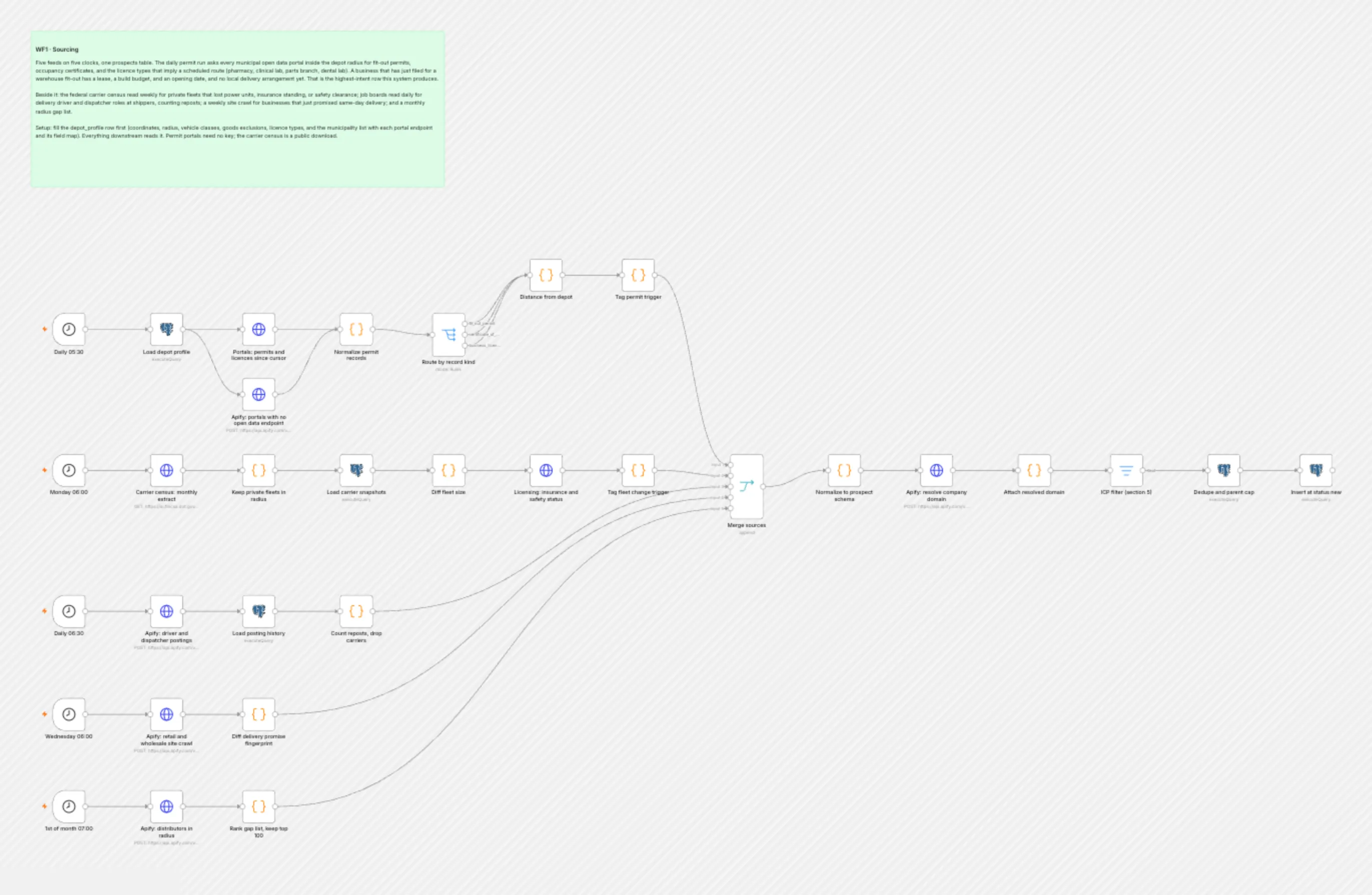
Five feeds run on separate clocks and land in one prospects table.
| Feed | What it gives | Pulled |
|---|---|---|
| Municipal permit and licence portals | Warehouse fit-out permits, certificates of occupancy, new pharmacy, lab, and parts branch licences | Daily |
| Federal motor carrier census and insurance records | Private fleets whose power units, insurance filings, or safety standing changed | Weekly |
| Job boards | Delivery driver, dispatcher, and transportation coordinator postings at shippers | Daily |
| Business listing and website crawls | Retail and wholesale sites that added a same-day or local delivery promise | Weekly |
| The radius gap list | Distributors and retailers inside the radius with no known carrier relationship | Rebuilt monthly |
Every row carries the company, its address, the distance from the depot, the trigger type, the trigger date, the goods class, and the detail the first email will quote.
2. Qualify
The filter runs before any credit is spent. A row survives only when all of these hold.
- Distance. The address sits inside the depot’s service radius.
- Goods class. The freight fits the fleet’s vehicle types and licences.
- Size. The location employs 10 or more people or occupies 5,000 square feet or more.
- Volume plausibility. The trigger implies at least 15 stops a week or one dedicated vehicle.
- Company. Absent from the customer, open-quote, and suppression tables.
- Standing. The prospect is an operating business with a current licence.
Rows that fail on distance alone are held in a second table, because a depot that opens a satellite location later gets a backfill.
3. Enrich
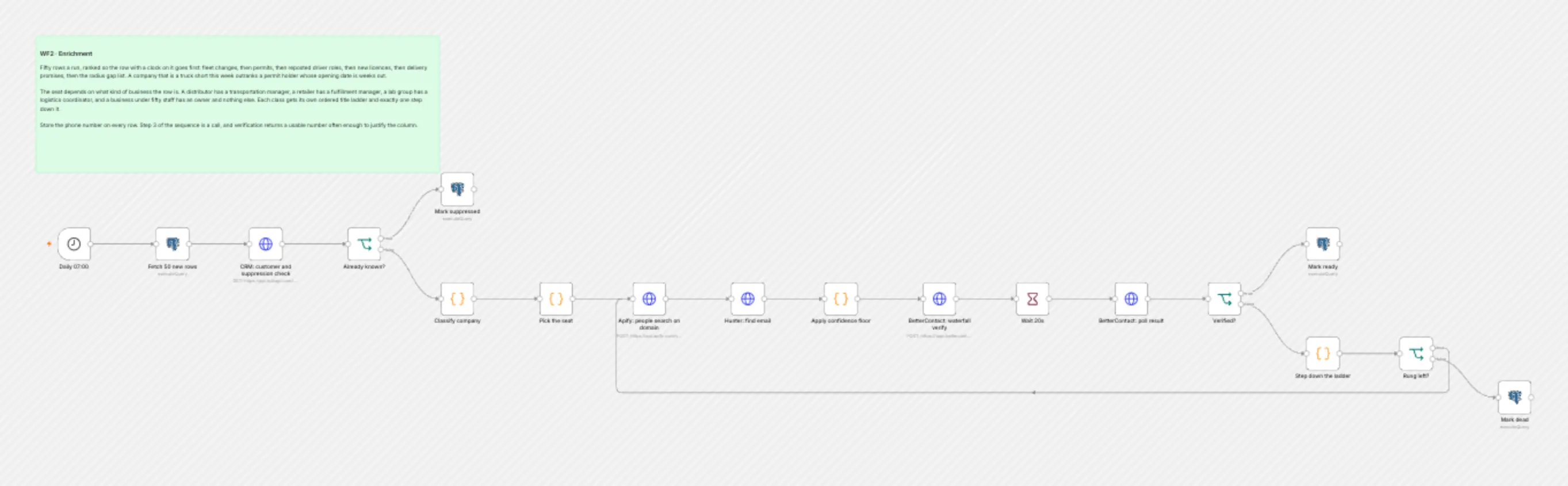
The trigger type decides which seat to look for.
| Prospect type | The seat |
|---|---|
| Distributor or manufacturer with a private fleet | The transportation or logistics manager |
| Retail or e-commerce brand | The fulfillment or operations manager |
| Pharmacy, clinical lab, or dental lab group | The courier or logistics coordinator |
| Third-party logistics provider | The final mile or transportation manager |
| Small business under 50 staff | The owner or the general manager |
Hunter finds the address from the name and domain, BetterContact verifies it, and one step down the title ladder runs when the first attempt fails.
4. Outreach
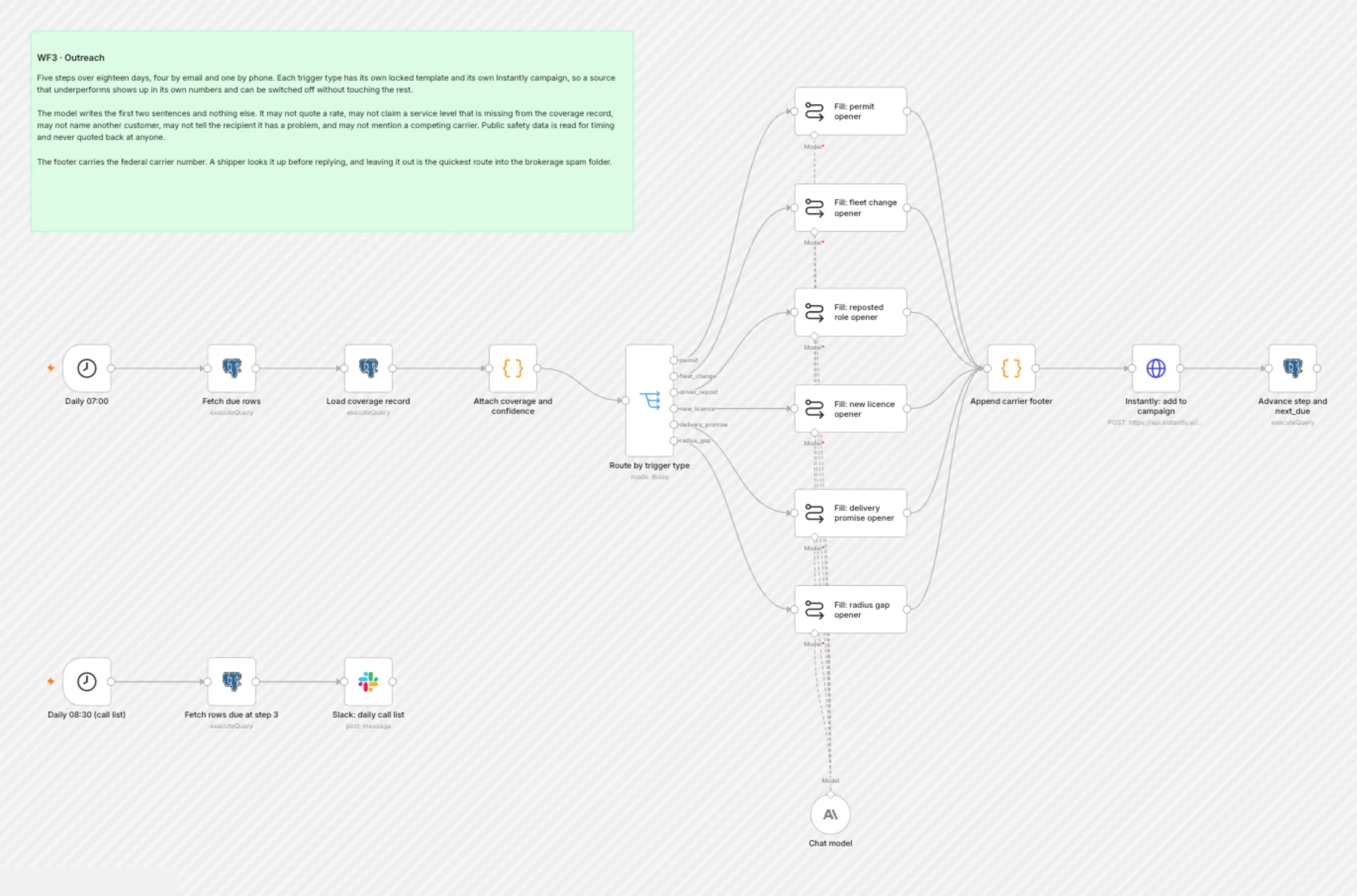
Five steps over 18 days, four by email and one by phone, each written from a locked template for the trigger type.
The model fills the first two sentences only, from the trigger record and the carrier’s own coverage figures.
What the model may never do:
- Quote a per-stop or per-mile rate.
- Claim a service level the fleet has not hit.
- Name another customer without written permission.
The offer is always the same: a 15-minute capacity call.
5. Book and track
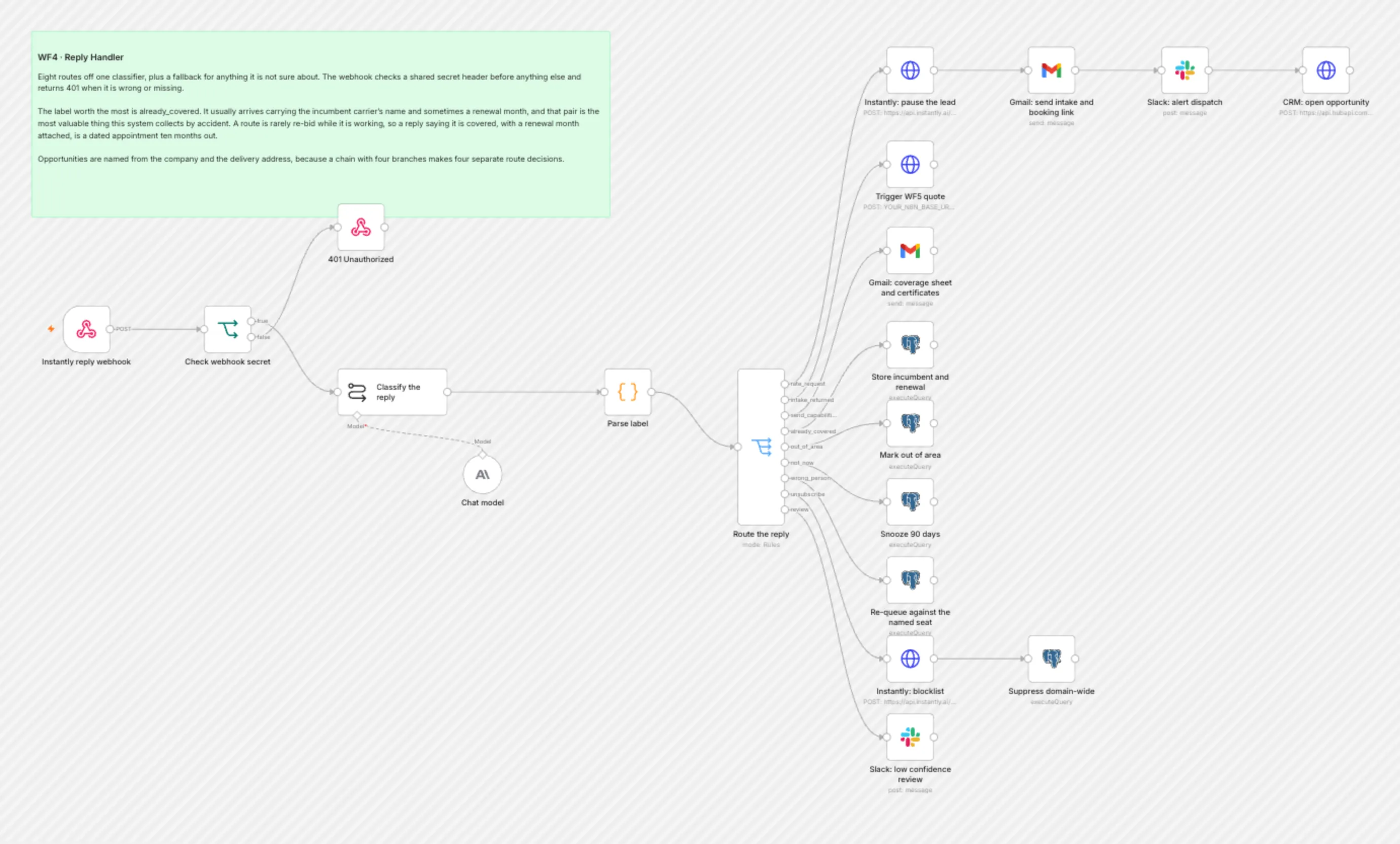
Replies arrive on a webhook and are classified into eight routes.
- A rate request. Pauses the sequence, sends the intake form and a booking link, alerts dispatch in Slack, and creates a CRM opportunity keyed on the location.
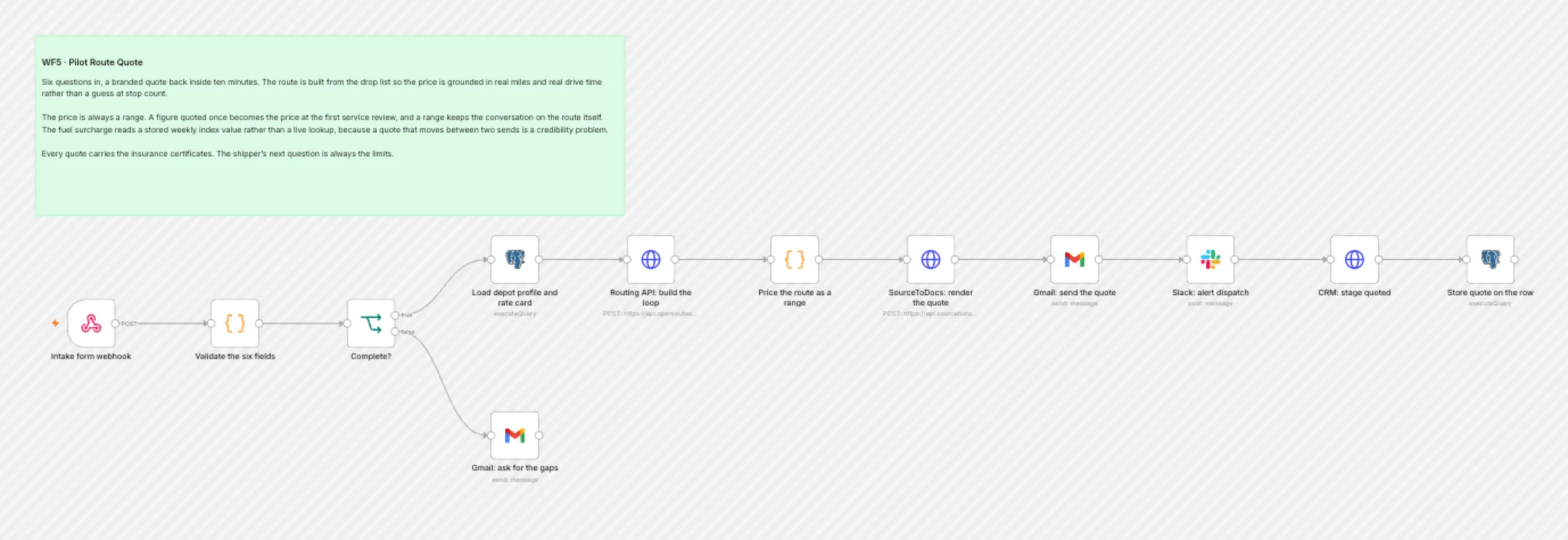
- A completed intake form. Triggers the pilot route quote, a branded PDF built from stop counts, radius, vehicle class, and service window, sent back inside 10 minutes.
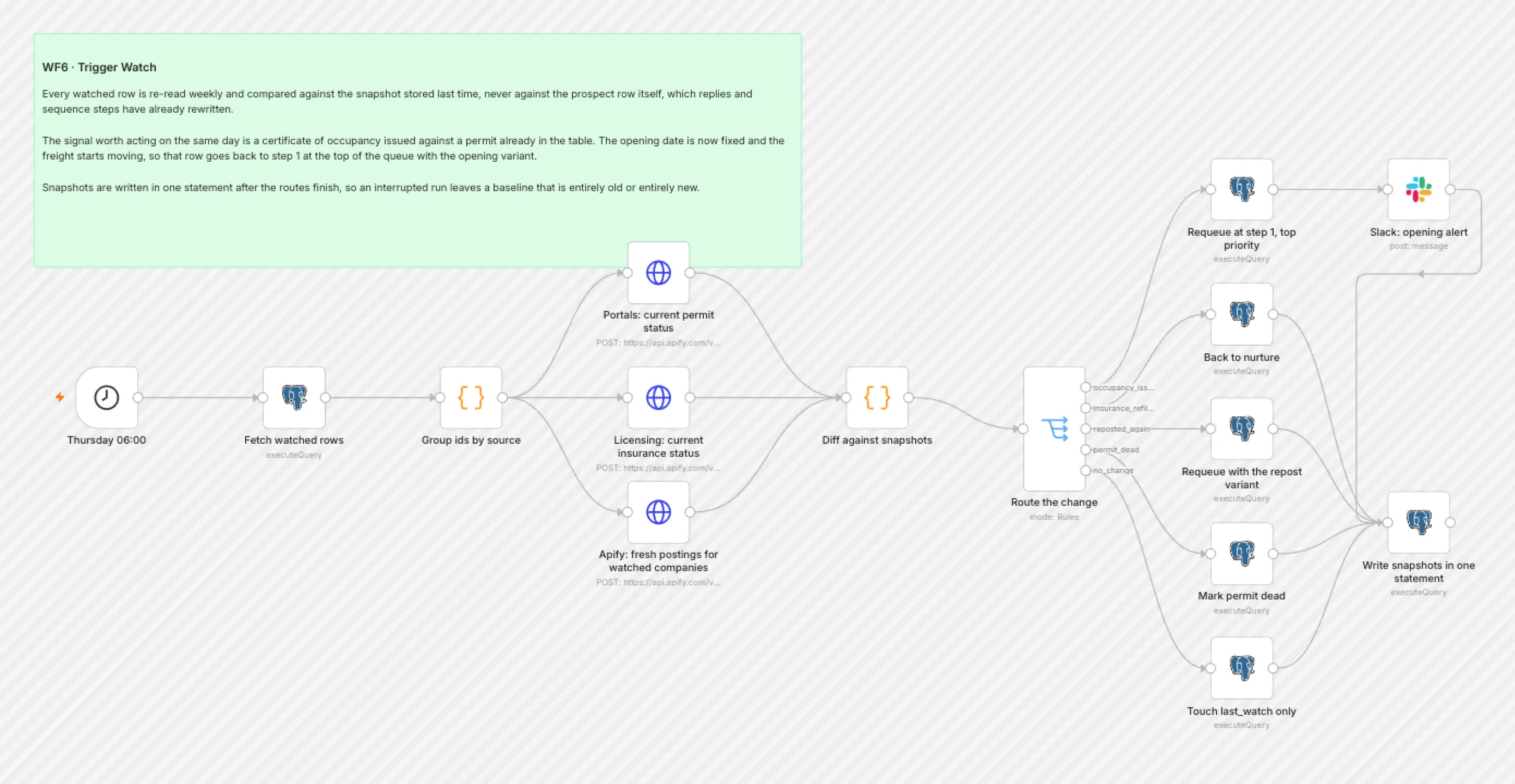
- A change at a watched company. Every watched record is re-read weekly, and a change puts the row back in the queue with the variant that fits it.
Lead sources for last mile delivery companies
1. Warehouse fit-out permits and new distribution leases
This is the trigger the market misses, and it exists because a building change is a permit application before it is a delivery contract.
A business opening a distribution point files for the fit-out, the racking, the dock levellers, or the certificate of occupancy, and the record names the company, the address, the square footage, the contractor, and the valuation.
The qualifying slice is narrow:
- Use class. Warehouse, distribution, storage, or retail with a stockroom over 5,000 square feet.
- Valuation. Above $50,000, which filters out signage and minor repairs.
- Distance. Inside the depot’s radius.
- Status. Issued inside the last 60 days, or a certificate of occupancy inside 30 days.
A company in that position has a lease, a build budget, an opening date, and no local delivery arrangement yet.
Highest intent of the five sources, because the need is dated, addressed, and published by the buyer.
A metro of 1 to 3 million people typically yields 60 to 110 qualifying permits a month, an estimate from portal volume in comparable markets.
2. Private fleets that just shrank
Federal records cover the businesses that haul their own goods, and those records move before anyone announces anything.
Every interstate carrier files a biennial update listing power units and drivers, and insurance filings and safety interventions sit in the same public system.
The three changes worth an email:
- Power units dropped. A fleet that reported 12 trucks and now reports 7 has the same freight and less capacity.
- Insurance lapsed or was cancelled. The filing history shows the date, and an unfiled replacement means the authority is at risk.
- A safety intervention landed. An out-of-service order or a conditional rating puts the fleet under a corrective plan.
Second highest intent, and the shortest sales cycle in the system at 2 to 6 weeks from first email to a signed pilot, an estimate.
The data is free, updated monthly for the census and daily for the insurance side, and almost nobody in this market reads it.
Expect 70 to 120 qualifying rows a month.
3. Delivery driver and dispatcher postings at shippers
A company posting for its own delivery drivers is telling the market that its freight is growing or its turnover is winning.
The signal sharpens with repetition. A shipper reposting the same driver role three times in 90 days has a staffing problem that a contracted route solves the same week.
An Apify job-board actor pulls postings by title across the metro, and the record gives the company, the title, the posting date, the location, the pay band, and often the vehicle class.
Medium to high intent, and the highest-volume source in the system.
Expect 120 to 200 rows a month.
4. New pharmacy, lab, and parts branch licences
Certain businesses cannot open without a scheduled courier, and their licences are public on the day they issue.
| Licence type | The route it implies |
|---|---|
| Retail pharmacy and long-term care pharmacy | Daily prescription runs and returns |
| Clinical lab patient service centre | Timed specimen pickups, often twice daily |
| Auto parts branch and dealer parts counter | Hourly parts shuttles to repair shops |
| Dental and orthodontic lab | Case pickups and appliance returns |
Medium intent with a long tail, because a new location books a courier in its first month and keeps that arrangement for years.
Expect 80 to 140 rows a month.
5. Sites that just promised same-day delivery
A retailer or wholesaler that added a same-day or local delivery page has made a promise its own staff now have to keep.
A weekly crawl of the metro’s business listings and websites flags new delivery pages, new checkout options, and new delivery apps on the storefront.
This is the lowest-intent source and it fills the sending schedule between triggers.
Expect 60 to 100 rows a month.
ICP definition
Filter logic the workflow applies.
What starts a row
| Filter | Rule |
|---|---|
| Distance | Address within the depot service radius, default 35 miles, or 60 miles for dedicated-vehicle rows |
| Permit use class | Warehouse, distribution, storage, manufacturing with shipping, or retail with a stockroom over 5,000 square feet |
| Permit valuation | $50,000 or more, or any certificate of occupancy for a qualifying use class |
| Permit age | Issued inside 60 days, or a certificate of occupancy issued inside 30 days |
| Fleet change | Power unit count down 20% or more between filings, or an insurance cancellation with no replacement on file, or an out-of-service order inside 90 days |
| Job posting | Delivery driver, dispatcher, transportation coordinator, or route supervisor, posted inside 30 days, at a company that is not a carrier |
| Repost flag | The same title at the same company posted 3 or more times inside 90 days |
| Licence type | Pharmacy, clinical lab patient service centre, parts branch, or dental lab, issued inside 45 days |
What keeps a row
| Filter | Rule |
|---|---|
| Company size | 10 or more employees at the location, or 5,000 square feet or more of occupied space |
| Goods fit | Freight class matches the fleet profile, so refrigerated, hazardous, and oversized rows drop unless the profile allows them |
| Volume floor | The trigger implies 15 or more stops in a five-day window, or one dedicated vehicle |
| Exclusions | Domain absent from the customer table, the open-quote table, and the suppression table on a 270-day window |
| Carrier guard | The company is not itself a for-hire carrier, checked against the federal census by name and address |
| Duplicate guard | One live row per company per location on a 180-day window, however many triggers fire |
| Volume cap | 25 rows per parent company per year, so a national chain never floods the queue |
Outreach sequence
The five steps
| Step | Day | Channel | Goal |
|---|---|---|---|
| 1 | 0 | Opener citing the permit, the fleet change, the reposted role, or the new licence; offer a 15-minute capacity call | |
| 2 | 3 | Send the coverage proof: vehicles by class, the zip codes covered daily, on-time percentage, and the scan and proof-of-delivery method | |
| 3 | 8 | Phone | Call dispatch or the operations desk with a one-line reason and the offer of a pilot route quote |
| 4 | 13 | Send the pilot route outline: a stop count, a service window, and what the first two weeks would look like | |
| 5 | 18 | Breakup offering a standing backup arrangement at no cost, used only when the regular carrier fails |
Example step 1 (permit trigger)
Subject: [Company]‘s [street] fit-out
Hi [First name], the fit-out permit for [address] was issued on [date] for [square footage] of [use class]. We run [N] vans and [N] box trucks out of [depot city], [N] miles away, and cover [zip count] zip codes on a daily route already.
Our on-time rate across [N] scheduled routes last quarter was [N]%, with photo proof of delivery on every stop.
Worth 15 minutes on what the first route would need?
Expected reply rate
| Row type | Expected reply rate |
|---|---|
| Permit and certificate of occupancy rows | 4 to 7% |
| Fleet change rows | The top of that range and sometimes above it |
| Reposted driver role rows | 3 to 5% |
| New licence rows | 3 to 6% |
| Delivery promise rows | 1 to 3% |
The 3 to 6% headline is an estimate for a warmed domain writing to operations, logistics, and fulfillment managers.
Timing decides more than copy here.
A permit contacted inside 3 weeks of issue replies well, and the same permit contacted after the location opens replies at roughly half that, because by then somebody is already driving the route.
Stack and running costs
| Tool | Purpose | Monthly |
|---|---|---|
| n8n Cloud | Orchestration | $24 |
| Municipal permit and licence portals | Fit-out permits, occupancy certificates, new licences | $0 |
| Federal carrier census and insurance records | Private fleet size, insurance, and safety changes | $0 |
| Apify | Job boards, portal scraping, site crawls, people search | $39 |
| Routing API (free tier) | Stop order and route miles for the pilot quote | $0 |
| Hunter | Decision-maker email finding | $34 |
| BetterContact | Waterfall enrichment + verification | $15 |
| Instantly | Sending + warmup | $37 |
| Claude API | First-line generation + reply classification | $9 |
| SourceToDocs (Starter) | Branded pilot route quote generation | $19 |
| Sending domain | Deliverability | $1 |
| Supabase (free tier) | Prospects, depot profile, rate card, snapshots, suppression | $0 |
| Total | ~$178 |
SourceToDocs is built by 2V Automation, the team behind this library.
Why the two data lines are free
The sources that carry the timing in this market are public records, and the reason is regulatory rather than generous.
- Building permits and business licences. Published as open data by most US municipalities, because permit records are public by statute.
- The federal carrier census. A downloadable extract refreshed monthly, with insurance and safety records queryable daily.
- What the paid lines buy. Enrichment, verification, sending, and the quote document, which is where the work actually is.
Route intelligence platforms sell parts of the same public data with a dashboard from roughly $300 to $1,500 a month.