How it works
1. Source
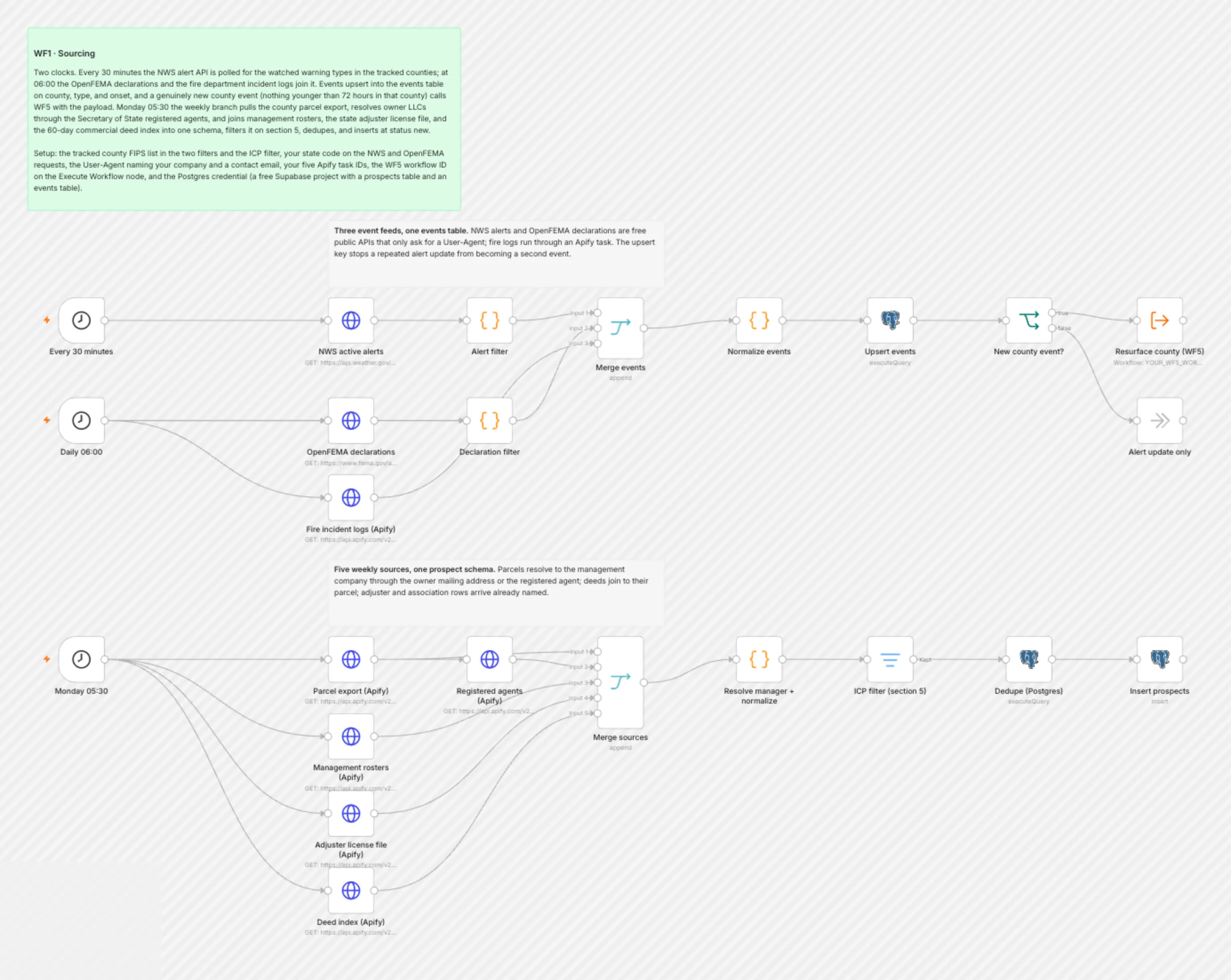
Two clocks run.
- Event poll every 30 minutes. The NWS alert API, polled for the tracked counties.
- Daily pull. The OpenFEMA declarations API and the fire department incident logs.
- Events table. Every event is written with its county, type, onset, and expiry.
- Weekly building refresh. Rebuilds the building list from county parcel records, property management company rosters, community association manager directories, state adjuster license files, and commercial deed transfers.
The list of people to contact exists before the next event arrives.
2. Qualify
Filters drop:
- Residential and undersized. Single-family parcels, and buildings under 20,000 square feet or 50 units.
- Nobody to write to. Owner-occupied buildings with no manager.
- Bought another way. Government buildings that buy through public bids, and buildings inside a national account restoration contract where the system knows about it.
- Carrier staff adjusters. Assignments reach them through a TPA desk, so an email is wasted.
- Already known. Anyone already in the CRM.
Roughly 60% of raw parcel rows leave here, an estimate from assessor extracts in three counties.
3. Enrich
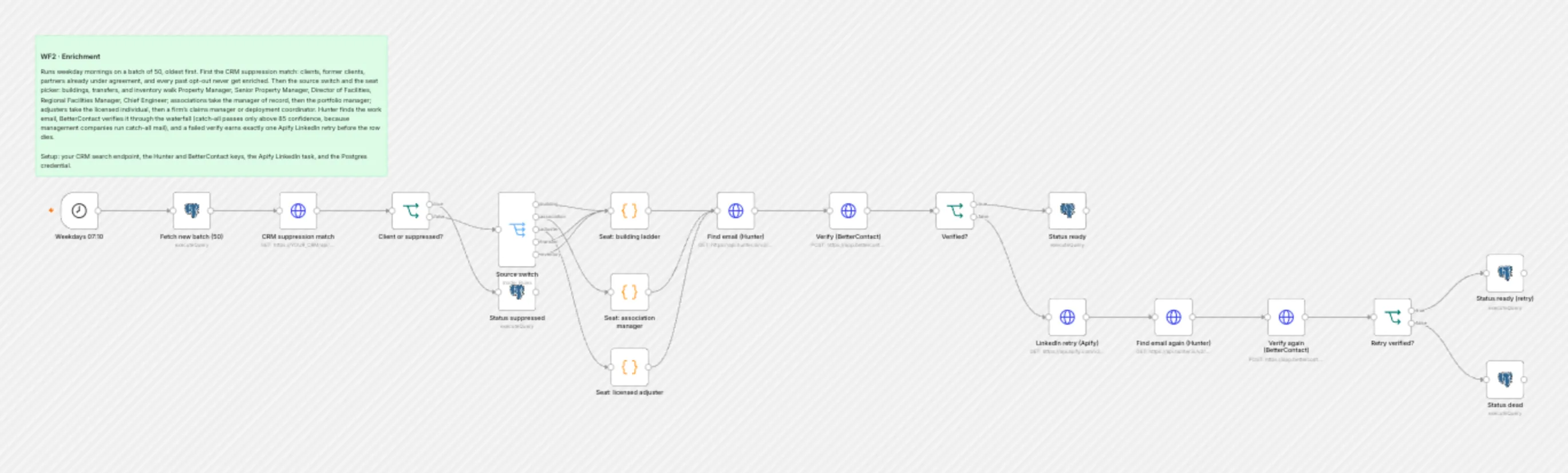
For each qualified building the system resolves the management company from the parcel’s owner and mailing address.
- Pick the seat. The person who assigns vendors: property manager, senior property manager, director of facilities, chief engineer, or the community association manager of record.
- Find the email. Hunter finds the work email for that person.
- Verify it. The BetterContact waterfall confirms the address.
- Adjusters skip a step. They arrive already named from the license file, so enrichment only has to find their firm domain.
4. Outreach
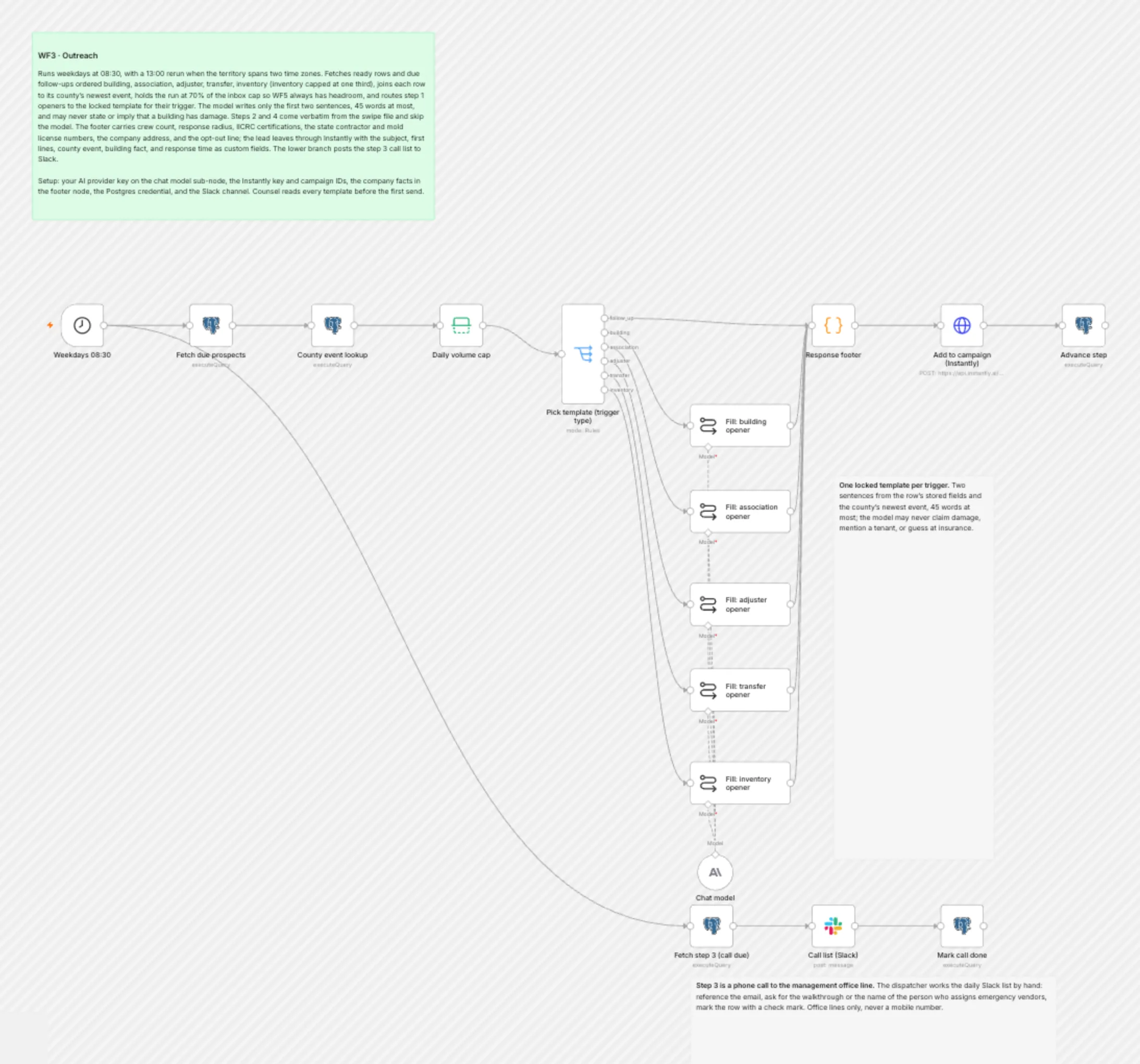
Three emails and one phone call over 14 days.
- The opening line. Cites the county’s active or most recent alert and one fact from the building’s parcel record: stories, year built, square footage.
- The offer. A 20-minute walkthrough that produces a written pre-loss plan with shutoff locations, riser rooms, roof access, after-hours contacts, and a signed emergency response agreement with a rate sheet.
5. Book & track
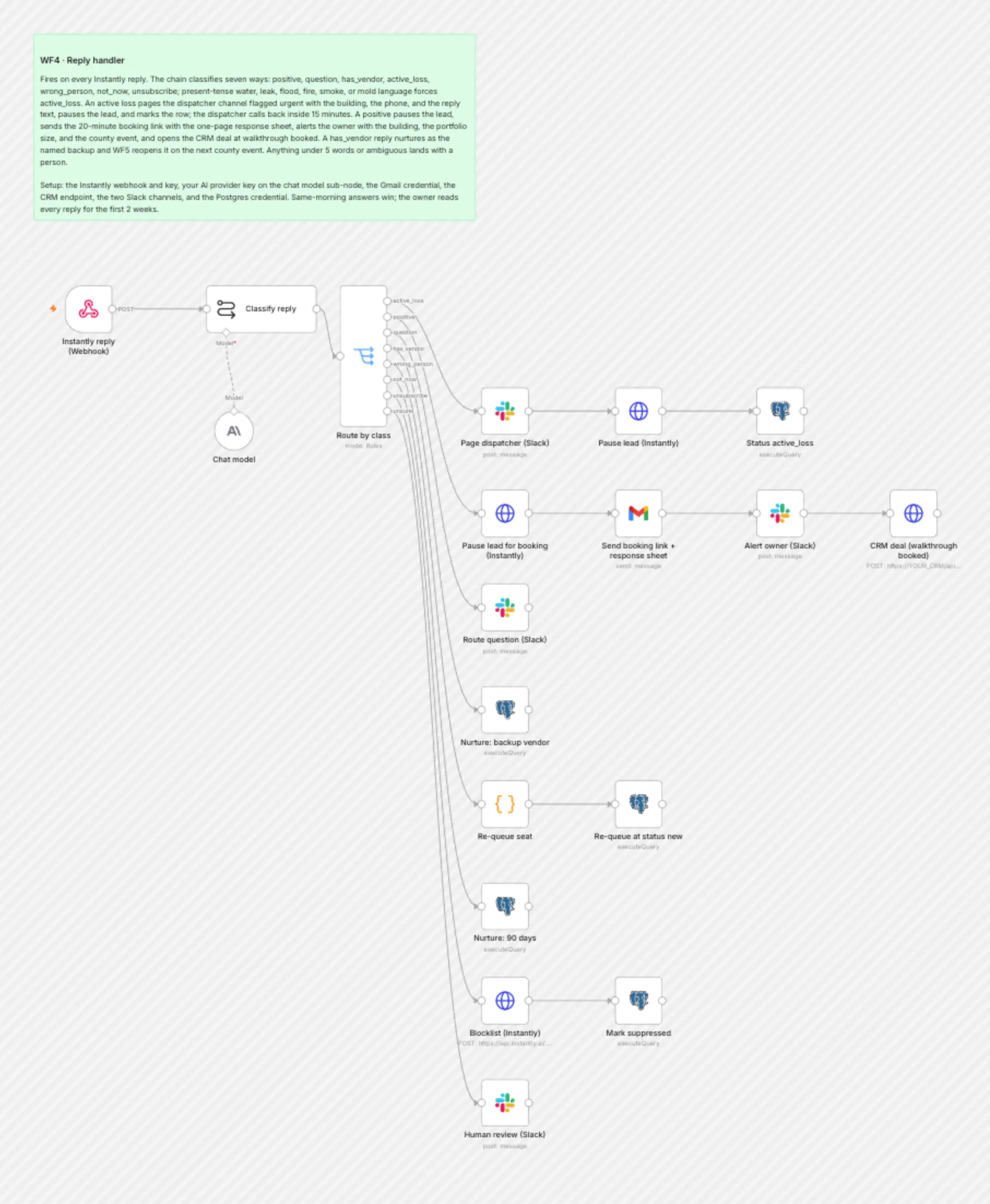
The Claude API sorts each reply into positive, question, has-vendor, active-loss, wrong-person, not-now, or unsubscribe.
- Active loss. Someone writes back that they have water in the building today, and the reply reaches the dispatcher’s phone through Slack within minutes.
- Positive reply. Gets the booking link and the one-page response sheet.
- Owner alert. A Slack message quoting the building and the alert that started the thread.
- CRM deal. Stores the building, the manager’s portfolio size, the county, and the event, so the walkthrough starts with the right map open.
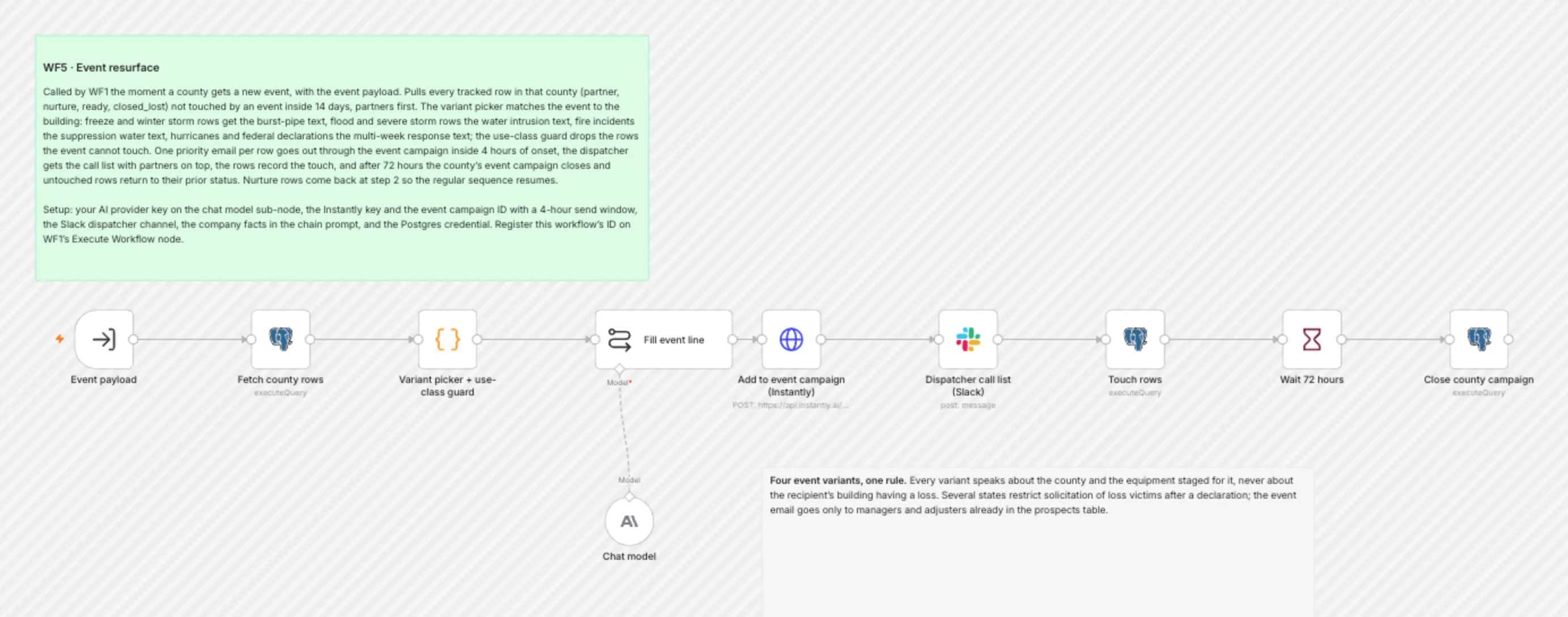
- New event in a tracked county. WF5 reopens every row in that county with the matching event variant, partners first.
Lead sources for restoration contractors
Ranked by signal quality:
1. County weather and disaster events
Restoration money moves in the 72 hours after an event. A hard freeze bursts sprinkler risers and rooftop lines at the thaw, a flash flood puts 2 inches of water across a ground-floor plenum, and a structure fire leaves suppression water in every unit below it.
Three public feeds give the timing, and a fourth sets the territory.
| Feed | What it gives | Pulled |
|---|---|---|
| NWS alert API (api.weather.gov) | Every active alert with event type, severity, onset, expiry, and the county SAME codes it covers. Free, with only a User-Agent header required | Every 30 minutes |
| OpenFEMA DisasterDeclarationsSummaries API | Every federal declaration with incident type, declared county, and incident begin date. Free | Refreshed daily |
| Fire department incident logs and press releases | Commercial structure fires with an address and a date, from department sites and city open data portals, through an Apify actor | Daily |
| NOAA Storm Events Database | The historical record, published 60 to 120 days after each month | Once, to rank counties by event frequency when the territory is chosen |
Watched alert types: Hard Freeze Warning, Freeze Warning, Flood Warning, Flash Flood Warning, Severe Thunderstorm Warning, Tornado Warning, Hurricane Warning, Winter Storm Warning, and Ice Storm Warning.
A declaration in a tracked county means insurance money and adjuster deployments are arriving for weeks.
The events do two jobs:
- Set the message. The event supplies the first line and the send time of the pre-loss outreach.
- Trigger the resurface. WF5 re-contacts every tracked manager in the affected county within 24 hours.
Highest intent of the five, because the event is public, dated, and on the recipient’s mind the same morning.
A 4-county territory in a freeze or flood state produces 15 to 40 qualifying alerts a year, an estimate from NWS alert archives.
2. Property managers, community association managers, and facility directors
Targeted building by building. The vendor call at 2 a.m. goes to whoever the property manager already has on file, and one manager typically holds 20 to 100 buildings.
- Parcel exports are the spine. County assessor and GIS parcel exports list every commercial parcel with use class, square footage, stories, year built, owner entity, and owner mailing address. An Apify actor pulls them weekly by county.
- Owner resolves to manager. The owner mailing address and the owner LLC’s registered agent resolve to the property management company in most cases.
- Rosters cover the rest. Property management company rosters, IREM and BOMA chapter directories, state real estate license files carrying a property management designation, and Community Associations Institute chapter lists for condo and HOA managers.
- What reaches enrichment. A building with a named management company and, often, a named manager.
High intent and long life: a walkthrough that ends in a signed emergency response agreement puts the company on the list for every building that manager runs.
3. Independent adjusters, adjuster firms, and public adjusters
The source is state insurance department license files. Every state publishes its adjuster license roll with name, license class, lines of authority, business address, and status, and most expose it as a downloadable file or a searchable portal an Apify actor can page through.
- Independent adjusters. Deployed into a county after a declaration, and they need a contractor who can produce a defensible mitigation scope with moisture maps, daily drying logs, and equipment logs on day 1.
- Public adjusters. They represent commercial policyholders and recommend the mitigation contractor on most of their losses.
- The ask. Both are referral partners the outreach treats as professionals, so the ask is a 20-minute call about scope documentation and response times.
- No money changes hands. No fee, gift, or referral payment is attached, because state adjuster laws forbid them.
- Carrier staff adjusters are excluded. Their assignments come through the carrier’s TPA desk, so the program application is the route to them.
Medium-high intent, and one working relationship with an independent adjuster firm yields commercial losses in every event season.
4. Commercial ownership transfers and management changes
The source is county recorder deeds. A commercial building sold in the last 60 days gets a new owner and usually a new manager, and the new manager rebuilds the vendor list in the first 90 days.
- Deed indexes. County recorder deed indexes list grantor, grantee, recording date, and parcel number. An Apify actor pulls commercial transfers weekly and joins them to the parcel record for size and use class.
- Management changes. These show up as a new mailing address on the parcel or a new name on the building’s leasing page.
Medium intent with a clean reason to write: the building has no incumbent vendor yet.
5. Commercial facility inventory (volume filler)
Hotels, senior living communities, medical office buildings, private schools, multifamily communities of 50 or more units, and distribution centers inside the response radius.
- Where it comes from. The parcel export by use class and the management company rosters, with no event or transfer attached.
- What it is for. Keeping the weekly send volume flat between events, capped at one third of sends.
Lowest intent of the five.
ICP definition
Filter logic the workflow applies.
What starts a row
| Filter | Rule |
|---|---|
| Event source | Alert or declaration whose county is in the tracked list; NWS severity Severe or Extreme; event type in the watched list; fire incidents coded commercial structure fire; an event fires WF5 once per county per 72 hours |
| Building source | Commercial or multifamily use class on the parcel record; 20,000 or more square feet, or 50 or more residential units; year built any; a management company or manager resolved from the owner mailing address, the registered agent, or a roster |
| Association source | Condominium, townhome, or master association with 50 or more units and a licensed or credentialed community association manager on record |
| Adjuster source | License class independent adjuster or public adjuster, property lines of authority, status active, business address in a tracked county or a listed independent adjuster firm; staff adjusters excluded |
| Transfer source | Commercial deed recorded within the last 60 days, consideration $2,000,000 or more, parcel meets the building size rule |
What keeps a row
| Filter | Rule |
|---|---|
| Geography | Counties within a 2-hour drive of the nearest equipment warehouse, 3 to 6 counties in total, listed by FIPS code |
| Portfolio size | Management company or manager holds 5 or more buildings in the territory, or the single building exceeds 100,000 square feet |
| Contact | A named person in the vendor-assigning seat, resolved and verified; general mailboxes and leasing-only contacts are dropped |
| Excluded | Single-family and small residential parcels, owner-occupied buildings with no manager, government buildings that buy through public bids, buildings under a known national account restoration contract, carrier staff adjusters, current and former clients (CRM match), competitors, domains on the suppression list |
Outreach sequence
The four steps
| Step | Day | Channel | Goal |
|---|---|---|---|
| 1 | 0 | Opener citing the county’s active or most recent alert and one parcel record fact; offer a 20-minute pre-loss walkthrough | |
| 2 | 4 | Send the one-page response sheet: crews, equipment counts, response radius, IICRC certifications, program affiliations, rate sheet on request | |
| 3 | 8 | Phone | Call the management office, reference the email, ask for the walkthrough or the name of the person who assigns emergency vendors |
| 4 | 14 | Breakup asking to be listed as the backup vendor, naming the county’s event count for the last 12 months |
Example step 1 (hard freeze warning trigger)
Subject: [Building] and the [County] hard freeze warning
Hi [First name], the NWS issued a hard freeze warning for [County] through [expiry date]. The parcel record shows [Building address] at [stories] stories, built in [year built], and buildings that age lose sprinkler risers and rooftop lines at the thaw.
We run [N] crews out of [city] and reach any address in [County] within [N] hours. A 20-minute walkthrough gives you a written pre-loss plan with shutoff locations and one number to call.
Worth a slot this week?
Expected reply rates
| Row type | Expected reply rate |
|---|---|
| Event-timed building rows | 3 to 6% |
| Adjuster and transfer rows | 2 to 4% |
| Inventory rows sent between events | 1 to 2% |
The 3 to 6% is an estimate for a warmed domain writing to property managers and community association managers in the week of an alert.
The calendar moves the rate more than the copy does.
- Freeze-state counties. They reply best from November to February.
- Flood and hurricane counties. They reply best from May to October.
- The 72 hours after a declaration. A row contacted in that window replies at the top of the range.
Stack and running costs
| Tool | Purpose | Monthly |
|---|---|---|
| n8n Cloud | Orchestration | $24 |
| NWS alert API + OpenFEMA + county open data | Events, declarations, parcels, deeds | $0 |
| Apify | Parcel exports, rosters, adjuster license files, fire logs, deed indexes, LinkedIn lookups | $30 |
| Hunter | Decision-maker email finding | $34 |
| BetterContact | Waterfall enrichment + verification | $15 |
| Instantly | Sending + warmup + the event campaign | $37 |
| Claude API | First-line generation + reply classification | $8 |
| Sending domain | Deliverability | $1 |
| Supabase (free tier) | Prospects, events, and suppression tables | $0 |
| Total | ~$150 |
The NWS alert API and OpenFEMA are free public APIs with no key. Both ask for an identifying User-Agent header.
County parcel and deed data is free in most counties and costs $50 to $300 a year as a bulk export in a few, which is left out of the total because the Apify actor pages through the public portal where no export exists.
A paid parcel data service (Regrid, ATTOM, from about $100/month) speeds up the first build across many counties and is optional.