How it works
1. Source
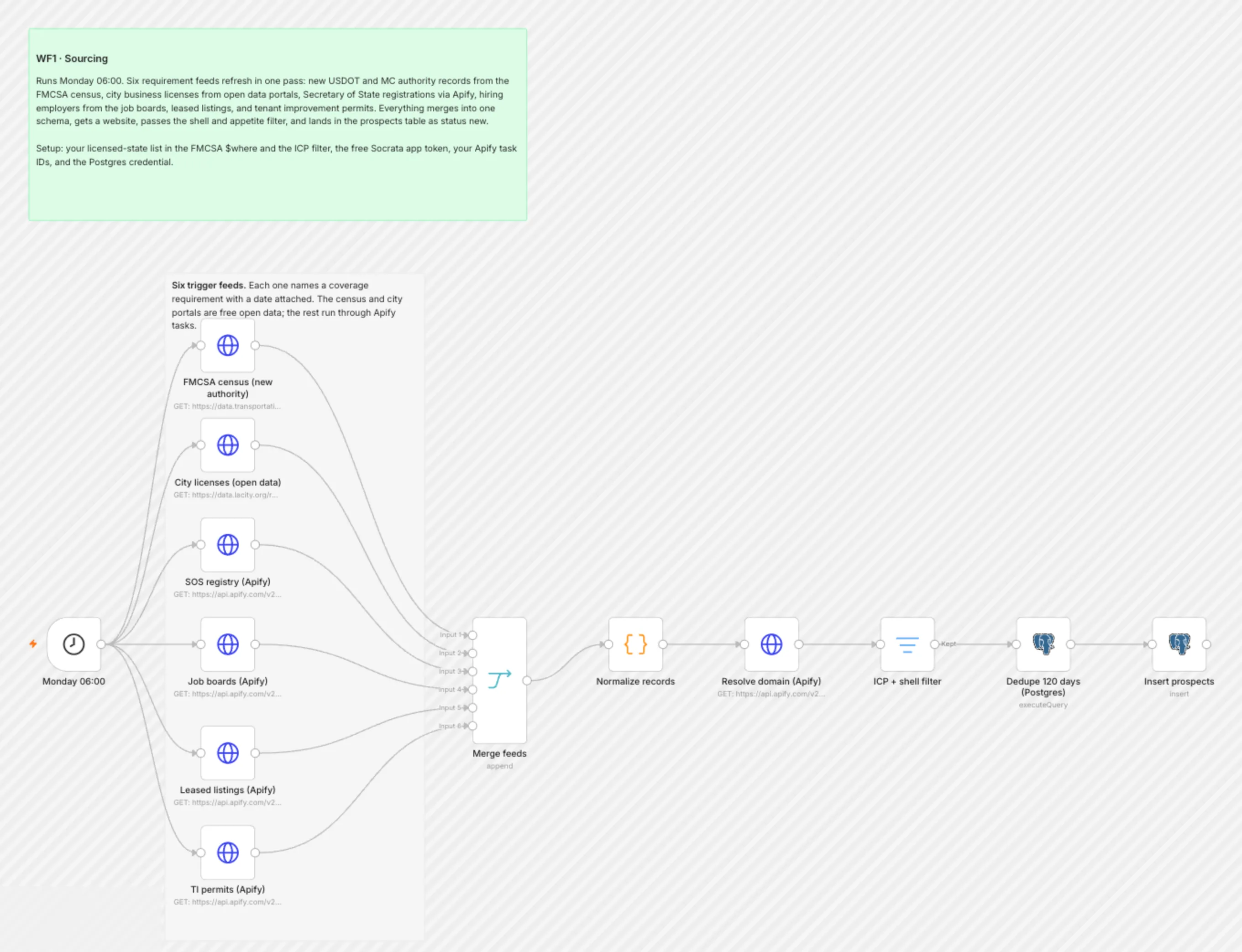
Four public-record feeds refresh weekly.
- Licenses and registrations. City business licenses and Secretary of State entity registrations.
- New motor carriers. New USDOT and MC authority records from the FMCSA Motor Carrier Census file.
- Hiring. Job postings from employers crossing a workers-comp or headcount threshold.
- New space. Commercial leases plus tenant improvement permits.
A Google Maps list of established businesses in classes your carriers write makes up any shortfall.
2. Qualify
The qualify step throws out:
- Shells. Registered-agent shells with no web presence.
- Outside your licenses. Businesses outside the states you hold licenses in.
- Outside your appetite. Class codes your carriers will not write.
- Too big. National accounts with a risk manager.
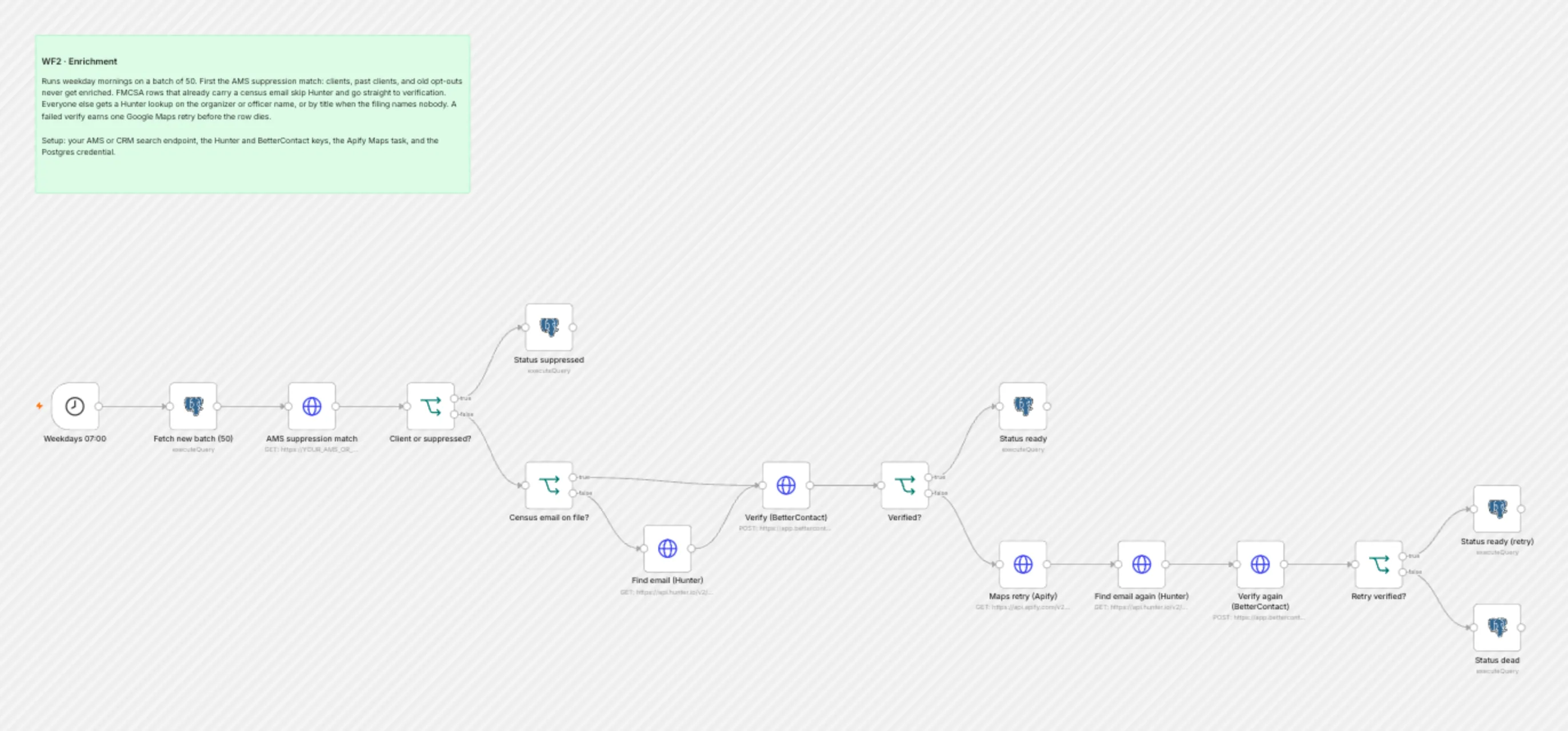
- Already known. Anyone already in your agency management system.
An out-of-appetite class never costs a Hunter credit.
3. Enrich
- The name on the filing. Hunter gets the organizer, officer, or carrier contact name from the filing plus the business domain and returns the address.
- Verify it. BetterContact then verifies the address across its data sources.
- When the filing names no person. The lookup runs on title instead: Owner, President, CFO, or Operations Manager.
4. Outreach
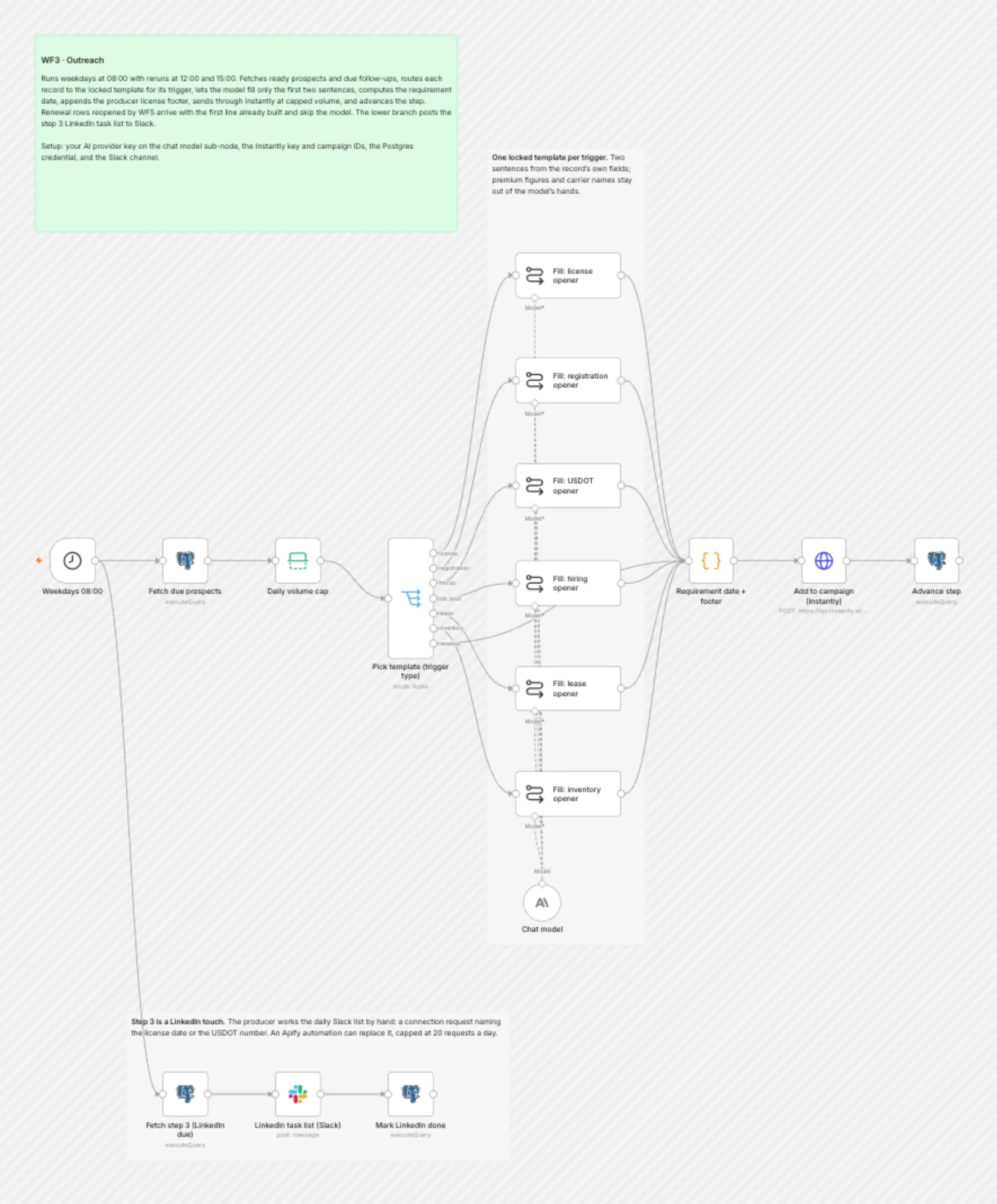
Three emails and one LinkedIn connection request spread across 14 days, timed to land before the certificate of insurance, authority grant, or first payroll is due.
- The opening line. Names the license, the USDOT number, the job post, or the lease.
- The offer. A 15-minute coverage review with quotes from named carriers within 48 hours.
5. Book & track
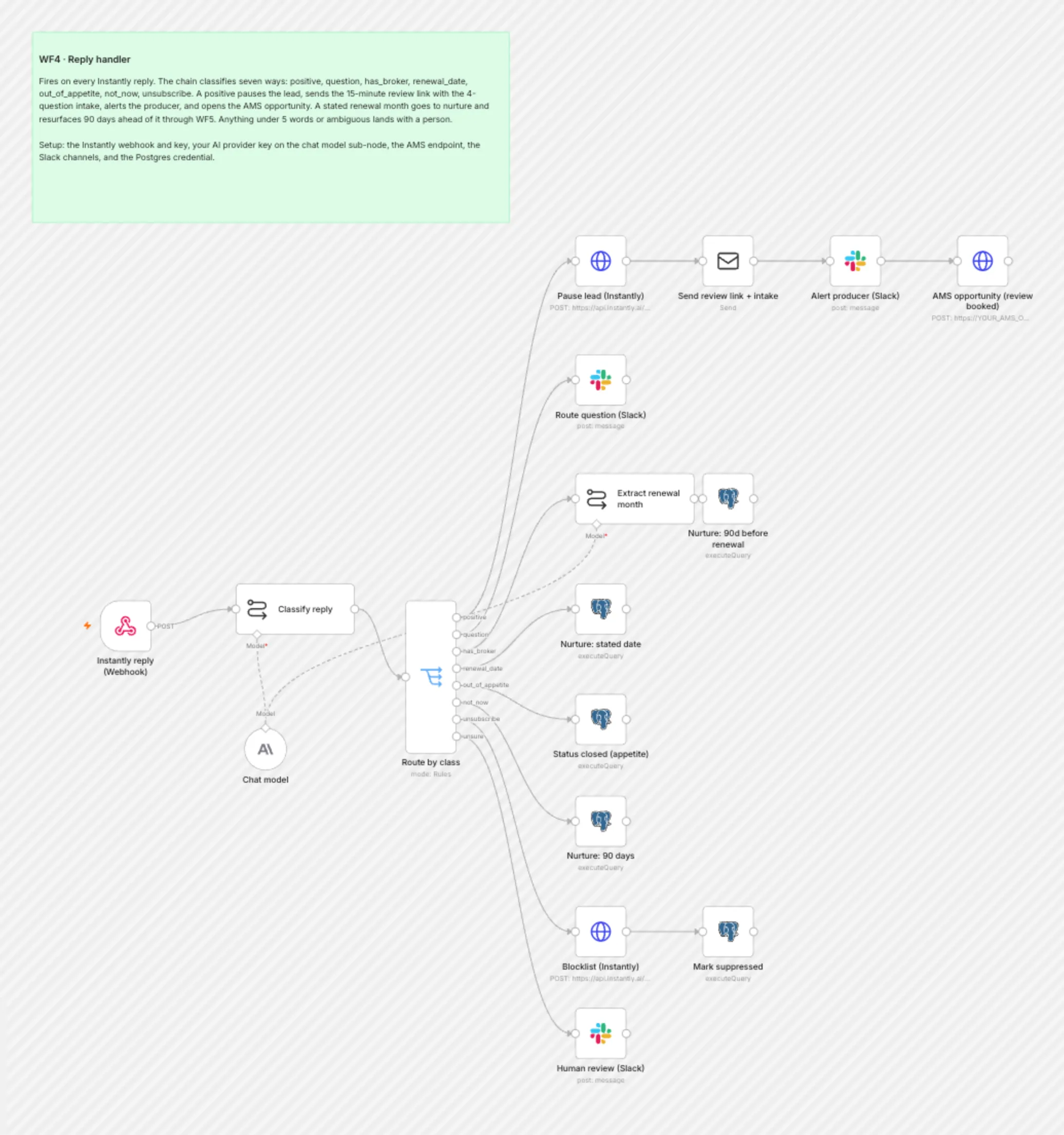
The Claude API classifies each reply as positive, question, has-broker, renewal-date, out-of-appetite, not-now, or unsubscribe.
- Positive reply. Gets the 15-minute coverage review calendar and a 4-question intake form: entity type, headcount, payroll band, vehicles.
- Producer alert. The Slack message carries the license or USDOT record, the stated renewal month, the incumbent carrier if named, and the employee count.
- The stored record. The agency management system or CRM holds the trigger record, the intake answers, the renewal month, and each email sent.
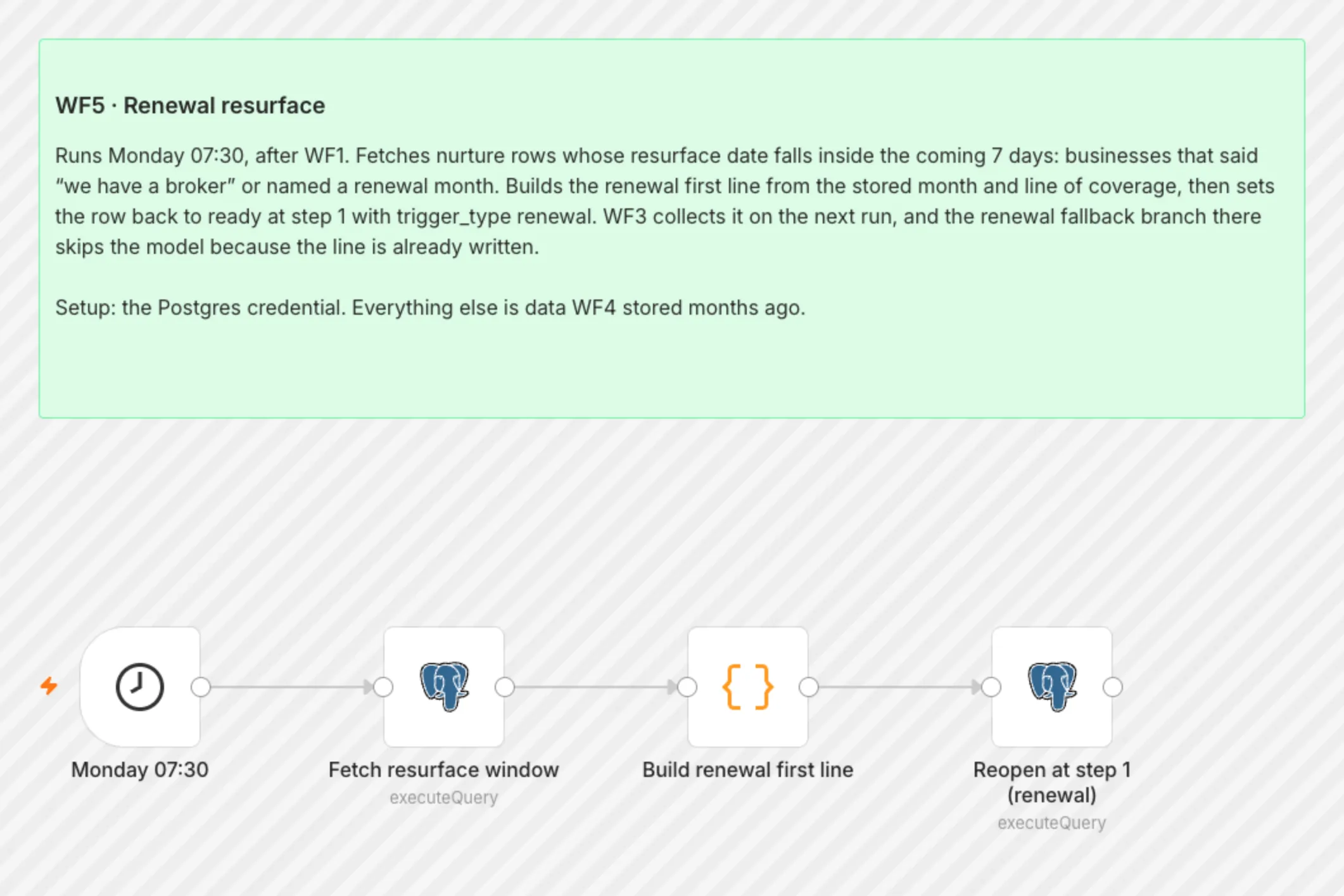
- A renewal-date reply. Resurfaces 90 days before that month with the original record attached.
Lead sources for commercial insurance brokers
Ranked by signal quality:
1. New business licenses and entity registrations
A business that received a city business license or formed an entity in the last 30 days needs general liability before its first customer, a certificate of insurance for its landlord, and a surety bond or GL proof if it holds a contractor license.
| Feed | What it gives | Pulled |
|---|---|---|
| City business license portals: Los Angeles Office of Finance, Chicago Data Portal, Seattle, and New York City | New business license records as open data, with issue date, business name, address, and license class | Weekly by HTTP request, with no key |
| Secretary of State registries: Florida Sunbiz, Texas SOSDirect, California bizfile, and New York DOS | Searchable registries of new entities | By an Apify actor, by formation date |
What the record gives: legal name, DBA, license or formation date, license class or entity type, organizer name, and address.
Highest intent when combined with a license class that requires proof of coverage: contractors, food service, transportation, childcare, security.
About 1 in 4 registrations survives the section 5 shell filter, an estimate from registry samples.
2. New USDOT and MC authority filings
A carrier that applied for operating authority must file proof of liability coverage before FMCSA grants the authority.
- The filing. BMC-91 or BMC-91X, $750,000 to $5,000,000 depending on cargo, higher for placarded hazmat.
- The clock. A new USDOT number with an MCS-150 showing 1 to 20 power units means a commercial auto policy is being bought within 20 days.
- Where it comes from. The FMCSA Motor Carrier Census file, a free monthly download from data.transportation.gov with a Socrata API for weekly pulls by
add_date. - What the record gives. Legal name, DBA, physical address, phone, email in many rows, power units, drivers, cargo classes, and operation type.
Very high intent with a hard date, and restricted to brokers with commercial auto and trucking markets.
3. Hiring growth crossing workers-comp thresholds
Most states require workers comp at the first employee, and a hiring round crosses the threshold in the states that set one higher.
| State | Threshold |
|---|---|
| Florida and South Carolina | 4 non-construction employees |
| Alabama, Missouri, and Tennessee | 5 employees |
Above 10 to 25 employees, employment practices liability and group benefits questions start.
- Where it comes from. Indeed, LinkedIn, and ZipRecruiter job postings, pulled weekly by an Apify job-board actor filtered by company size 1 to 200 and by 2 or more open roles at one company, which is the growth signal.
- What the record gives. Company name, titles, posting dates, location, and the hiring manager when shown.
Medium-high intent, strongest in construction, manufacturing, logistics, and healthcare where class codes carry high rates.
4. New commercial leases and build-outs
A tenant signing a lease owes the landlord a certificate of insurance with named additional insured within 30 days, and a build-out adds builder’s risk and property coverage on the improvements.
- Where it comes from. LoopNet and CREXi leased listings, city tenant improvement permits, and local business journal lease roundups.
- How it is pulled. Apify scrapers pull “leased” status changes weekly, and a city permit portal scraper pulls tenant improvement permits with tenant name.
- What the record gives. Tenant name, address, square footage, lease or permit date, and valuation on permits.
Medium intent, useful because the tenant is an operating business with a physical location to insure.
5. Business inventory (volume filler)
Businesses with 5 to 200 employees in classes your carriers write and no renewal date on file.
- Where it comes from. Google Maps.
- What it is for. The sourcing workflow opens it only in a month when licenses, FMCSA records, job posts, and leases together leave the month short of 400 prospects.
Lowest intent of the five.
ICP definition
Filter logic the workflow applies.
What starts a row
| Filter | Rule |
|---|---|
| License source | City license issued within the last 30 days in a class the agency serves |
| Registration source | LLC, corporation, LP, or PLLC formed within the last 45 days, registered agent address differs from the mailing address |
| FMCSA source | Added within the last 30 days, 1 to 50 power units, operation type interstate, intrastate hazmat, or intrastate non-hazmat, in a licensed state |
| Job post source | Company of 1 to 200 employees with 2+ open roles posted within the last 14 days, in construction, manufacturing, logistics, healthcare, hospitality, or professional services |
| Lease source | Marked leased within the last 30 days at 1,000 to 50,000 sq ft, or a tenant improvement permit valued at $50,000+ |
What keeps a row
| Filter | Rule |
|---|---|
| Size | 5 to 200 employees; new entities below 5 pass only on a hard-requirement trigger (license, FMCSA, or lease) |
| Activity check | A website, or 3+ Google reviews, or a phone on the FMCSA record (removes shells and inactive filings) |
| Geography | States where the agency holds a producer license |
| Industry | Excludes NAICS 524 insurance carriers and agencies, 525 funds and trusts, and 92 public administration |
| Class appetite | Excludes classes outside carrier appetite (aviation, cannabis, nightclubs, roofing above 3 stories; adjust per agency) |
| Excluded | National chains and franchises with corporate programs, nonprofits on a pooled program, publicly traded companies, current and former clients (AMS match), domains on the suppression list |
Outreach sequence
The four steps
| Step | Day | Channel | Goal |
|---|---|---|---|
| 1 | 0 | Open with the license, USDOT number, job post, or lease and the coverage it requires; ask for a 15-minute coverage review | |
| 2 | 3 | Follow-up listing the 3 carriers you can quote in 48 hours, with the review calendar | |
| 3 | 7 | Connection request that mentions the license date or the USDOT number | |
| 4 | 14 | Breakup naming the requirement date (COI due, authority grant, first payroll, lease start) |
Example step 1 (business license trigger)
Subject: certificate of insurance for [address]
Hi [First name], I saw [Company] received its [city] business license on [license date] for [address]. Most landlords ask for a certificate of insurance within 30 days of move-in, and the first quote a new business gets is usually the highest one.
We place general liability, property, and workers comp for [N] businesses with 5 to 200 employees in [city], with quotes from 3 carriers in 48 hours.
Open to a 15-minute coverage review this week?
Expected reply rates
| Row type | Expected reply rate |
|---|---|
| License, FMCSA, job post, and lease feeds | 2 to 5% |
| Business inventory | 1 to 2% |
All of them are estimates.
- Answers near 5%. A carrier waiting on an authority grant, or a tenant with a COI due in 30 days.
- Answers near 2%. A registration with no license and no revenue.
New business licenses and entity filings peak in January and again in spring, and FMCSA applications dip in December, so monthly reply counts follow those two calendars.
Stack and running costs
| Tool | Purpose | Monthly |
|---|---|---|
| n8n Cloud | Orchestration | $24 |
| Apify | Secretary of State, job board, lease, and permit scrapers | $30 |
| FMCSA Census and city license open data | USDOT and business license feeds | $0 |
| Hunter | Decision-maker email finding | $34 |
| BetterContact | Waterfall enrichment + verification | $15 |
| Instantly | Sending + warmup | $37 |
| Claude API | First-line generation + reply classification | $6 |
| Sending domain | Deliverability | $1 |
| Supabase (free tier) | Prospect database | $0 |
| Total | ~$150 |
The FMCSA Motor Carrier Census file and the city license portals in section 4 are public open data with no fee.
OpenCorporates API (from $20/month) is an optional addition for states without a scraper-friendly registry.